Think of AI product discovery as the ultimate 'gut-check' for your roadmap. Before you burn months of development time on a product nobody wants, these frameworks serve as a high-precision filter, ensuring you’re solving real customer struggles rather than chasing guesses.
AI transforms product management from a slow-motion guessing game into a high-speed, data-driven discipline. With AI, weeks of soul-crushing analysis can be compressed into mere minutes of actionable clarity, helping you align stakeholders and build consensus on actual customer behavior—not just opinions.
As products grow more complex and feedback signals flood in from every direction, relying on manual synthesis is no longer an option. AI turns discovery from a 'one-off phase' into a continuous, intelligent heartbeat for your product. By weaving together disparate signals into a coherent narrative, it gives you the power to learn faster, navigate trade-offs with confidence, and keep your decision-making firmly rooted in evidence from day one to launch.
A Brief on Product Discovery Framework
Product discovery is the stage where teams figure out what to build and why. It’s about understanding customer pain points, validating ideas, and ensuring that every feature solves a real problem. Traditionally, this meant endless spreadsheets, surveys, and brainstorming sessions. But AI changes the game by automating and accelerating these steps.
Product discovery frameworks assist teams in comprehending customer needs, investigating potential solutions, and validating opportunities prior to development. They establish a unified process for transforming assumptions into testable insights and determining what should be prioritized for investment next.
Fundamentally, these frameworks enable teams to address several critical questions:
- What issue is the customer attempting to resolve?
- How important is that issue?
- Which opportunities are in line with the Product strategy and business objectives?
By steering research, synthesis, and decision-making, discovery frameworks mitigate uncertainty and help teams avoid creating features that do not have a clear demand or impact. They also foster consistency across various roles. Designers, product managers, engineers, and stakeholders (such as customers, senior leadership, and investors) can collaborate using the same evidence and criteria instead of depending on personal intuition.
In practice, product managers utilize a variety of established discovery frameworks based on the specific question they are addressing:
- Problem-focused frameworks: Customer interviews, Jobs To Be Done, and opportunity solution trees aid teams in grasping user needs and motivations.
- Opportunity evaluation frameworks: RICE (Reach, Impact, Confidence, Effort), value versus effort scoring, and assumption mapping facilitate prioritization and initial decision-making.
- Validation-oriented frameworks: Prototype testing and usability studies enable teams to evaluate whether proposed solutions are likely to succeed before the delivery phase commences.
Why do Traditional Discovery Frameworks Break Down?
As Product managers are now expected to operate as AI PMs, numerous teams are discovering that conventional discovery frameworks struggle to keep pace with the speed and intricacy of contemporary product development. These frameworks were originally created for slower feedback loops and limited qualitative inputs, rather than for environments where signals are constantly received and decisions need to be reassessed regularly.
As teams attempt to implement traditional discovery methods on a larger scale, several common limitations become apparent.
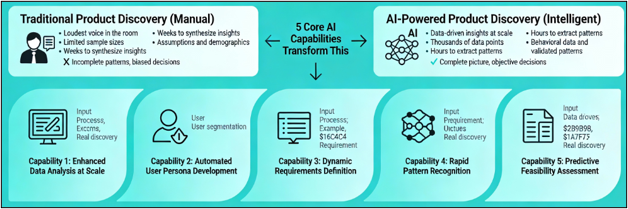
The manual synthesis of insights fails to keep up
Conventional frameworks depend significantly on interviews, surveys, and workshops that require manual review and summarization. With the increasing volume of feedback from support tickets, product analytics, sales calls, and research notes, teams find it challenging to maintain up-to-date insights. Critical patterns are often overlooked or identified too late to impact decision-making.
Discovery is perceived as occurring in distinct phases
Many frameworks operate under the assumption that discovery is a phase that teams complete before starting delivery. However, in reality, learning persists throughout the product lifecycle, yet traditional methods hinder the integration of new evidence once plans are underway. This results in decisions being made based on outdated assumptions rather than the evolving realities of customer needs.
Signals are dispersed across various tools and teams
Customer feedback, usage statistics, and business context frequently reside in different systems managed by various departments. Traditional discovery frameworks do not provide a dependable means to link these inputs, complicating the process for teams to develop a unified understanding of what is most important.
The rationale behind decisions is challenging to maintain over time
Insights are often documented in files or presentations that quickly become outdated. As teams evolve and products change, the reasoning behind previous decisions can be lost or difficult to trace. This complicates the ability to learn from past experiences and heightens the risk of repeating previous errors.
AI’s Influence in Changing the Nature of Product Discovery
AI product discovery frameworks transform the discovery process from a manual, document-centric task into a dynamic system of action that encompasses customer, product, and business contexts. Instead of depending on periodic research cycles and static documents, teams can maintain an ongoing discovery process as inputs change and new signals arise.
Instead of replacing traditional discovery methods, AI for product managers alters their daily operations by accelerating learning, enhancing connectivity, and facilitating long-term sustainability.
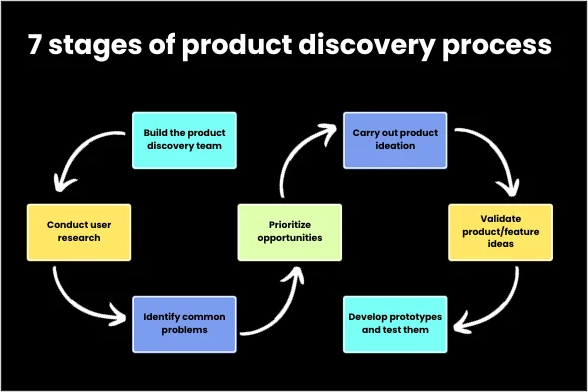
Continuous insight synthesis occurs
AI is capable of processing extensive amounts of qualitative and quantitative data as it becomes available, eliminating the need to wait for scheduled research evaluations. Customer feedback and usage signals are systematically organized and highlighted, enabling teams to react to emerging trends without having to restart the discovery process from the beginning.
Signals are interconnected across contexts
Discovery inputs are no longer treated in isolation. AI assists in linking customer feedback to product usage, strategic objectives, and business results, providing teams with a comprehensive understanding of the significance of specific issues and the relevance of opportunities. This shared context enhances alignment and minimizes interpretation discrepancies across different functions.
Decisions remain anchored in current evidence
As assumptions are validated and new data emerges, AI product discovery frameworks ensure that the rationale behind decisions is kept up to date. Teams can swiftly revisit priorities and refine problem definitions, which aids in validating direction without losing sight of previous insights or starting anew.
Discovery scales with product complexity
As products, teams, and markets expand, AI facilitates the scaling of discovery practices without a corresponding increase in manual effort. Product managers can maintain a consistent discovery discipline even as the volume of signals and stakeholders grows.
AI product discovery fosters quicker learning and more transparent decision-making. It ensures that discovery remains active throughout the product lifecycle, rather than being confined to the initial stages.
How AI Speeds up Product Discovery?
Customer Insights in Real Time
AI tools can analyze thousands of customer reviews, social posts, and support tickets instantly. Instead of manually reading feedback, teams get summarized insights showing what users love, hate, or wish existed. Gartner reports that AI-driven analytics can reduce research time by up to 60%
Idea Validation Through Simulation
Generative AI can simulate user behavior—testing how people might respond to new features before they’re built. This helps teams validate ideas faster and focus only on what truly matters.
Automated Trend Detection
Machine learning models spot emerging patterns in market data, helping teams predict what customers will need next. According to McKinsey, companies using AI in product development see 20–30% faster time-to-market.
AI doesn’t replace human creativity—it amplifies it. Product managers and designers can now spend less time collecting data and more time interpreting it. What once took months of research and validation can now happen in a matter of days, allowing teams to innovate continuously. AI is transforming product discovery from a slow, uncertain process into a fast, insight-driven journey. This is where ideas evolve at the speed of customer needs. Follow AI product discovery trends 2026 to become a leading AI product manager.
Now that you have understood the nuances of creating a scalable Gen AI data science pipeline, it is time for you to deep dive into building one yourself. At Eduinx, a leading edtech institute in India, we offer both virtual classroom and offline learning to help you get familiarized with scalable generative AI. Take up our post graduate program in gen AI and data science and land your dream job. This course is also designed for business entrepreneurs as we guide you on how to build a scalable gen AI data science pipeline for your company. Get in touch with us to know more.
Frequently Asked Questions (FAQs)
What is meant by product discovery in product management?
Product discovery is the phase when the teams discover what to build, and why: they identify their customers' pain points, validate their ideas, and make sure each feature is addressing a true customer need. It's about identifying the problem that a customer is trying to solve and determining whether it is a problem worthy of solving, traditionally this would be done with spreadsheets, surveys and brainstorming sessions.
What is a product discovery framework?
The product discovery framework is a structured process for gathering knowledge about customer needs, investigating possible solutions and confirming the opportunities to develop a product. These include frameworks focused on the problem such as Jobs-to-Be-Done, opportunity evaluation frameworks such as RICE scoring, and validation-oriented frameworks such as prototype testing.
Reasons why traditional product discovery frameworks are ineffective in today's world?
The traditional concepts were developed for slower feedbacks and qualitative input, which are not adequate in the case of continuous incoming signals. They heavily depend on manually synthesizing interviews and surveys, which are unable to catch up with the feedback they receive through support tickets, analytics and sales calls, leading to important patterns being missed or discovered late.
Why does manual synthesis of customer insights fail to scale?
With more and more feedback in every support ticket, product analytics, sales calls and research notes, it becomes difficult for teams to dig through the data and summarize. One of the fundamental drawbacks that AI is now addressing is that there are critical patterns that are frequently missed or only emerge at the last minute and can't be used to actually inform decisions.
How is AI transforming the product discovery industry?
AI makes discovery into a system that evolves over time, adding context to customer, product, and business. While not a replacement for the traditional discovery methods, AI can help speed up learning, make signals more interconnected and ensure discovery remains sustainable as products and teams grow.
How does AI connect signals across different tools and teams?
The AI helps link customer feedback to product usage data, strategic objectives, and business outcomes, giving teams a fuller picture of why an issue matters and how relevant an opportunity actually is. This shared context reduces the misalignment between departments that previously worked from inconsistent or incomplete evidence.
In what ways does the AI maintain product decisions based on the current evidence?
The AI product discovery frameworks continuously update reasoning behind the decisions as assumptions are validated and new information comes in. This enables teams to rapidly review priorities and sharpen the problem definitions without losing out on what the have learned earlier in the discovery process or needing to begin anew.
What is the time saved by AI in customer research?
The AI-powered analytics can save up to 60% of the time spent on research by instantly analyzing thousands of customer reviews, social posts and support tickets, according to the Gartner. Teams don't have to read through all the feedback themselves, but instead get summarized feedback of what users love, do not like and what they want to have.
How does the AI help detect emerging market trends for the product teams?
Machine learning models can identify the trends in market data and predict what customers are likely to want next, instead of responding to it after the fact. AI also helps speed product development, with McKinsey reporting a 20% to 30% reduction in time to market.
Will AI take the place of human judgment when it comes to product discovery?
No - AI will not take the place of human creativity; it will enhance it. It saves the product managers and designers time in gathering and organizing data so they can spend more time interpreting data and making decisions based on their judgment that AI cannot make.
What are the AI product discovery frameworks best used for in 2026?
The AI product discovery frameworks are the most appropriate when you need to continuously incorporate feedback, tie up loose ends in tools, stay current with product discovery decisions based on current evidence, and expand the scope of discovery discipline as the product gets more complex. Knowing how to follow these frameworks is a crucial skill for any individual who wants to be a product manager who is fluent in AI.