With AI product management taking a strong foothold across all e-commerce and IT sectors, AI-powered go-to market strategy is the way to go. Product managers now harness the power of AI to make data-driven decisions rather than relying on guesswork.
Launching a new product has always been a mix of science and art.Product managers (PMs) rely on market research, customer insights, and intuition to decide when, where, and how to introduce a product. But in 2026, the landscape is shifting dramatically. With the rise of AI-powered go-to-market strategy, PMs now have tools that reduce guesswork and bring precision to every stage of the launch process.
This blog explores how AI in product launches is transforming workflows, empowering PMs, and reshaping industries. We’ll break down the role of predictive marketing tools, AI for customer segmentation, launch optimization with AI, automated GTM workflows, and AI-based competitor tracking — all explained in simple terms for easy understanding.
The Evolution of Go-to-Market Strategies
Traditionally, go-to-market (GTM) strategies involved analyzing historical data, conducting surveys, and relying on expert judgment. While effective, these methods often left gaps. Markets change quickly, customer preferences evolve, and competitors move fast.
By processing massive datasets in real time, AI can uncover hidden patterns, predict outcomes, and even generate new strategies. For PMs, this means fewer assumptions and more evidence-based decisions. Here are seven ways how product managers (PMs) launch products with a go-to marketing strategy powered by AI.
AI-Powered Go-to-Market Strategy- Machine Learning and Gen AI
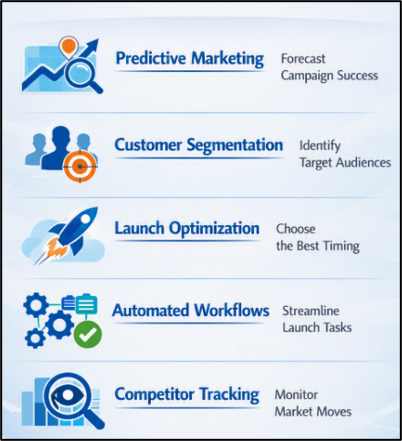
At its core, an AI-powered go-to-market strategy uses machine learning and generative AI to guide product launches. Instead of static plans, PMs get dynamic, data-driven roadmaps that adapt to market signals. PMs use AI to analyze social media chatter, competitor pricing, and customer purchase behavior simultaneously. This tool then recommends the best launch timing, target audience, and promotional channels. This allows PMs to move from reactive planning to proactive, intelligent execution. Here’s a quick peek on some of the common GTM strategies that industries use.
| Strategy | How AI Helps | Example |
|---|---|---|
| Predictive Marketing Tools | Forecast campaign success before launch | HubSpot’s AI Copilot predicts conversion likelihood and churn risk. |
| Customer Segmentation | Identify micro-segments based on behavior and preferences | AI clusters customers into precise groups (e.g., eco-conscious urban professionals). |
| Launch Optimization | Choose the best timing for product release | AI analyzes seasonal demand and competitor activity to suggest launch dates. |
| Automated GTM Workflows | Streamline repetitive tasks across teams | Salesforce Einstein GPT automates insights across marketing, product telemetry, and sales pipelines. |
| Competitor Tracking | Monitor rivals’ pricing, positioning, and campaigns | AI scans competitor websites and reviews to identify gaps and opportunities. |
Predictive Marketing Tools
One of the biggest advantages of AI in product launches is access to predictive marketing tools. These tools forecast how customers will respond to campaigns before they even happen. PMs text multiple ad variations virtually. They use AI to simulate customer reactions and predict which version will generate the highest engagement. This saves time, reduces costs, and ensures campaigns are optimized before going live. For PMs, this is like having a crystal ball that shows which marketing idea will work best.
Source
AI for Customer Segmentation
Knowing your audience is half the battle. With AI for customer segmentation, PMs can divide customers into precise groups based on behavior, preferences, and demographics.
Instead of broad categories like “young professionals” or “parents,” AI can identify micro-segments such as “urban professionals who shop online twice a week and prefer eco-friendly products.” This level of detail allows PMs to tailor messaging and offers that resonate deeply with each group. This allows PMs to personalize campaigns that feel relevant and increase conversion rates.
Launch Optimization with AI
Timing is everything in product launches. Launch optimization with AI ensures PMs pick the right moment to introduce a product. AI models analyze factors like seasonal demand, competitor activity, and even weather patterns. For instance, a beverage company might learn that launching a new drink just before summer yields maximum sales. Having a smart assistant that tells you the perfect day to open your store is a perfect choice for PMs.
Automated GTM Workflows
Launching a product involves countless tasks from coordinating teams to managing campaigns. PMs use automated GTM workflows powered by AI to streamline these processes. AI tools can schedule tasks, send reminders, and even execute parts of the campaign automatically. For PMs, this means less manual work and more focus on strategy. This helps companies achieve a faster execution with fewer errors.
AI-Based Competitor Tracking
Competitors are always moving, and keeping track of them is critical. AI-based competitor tracking allows PMs to monitor rival activities in real time.AI can scan websites, social media, and news feeds to detect changes in competitor pricing, promotions, or product launches. It then alerts PMs and suggests counter-strategies.
Use Cases of Go-to Marketing Strategies
Here are a few real time use cases of go-to marketing strategies of leading brands.
- Salesforce Einstein GPT: Connects marketing engagement, product telemetry, and sales pipeline activity in real time. Companies report 28% shorter sales cycles and higher customer lifetime value
- HubSpot Smart CRM + AI Copilot: Merges marketing, sales, and service data into one feedback loop, predicting conversion likelihood and churn risk for small-to-midmarket firms.
- Adobe Experience Orchestration: Uses AI to unify marketing, product, and customer experience data, enabling personalized campaigns and improved product positioning.
AI for Product Managers: A Strategic Ally
AI is not replacing intuition for PMs, it just enhances it. By combining human creativity with machine intelligence, PMs can make smarter, faster, and more confident decisions. AI can play a key role and makes it a strong ally for PMs during product launches. It helps PMs to.
- Identify untapped markets
- Personalize customer experiences
- Optimize launch timing
- Automate repetitive tasks
- Stay ahead of competitors
The Future of AI-Powered GTM
Looking ahead, AI-powered go-to-market strategies will evolve further:
- Generative AI simulations: Testing entire launch campaigns virtually before execution.
- Voice-of-customer AI: Real-time analysis of customer feedback during launches.
- Autonomous GTM systems: AI agents that manage launches end-to-end with minimal human input.
As these innovations mature, PMs will spend less time firefighting and more time innovating. In 2026, product launches are no longer about guesswork. With AI-powered go-to-market strategy, PMs can harness predictive marketing tools, AI for customer segmentation, launch optimization with AI, automated GTM workflows, and AI-based competitor tracking to deliver smarter, faster, and more successful launches. For enterprises, this means reduced risk, improved efficiency, and stronger customer connections. For PMs, it means confidence in every decision.
Are you looking forward to starting your career as an AI product manager? Well look no further than Eduinx. As a leading edtech institute in India, we have a team of non academic thought leaders with over a decade of industry experience in product management and AI. They will help you understand complex concepts with relative ease. You can complete capstone projects with hands-on guidance from our mentors. Build a stellar portfolio and land your dream job. Get in touch with us and learn more about our AI in product management course.
Frequently Asked Questions (FAQs)
1. What is a Go-to-Market Strategy?
- An AI-driven go-to-market strategy relies on machine learning and generative AI to inform product launches with dynamic, data-driven roadmaps and a strong data foundation.
- PMs can view tweets, competitor pricing, and customer purchase history all at once, and the AI system suggests the optimal launch date, market segment, and marketing approach.
2. What are the top AI techniques in GTM for product managers?
Many of the AI-powered launches share common strategies:
- Predictive marketing tools that help predict the success of a campaign before it is launched.
- AI-powered customer segmentation for targeted micro-segments.
- Launch optimization that determines the optimal launch time according to demand and competitor activity.
- Automated GTM workflows that eliminate the repetitive cross-team tasks.
- AI-based competitor tracking to keep track of competitor pricing, positioning, and campaigns.
3. What are the platforms that companies are leveraging to support AI in the GTM?
Some common examples are listed below:
- Enhanced real-time data integration with Salesforce Einstein GPT, which integrates marketing engagement, product telemetry, and sales pipeline activities in real time, with 28% shorter sales cycles reported by companies.
- HubSpot Smart CRM + AI Copilot, which foresees conversions and churn risk for small-to-midmarket businesses.
- Adobe Experience Orchestration brings together marketing, product, and customer experience data to deliver personalized campaigns.
4. Why is it important to track our competitors when launching any product?
- Competitors are always on the move, and AI-driven competitor tracking enables PMs to keep track of their competitors' pricing, promotions, and product launches in real-time by scanning websites, social media, and news feeds.
- This will enable AI to notify PMs of competitor changes in real-time and propose counter-strategies without delay, as opposed to finding out after competitors have already impacted the market.
5. Why should the product managers care about automating GTM workflows?
- There are many tasks to coordinate in teams to launch a product, from coordination to timeline management, and automated GTM workflows allow AI to schedule tasks, send reminders, and even automate a part of the campaign.
- This minimizes manual effort and allows PMs to dedicate more time to strategy and less to logistics and coordination.
6. Why is it that AI is an “ally” for PMs and not a “replacement” for intuition?
- AI is not a replacement for a PM's judgment; it's a complement to human creativity that will help a PM make smarter, faster, and more confident decisions during launches.
- In particular, it enables PMs to discover untapped markets, customize customer experiences, time the launch correctly, automate repetitive work, and keep an edge over rivals.
7. How does the AI recommend the best timing, audience, and channels for a launch?
- AI can analyze social media sentiment, competitor pricing, and customer purchasing patterns, and then use all of this data to suggest optimal launch timing, customer groups, and promotional avenues.
- This shifts PMs from reactive planning (when a shift is detected) to proactive, evidence-based execution.
8. How does AI simulate customer responses to a marketing campaign before a launch?
- Using AI to simulate customer segments to see how different audience groups will respond to each ad variation, PMs can test multiple ad variations virtually and then spend real money on the successful ones.
- It then suggests which variation will get the most engagement, serving as a sort of pre-test before sending a live campaign.
9. How will the AI-powered go-to-market (GTM) strategy evolve in the future?
The next generation of the AI-powered GTM is expected to include:
- Generative AI simulations that test entire launch campaigns virtually before execution.
- Voice-of-customer AI that analyzes real-time customer feedback during a launch.
- Autonomous GTM systems where AI agents manage launches end-to-end with minimal human input.
10. How does the AI-powered GTM change what a product manager spends their time on?
- With time dedicated to repetitive tasks such as scheduling, monitoring, and initial forecasting being taken over by the AI, PMs should dedicate less time to firefighting operational details and more to innovation and strategic decision-making.
- This change does not mean that the PM's job in a launch goes away — in simple terms, it changes the balance of where their time and judgment are actually needed.