If you ask any working data scientist what eats most of their week, the answer is rarely "building models" or "fine-tuning algorithms." It's cleaning data. Renaming malformed columns, imputing missing values, chasing down duplicate records, standardizing date formats across 14 source systems. The unglamorous foundation that every analysis depends on.
Data professionals spend anywhere from 60 to 80 percent of their time on data preparation, not on the analysis they were actually hired to do. That imbalance has always been a known problem. What's changed in 2026 is that we now have tools capable of fixing it.
Large language models have entered the data pipeline. And they are quietly automating the most repetitive, error-prone parts of data wrangling in ways that would have seemed speculative just two years ago.
What Is Data Wrangling, and Why Does It Matter?

Data wrangling (also called data munging) is the process of transforming raw, messy data into a clean, structured format that can be analyzed, modeled, or fed into an AI system. It typically involves:
- Ingestion: Pulling data from multiple source systems, often in different formats
- Cleaning: Fixing errors, handling nulls, removing duplicates, correcting inconsistencies
- Transformation: Reshaping, joining, pivoting, or aggregating data to fit your target schema
- Validation: Checking that the output meets quality standards before downstream use
Think about a simple real-world example. A retail company pulls sales data from three regional systems. One uses DD/MM/YYYY for dates, another uses YYYY-MM-DD, and the third stores dates as Unix timestamps. Customer names are inconsistent: "Rahul Sharma," "R. Sharma," and "rahul sharma" might all refer to the same person. Revenue figures in one system include GST; in another, they don't.
Before any model can run on this data, someone has to resolve all of that. Historically, that someone has been a data engineer writing Python scripts by hand, one messy column at a time.
Before touching transformation scripts, run a quick profiling pass using tools like
pandas-profiling or ydata-profiling. These generate instant summaries of null rates, cardinality, data types, and outlier distributions. In 2026, several AI-powered data tools do this automatically on ingestion.
Explain Data Wrangling Methods with a Suitable Example
To understand how AI changes data wrangling, it helps to first see what traditional wrangling methods look like and where they break down.
Method 1: Rule-Based Cleaning Scripts
The old-school approach is to write explicit rules. If age > 120, drop the row. If city == "Bombay", replace with "Mumbai". These scripts work well for predictable, narrow problems. They break the moment a new data source arrives with a format you didn't anticipate.
Method 2: Schema Mapping and ETL Pipelines
Traditional ETL (Extract, Transform, Load) tools like Informatica and Talend let teams define transformation logic visually and apply it at scale. Reliable for stable schemas, but expensive to maintain when upstream sources change. Any schema shift means someone has to rewrite the mapping.
Method 3: Interactive Wrangling Tools
Platforms like Alteryx Designer Cloud (formerly Trifacta) introduced a smarter layer: machine learning-based transformation suggestions. You select a column, and the tool proposes likely transformations based on the data's pattern. This reduces manual guesswork, but a human still reviews and approves each suggestion.
Method 4: LLM-Powered Automated Wrangling
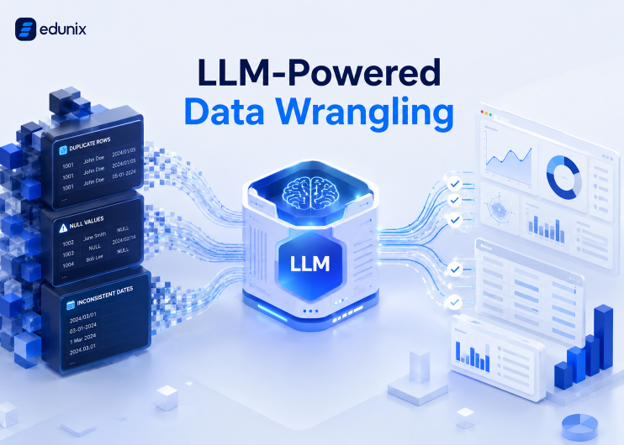
This is where 2026 is genuinely different. You describe the transformation you want in plain English, and an LLM generates the executable Python or SQL code to implement it. Research from ACM has shown that LLMs applied to data transformation tasks can achieve up to 37.2 points improvement on F1 score compared to prior automated baselines, at significantly lower computational cost.
Tools like PandasAI let you type: "Remove duplicate customer records, keep the most recent entry, and standardize the name column to title case." The LLM parses that instruction, generates Pandas code, executes it, and returns a clean DataFrame. No script writing required.
Understanding the lifecycle of AI in data science makes it clear why this automation is arriving now: the combination of better code-generating models and broader data infrastructure has made natural-language-to-transformation workflows finally production-viable.
"The question is no longer whether LLMs can generate data cleaning code. They clearly can. The question is whether the generated code is auditable, reproducible, and enterprise-safe." – Zach Wilson, Data Engineering Lead, former Netflix, via Twitter/X @EcZachly
When using LLM-powered wrangling tools, request that the tool export the generated code as a Python script before applying it. This gives you an audit trail, lets you catch edge cases, and makes the transformation reproducible in downstream pipelines. This is critical for enterprise compliance.
Data Wrangling Tools in 2026: What Actually Works
The tooling landscape has matured considerably. Here is a practical breakdown of where different tools fit.
Python-Native AI Tools
PandasAI remains one of the most widely adopted options for data scientists who want to stay in their existing Python workflow. It wraps LLM calls around a standard Pandas DataFrame, accepting natural language queries and returning transformed DataFrames or visualizations. Pair it with Claude or GPT-4 as the underlying model, and it handles a surprising breadth of cleaning tasks.
Jellyfish (from a 2023 research paper that has since matured into production tooling) focuses specifically on data preprocessing tasks: type detection, null imputation strategies, and schema normalization.
Visual Platforms
Alteryx Designer Cloud uses ML to suggest column transformations and lets analysts preview changes before applying them. Smart data sampling means you can build and test transformation workflows without ingesting full datasets, which matters enormously when dealing with tens of millions of rows.
OpenRefine remains the best free option for one-off cleaning of medium-sized messy datasets. Its clustering algorithms for merging similar values ("Rahul Sharma" vs. "R. Sharma") are still hard to beat for that specific problem, even among paid tools.
Enterprise Platforms
Kleene.ai sits at the high end: it handles the full ingestion-to-transformation workflow and adds an AI intelligence layer on top, turning clean data directly into forecasts and segmentation models without requiring a separate modeling step. Best suited for data teams with operational analytics needs.
Domo and Informatica offer the compliance and governance features that large enterprises require. When evaluating AI features in these platforms, the key questions are whether the tool sends data to external LLMs, whether you can inspect AI-generated transformations before applying them, and whether the tool logs all AI-generated logic for audit trails.
For teams building custom pipelines, knowing how to evaluate these tools properly matters as much as knowing how to use them. The evaluation skills that apply here overlap heavily with what it takes to assess LLM evaluation metrics in production AI systems.
For datasets under 500,000 rows with a data science team already comfortable in Python, PandasAI or LIDA will cover most wrangling tasks. For multi-source enterprise pipelines with strict data lineage requirements, invest in a platform like Alteryx or Informatica that provides auditing and governance out of the box. Overfitting your tooling to your data volume is one of the most common (and costly) wrangling mistakes.
Where Agentic Wrangling Is Headed
The next evolution is already in early production at several enterprise data teams. Instead of triggering a single LLM call to generate one transformation, agentic pipelines run a sequence of autonomous steps: profile the data, identify quality issues, generate transformation code, test it against a validation schema, fix errors, and only surface the final clean dataset to the human reviewer.
Research published in late 2024 introduced AutoDCWorkflow, a framework that uses LLMs to auto-generate data cleaning workflows for tabular datasets, sequencing individual cleaning tasks in the right order and adapting when one step fails. The system doesn't just generate code. It reasons about what cleaning operations need to happen, in what sequence, and verifies the output at each step.
This connects directly to how AI agents with RAG architectures are being deployed to power self-learning enterprise workflows. The same agentic patterns that help an LLM retrieve and reason over enterprise knowledge bases can be applied to data pipelines: the agent retrieves schema documentation, reasons about transformation requirements, and executes the cleaning workflow autonomously.
The practical implication for data scientists is significant. The role is shifting from writing transformation scripts to defining validation rules, setting quality thresholds, and reviewing what the agent produces. Less execution, more supervision.
What This Means for Your Career
Data wrangling is not disappearing as a skill. What is disappearing is the need to spend hours writing boilerplate cleaning scripts for predictable problems.
The data scientists who will thrive are those who understand what good cleaned data looks like, can articulate transformation requirements clearly enough for an LLM to execute them, and can audit AI-generated code for edge cases and bias. The underlying data intuition still matters. The manual execution less so.
If you are building toward a data science role in 2026, learning to work alongside these tools, rather than treating them as replacements, is the most practical skill investment you can make. The floor for what counts as "clean enough" has not moved. What has changed is how fast you can get there.
Conclusion
AI-augmented data wrangling in 2026 is not a future state. It is an operational reality at teams that have made the tooling investment. LLMs now handle the mechanical repetition of column standardization, type inference, duplicate resolution, and null imputation at a speed and consistency no human team can match at scale.
The opportunity for data professionals is clear: shift your time toward the decisions that require judgment, business context, and domain expertise. Let the LLM generate the transformation code. You own the validation logic and the quality bar. That division of labor is already producing measurable results for teams using AI-augmented data wrangling pipelines, and it is only becoming more accessible as the tooling matures through 2026 and beyond.
Frequently Asked Questions (FAQs)
1. What is AI-augmented data wrangling?
AI-augmented data wrangling is the use of artificial intelligence, especially large language models, to help clean, transform, map, validate, and prepare raw data for analysis or machine learning. Instead of writing every cleaning script manually, data professionals can use natural language instructions such as “remove duplicates, standardize date formats, and fill missing values.”
2. How does AI-Augmented Data Wrangling work?
AI-augmented data wrangling works by converting natural language instructions into data transformation steps or executable code. A typical workflow includes data ingestion, profiling, issue detection, transformation, validation, and documentation. The LLM can identify missing values, duplicate records, inconsistent date formats, schema mismatches, outliers, and naming inconsistencies. It then generates code to fix them.
3. What data wrangling tasks can LLMs automate?
LLMs can automate many repetitive data wrangling tasks, including deduplication, null value handling, date normalization, column renaming, schema mapping, text standardization, format conversion, and data validation.
4. Which automatic and standard data cleansing tools are the best for 2026?
The best tools are: PandasAI for NLP-based DataFrame queries, Alteryx Designer Cloud for applying ML for transformation suggestions, and OpenRefine for free clustering-based deduplication. Kleene.ai, Informatica and Domo provide compliance, audit trails and end-to-end pipeline automation for enterprise use.
5. What's the difference between Data Wrangling and Data Cleaning?
Data Wrangling is the entire process from data ingestion, cleaning, transforming through to its validation; Data cleaning is only a part of data wrangling that concentrates on data errors, nulls and duplicates. Wrangling is the whole process of making raw data usable, cleaning is the quality control within the process.
6. What is PandasAI? How to use PandasAI for data wrangling?
PandasAI is a Python library which encapsulates LLMs within Pandas DataFrames, enabling the handling of data in natural language. You can type commands like 'remove duplicates and standardize the name column to title case', and it will produce the Pandas code, execute it, and return the cleaned DataFrame.
7. How can PandasAI be used for data wrangling?
PandasAI can be used for data wrangling by giving natural language instructions to a DataFrame. For example, a user can ask: “Remove duplicate rows, convert the date column to DD-MM-YYYY format, and standardize customer names in title case.” PandasAI interprets the request, generates the logic, and returns the output.
8. What are the key techniques of data science data wrangling?
The four methods are: rule-based cleaning scripts, ETL pipelines with tools such as Informatica or Talend, interactive platforms based on ML suggestions such as Alteryx, and automated ETL using LLM with natural language instructions that are converted into ETL code directly. This is the expected standard for new data flows in 2026.
9. Will AI replace data scientists in data wrangling?
AI will not fully replace data scientists in data wrangling, but it will reduce the manual effort required. LLMs can automate repetitive tasks, but data scientists still need to define the business logic, check data quality, validate assumptions, handle edge cases, and ensure reliability. The winning skill is knowing how to guide and validate AI workflows.
10. Why is AI-augmented data wrangling important in 2026?
It is important because organizations are working with larger, messier, and more diverse datasets than ever before. Manual preparation slows down analytics projects. LLM-powered wrangling helps teams move faster by automating repetitive tasks, improving productivity, and making preparation more accessible to analysts and business users.