Product teams are under more pressure than ever to ship faster, iterate smarter, and do it all with learner resources. The answer increasingly lies in agentic AI in product management - a shift that is moving AI from a simple assistant to a full workflow orchestrator.
In this blog, we break down what agentic AI workflows actually are, how they are reducing time-to-market with AI across real product lifecycles, and what it means for the PM's role when autonomous systems start running end to end.
If your team is still treating AI as a helper for writing, then this blog will change how you think about what it actually can do.
What Are Agentic AI Workflows?
Most product teams have already experimented with AI in Product Management. They have used it to draft PRDs, summarize user research, and write release notes. Useful, yes. But still fundamentally reactive. You prompt, it responds. The cognitive load of orchestrating work still sits entirely with you.
AI agentic workflows are different. They are connected, goal-driven sequences where the system does not wait for a new instruction after each step. It receives an objective and moves through an entire pipeline independently, coordinating data, tools, and outputs until the goal is reached. These autonomous workflows change the architecture of how product work gets done entirely.
Imagine kicking off a discovery phase for a new feature. An agentic system could pull recent support tickets, cross-reference them with behavioral data from your analytics platform, scan competitor release notes, synthesize an opportunity brief, flag the riskiest assumptions, and post a draft to Confluence for your review. That entire sequence runs while you are in your one-on-ones. You come back to something ready to think about, not something you still need to build.
"The key question is not whether AI can do a task. It is whether your team has designed the workflows that let AI do the right tasks at the right moments."
— Lenny Rachitsky, Product advisor and founder of Lenny's Newsletter
Reducing Time-to-Market with AI
The product lifecycle has always had the same weak points. Discovery to definition. Definition to design. Design to engineering scoping. Each transition involves someone translating outputs from one stage into inputs for the next. That translation work is often undocumented, inconsistent, and surprisingly slow.
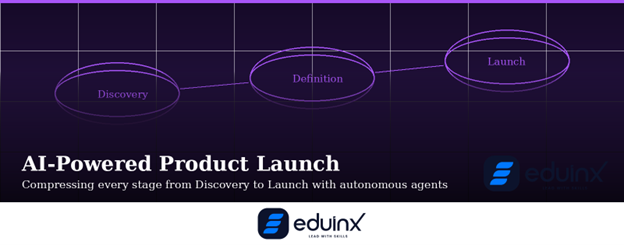
Agentic systems are starting to own those handoffs. In discovery, agents monitor data streams and surface emerging user needs without waiting for a scheduled research sprint. In definition, they draft acceptance criteria and cross-check feasibility signals from your engineering backlog. In the go-to-market phase, they generate draft messaging and create the enablement materials that typically stall an AI-powered product launch for days after a feature is technically ready.
The result is a genuinely compressed timeline across end-to-end workflows. Not because corners are being cut, but because the dead time between stages is disappearing. The thinking still happens. The deliberation still happens. The work that connects the thinking to the output is increasingly automated.
💡 Pro Tip: Start with Your Biggest Time Drains, Not Your Biggest Ambitions
Before deploying agentic AI across your entire product workflow, map where your team actually loses the most hours. For most PMs, it is meeting prep, status updates, and translating research into requirements. Build your first agent to own exactly one of those tasks and get it reliable before scaling. The teams that see the fastest results are not the ones who automate everything at once. They are the ones who made one workflow genuinely excellent first.
The PM's Role Does Not Shrink. It Shifts
There is understandable anxiety here. If AI Product Management Tools can draft the PRD, run competitive analysis, and set up the launch checklist, what exactly is the product manager doing?
The role shifts toward judgment and context. An agent does not know that your VP of Sales has been burned by a similar feature and will torpedo a launch if not brought in early. It does not know that the engineering team needs a win right now, not another ambitious scope. It does not know the political texture of your organization.
AI Transforming Product Management does not mean the PM disappears. It means the PM finally has room to be excellent at the parts only a human can do. The more operational overhead is handled autonomously, the more strategic and human contributions become the visible, differentiating layer of the work.
"Software is eating the world, but AI is about to eat the software. The product managers who thrive next decade will be the ones who learn to think at the level of systems, not tasks."
— Marc Andreessen, Co-founder of Andreessen Horowitz
Building Trust in Autonomous Workflows
One early challenge is calibration. A system that checks in at every step becomes a chatbot again. One that acts too independently and ships a document with a strategic error becomes a liability. Finding the right level of autonomy takes deliberate design.
The most effective approach is building explicit checkpoints where human judgment is required, and letting the agent own everything in between. Define the gates, not the path. The agent runs research and synthesis independently. It presents structured outputs at the gate. The PM reviews, adjusts, approves. Then the agent carries those inputs forward.
This also helps with organizational buy-in. Stakeholders are far more comfortable with autonomous workflows when they can see meaningful human review built into the process. Starting with visible checkpoints and loosening them gradually is a smarter adoption path than pushing for full autonomy from day one.
AI-Enhanced Product Analytics and the Cross-Functional Shift
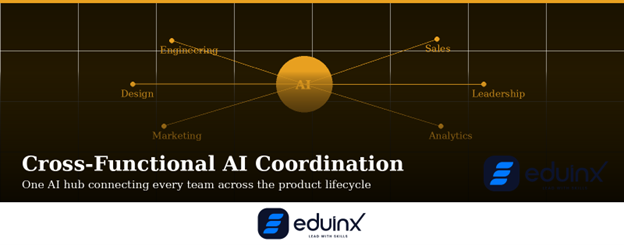
Product management has always been a coordination role. PMs sit between engineering, design, marketing, sales, and leadership, translating context in every direction. Agentic AI does not eliminate that need but it changes what coordination actually looks like.
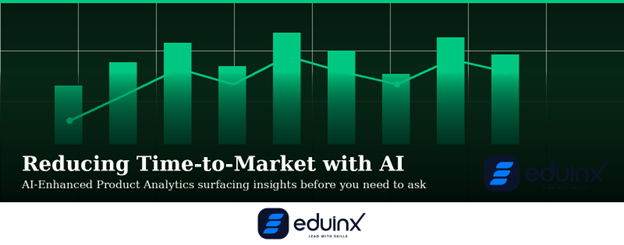
AI-enhanced product analytics is one of the clearest examples. Previously, making sense of behavioral data and feature adoption metrics required a PM to dig in personally or wait on a data team with a packed backlog. Agentic systems now pull from those data sources continuously, surface patterns worth flagging, and fold insights directly into planning documents where decisions are being made. The analytics stop sitting in a separate dashboard nobody remembers to check.
When agents also handle status updates, flag blockers from ticket data, and keep project wikis current, the PM's role shifts from information relay to strategic facilitation. You are not summarizing where things stand. You are deciding what to do about it.
This creates a compounding effect on velocity. Engineering does not wait for requirement clarifications because the agent surfaced edge cases before the sprint started. Marketing does not scramble for copy because the agent drafted it in parallel with the build. The AI-powered product launch is not faster because anyone worked harder. It is faster because coordination overhead finally moved into the background.
"The best PMs I know are multipliers. They make everyone around them more effective. AI agents are the most powerful multiplication tool that product teams have ever had access to."
— Gibson Biddle, Former VP of Product at Netflix.
The Competitive Reality
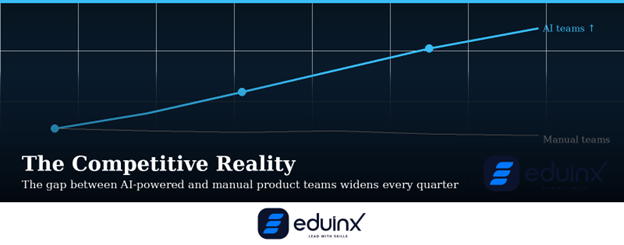
AI transforming product management is not a trend to watch. It is a shift already underway, and the distance between early adopters and everyone else grows with each quarter.
Teams running agentic end-to-end workflows are shipping more frequently, with higher consistency between launch phases, and with noticeably less PM burnout. The gap between those teams and ones still operating manually is widening fast.
The product managers who define excellence over the next five years will be the ones building fluency with these systems now, not as power users but as architects. Knowing how to design the workflows, define the checkpoints, and use AI-enhanced product analytics to close the feedback loop is the new core skill. It sits alongside roadmap strategy and user empathy as something serious PMs cannot afford to ignore.
Agentic AI is not a shortcut. It is an infrastructure upgrade. And like any infrastructure upgrade worth making, the value compounds over time as workflows get smarter, documentation gets richer, and teams grow more confident trusting the system with higher-stakes work.
The launches that used to take six months will take three. Not because the product thinking got shallower, but because everything surrounding that thinking finally got out of the way.
Conclusion
Agentic AI in product management is not a distant future concept. It is happening right now, on product teams that are shipping faster, coordinating smarter, and burning out less. The technology is ready. The workflows are buildable. The only thing standing between most teams and these results is the decision to start.
The PMs who will lead the next generation of product development are not the ones who waited to see how it all played out. They are the ones who got their hands dirty early, figured out where autonomous workflows fit into their specific team's rhythm, and built the operational muscle to scale it over time.
You do not need to automate everything at once. You do not need a perfect strategy before you begin. You need one workflow, one agent, one real problem worth solving. Start there. The compounding takes care of the rest.