A/B testing has long been one of the most trusted tools in a product manager's toolkit. It is the process of showing two versions of something—say, a button color, a headline, or a pricing plan—to different groups of users and then measuring which version performs better. The idea is simple: let the data tell you what works. But while the concept is straightforward, running Generative AI for A/B testing in practice can be slow, resource-heavy, and sometimes confusing. This is where generative AI is starting to change the game.
Generative AI, the technology behind tools that can create text, images, or even code, is not just about flashy chatbots or image generators. For product managers, it can be a powerful accelerator for experimentation. By helping design, run, and interpret Generative AI for A/B testing tests more efficiently, AI can make the process smarter and faster. Let's break down how this works in plain language. Whether you are a working professional or an emerging entrepreneur, understanding gen AI to run A/B tests efficiently is essential.
Why A/B Testing Matters?
Before diving into AI, it is worth reminding ourselves why A/B testing is so important. Imagine you're launching a new app feature. You're debating whether the "Sign Up" button should say "Join Now" instead. Instead of guessing, you run an A/B test: half your users see "Sign Up," the other half see "Join Now." After a week, you measure which button gets more clicks. The winner becomes your default.
Source
This method removes guesswork and personal bias. It is data-driven decision-making at its best. But here's the catch: setting up these tests, collecting enough data, and analyzing results can take weeks or even months. And if you're testing multiple ideas at once, the complexity multiplies. That's where generative AI steps in.
3 Ways How Generative AI Speeds Up A/B Testing
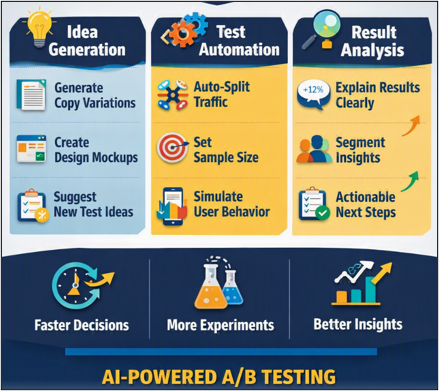
AI testing for product managers is essential. Generative AI can help product managers in three big ways: idea generation, test automation, and result interpretation.
Idea Generation
One of the hardest parts of A/B testing is coming up with meaningful variations to test. Often, teams spend hours brainstorming copy changes, design tweaks, or feature adjustments. Generative AI can act like a creative partner. For example:
- You can ask AI to suggest 10 alternative headlines for a landing page.
- You can generate multiple button texts that fit your brand tone.
- You can even create mockups of different layouts without involving a designer right away.
This doesn't mean AI replaces creativity. Instead, it gives product managers a starting point, saving time and sparking new directions.
Test Automation
Running A/B tests involves technical setup: splitting traffic, ensuring randomization, tracking metrics, and avoiding bias. Generative AI can help automate parts of this. For instance:
- AI can generate code snippets to implement tests quickly.
- It can recommend the right sample size based on your traffic.
- It can simulate user behavior to predict how long you'll need to run the test before results are reliable.
This reduces the dependency on engineering teams for small experiments and empowers product managers to move faster.
Result Interpretation
Perhaps the most valuable role of AI is in analyzing results. Traditional A/B testing requires statistical knowledge—confidence intervals, p-values, significance thresholds. Many product managers find this intimidating. Generative AI can simplify the process by:
- Explaining results in plain language ("Version B increased clicks by 12%, which is statistically significant").
- Highlighting hidden patterns, like differences across user segments.
- Suggesting next steps, such as whether to roll out the winning version or run another test.
This makes insights more accessible and actionable.
Smarter Testing with AI: Practical Examples
Let's look at some everyday scenarios where AI can make A/B testing smarter.
Landing Page Headlines
A product manager wants to test headlines for a new campaign. Instead of spending hours brainstorming, they ask AI: "Generate 10 headlines that emphasize trust and simplicity." The AI produces options like "Your Data, Your Control" or "Simple Security for Everyday Use." The manager picks the top two and sets up a test. AI also helps calculate how many visitors are needed to get reliable results. What used to take days now takes hours.
Pricing Experiments
Pricing tests are tricky because they involve sensitive user behavior. AI can simulate how different price points might affect conversion rates before running a live test. This helps narrow down options and reduces risk. Once the test is live, AI explains the results clearly: "The $9.99 plan increased sign-ups by 8% compared to $12.99, but retention after one month was lower." This balanced view helps managers make smarter decisions.
Mobile App Features
Suppose a team is testing whether a new onboarding tutorial improves user retention. AI can analyze early data and flag trends: "Users who completed the tutorial are 15% more likely to return after three days." It can also suggest segment-specific insights, like "The tutorial had the biggest impact on new users aged 18-25." This level of detail helps teams refine features faster.
Benefits Beyond Speed
The obvious advantage of using AI is speed. But the benefits go deeper:
- Accessibility: AI makes complex statistical concepts easy to understand, so even non-technical product managers can run tests confidently.
- Creativity: By generating multiple variations, AI expands the range of ideas tested, leading to more innovative outcomes.
- Scalability: AI allows teams to run more tests simultaneously without overwhelming resources.
- Learning: AI can summarize insights across multiple tests, helping teams build a knowledge base of what works and what doesn't.
Common Challenges
Of course, AI is not a magic wand. Product managers should be aware of its limitations:
- Quality of Ideas: AI-generated suggestions may not always align with brand voice or strategy. Human judgment is still essential.
- Data Privacy: Running tests often involves user data. AI tools must comply with privacy regulations like GDPR.
- Over-Reliance: AI can simplify analysis, but managers should still understand the basics of statistics to avoid blind trust.
- Bias Risks: If AI models are trained on biased data, they may produce skewed recommendations. Product managers must validate results carefully.
The key is to treat AI as an assistant, not a decision-maker. It accelerates the process but doesn't replace human oversight.
How to Get Started
For product managers curious about using generative AI in A/B testing, here's a simple roadmap:
- Start Small: Use AI to generate copy variations for a single test. See how it compares to your usual process.
- Automate Setup: Explore AI tools that help with traffic splitting or sample size calculation.
- Simplify Analysis: Use AI to explain test results in plain language. Share these summaries with stakeholders to build confidence.
- Build a Workflow: Over time, integrate AI into your testing workflow—idea generation, setup, analysis, and reporting.
- Stay Critical: Always validate AI outputs with your own judgment and data.
The Future of A/B Testing with AI
Looking ahead, generative AI could transform A/B testing even further. Imagine:
- Real-Time Testing: AI dynamically adjusts experiments as data comes in, shortening test cycles.
- Personalized Variations: Instead of one-size-fits-all tests, AI creates tailored experiences for different user segments.
- Automated Reporting: AI generates dashboards that explain not just what happened, but why, and what to do next.
Many companies are already experimenting with AI-driven testing platforms. For product managers, the opportunity is clear: embrace AI now to stay ahead of the curve.
A/B testing is the backbone of data-driven product management. But traditional methods can be slow and resource-intensive. Generative AI offers a way to make testing smarter and faster—by generating ideas, automating setup, and simplifying analysis. For product managers, this means less time spent on mechanics and more time focused on strategy.
Now that you have understood the nuances of using gen AI to run A/B tests, you need to understand more about AI testing for product managers. At Eduinx, a leading edtech institute in India, we offer a comprehensive course on AI product management that dives into AI experimentation platform, AI conversion rate optimization, AI for product growth, product experimentation with AI and enterprise AI experimentation. Our non academic mentors have decades of industry-relevant experience. Our team also offers placement assistance. Get in touch with us to learn more.
Frequently Asked Questions (FAQs)
What is A/B testing and what a Product Manager uses it for?
The A/B testing is a method of displaying the two different versions of a particular element-such as a button color, headline, or pricing plan-to a division of users and tracking which one is more successful. It eliminates the subjectivity and educated guessing in product decisions, based on actual user data instead of the imagination of the individual.
How generative AI can be used in A/B testing?
From designing tests to their execution and interpretation, Generative AI can be a catalyst throughout the A/B testing life cycle, aiding product managers in efficient test design, execution, and analysis. It is not an alternative to the testing methodology; it accelerates the slow and resource-consuming aspects of the testing process: idea generation, test design and interpretation.
What are the top 3 ways generative AI can accelerate A/B testing?
Here are three key roles generative AI can support product managers in the testing process:
- Idea generation
- Test automation - helping with code snippets, sample size, traffic splitting etc.
- Interpretation of results - Communicate the results of statistics in simple terms and propose what to do next
How can a generative AI be used for test idea generation?
At the idea stage of testing, Generative AI can serve as a creative partner as it can generate:
- A variety of possible headlines for landing pages
- A number of options for button text that conform to a particular brand's tone
- Mock-ups of various layouts – without having to wait for a designer up front.
What are some common challenges product managers need to be mindful of for A/B testing with AI?
The Product managers need to be mindful of a couple of common problems:
- While AI can generate ideas, they might not always fit with the brand's tone, voice, or strategy, making human input still necessary.
- Testing with the user's data involves adhering to the privacy laws such as GDPR.
- AI can sometimes make managers rely too heavily on the data without a full comprehension of how it works.
- The recommendations may be biased, depending on the quality of training data; this must be verified carefully.
What does the future of A/B testing with AI look like?
The future will include the real-time testing, with AI dynamically modifying experiments as data is received; customizing variations based on user segments rather than a one-size-fits-all approach; and automated reporting that is not only more informative but also provides explanations on why and what to do next. There are already several businesses that have been testing out AI-powered testing platforms today.
Why do you think the test ideas produced by AI need to be reviewed by a human before launched?
While these AI-generated suggestions might be statistically or creatively viable, they may not necessarily reflect the brand's tone or overall messaging. Using AI as an assistant in the testing process, instead of a decision-maker, ensures that the ideas generated are still the decisions of the product manager, and not the result of an AI.
What role does generative AI play in automating the technical aspects of setting up an A/B test?
With Generative AI, developers can use the tool to generate code snippets for implementing tests in a fast manner; provide sample size recommendations based on existing traffic; simulate users to determine how long a test should run until it is reliable to use. This decreases the reliance of a product manager on engineering teams for smaller experiments.
What does AI have to do to help improve a pricing experiment before it's even deployed?
AI can model the impact that various price points may have on conversion rates even prior to a live test running, which can help to whittle down the number of options to test and minimize risk. After it goes live, AI can then give a level-playing field analysis of results, for instance, a drop in price led to higher signups and lower one month retention.
What would you expect a product manager to start with when it comes to generative AI for A/B testing?
A working starting path would resemble this:
- If you want to go big, you can use AI to create copy variations for an entire test
- Discuss AI applications for traffic splitting, or sample size calculations.
- Breakdown results using AI for stakeholders
- Slowly integrate AI into the entire process - idea generation, setting up, analysis and reporting.
- DO validate outputs from AI against their own judgment and their data