Are you an aspiring data scientist looking to kick start your career in data science? The best way to start learning is by understanding how to build an end-to-end data science pipeline with generative AI tools. Here’s a deep dive into the process.
Did you know that nearly 88% of organizations use AI in at least one of their business functions, while broader enterprise AI adoption is at 35% with 42% actively exploring implementation? The practice of data science has undergone a profound transformation. Just a few years ago, building an end-to-end data science pipeline meant spending weeks writing boilerplate extraction scripts, manually cleaning messy CSV files with feature engineering edge cases, and spending countless hours debugging training loops.
Today, the integration of generative AI tools and autonomous coding agents has compressed these timelines from weeks to hours, shifting the data scientist's role from a manual coder to a strategic orchestrator.
Building a production-ready data science pipeline is no longer just about executing Python scripts in a Jupyter notebook. It is about orchestrating an intelligent ecosystem where generative AI assists at every single stage of the data lifecycle—from raw ingestion and exploratory data analysis (EDA) to automated feature engineering, model validation, and deployment.
With generative AI reaching roughly 53% of the global population within the next three years of widespread release, data science has harnessed the power of gen AI to transform operations and scalability.
Here is a comprehensive phase-wise approach that explores how modern data science and product teams can leverage generative AI tools to build robust, scalable, end-to-end data pipelines.
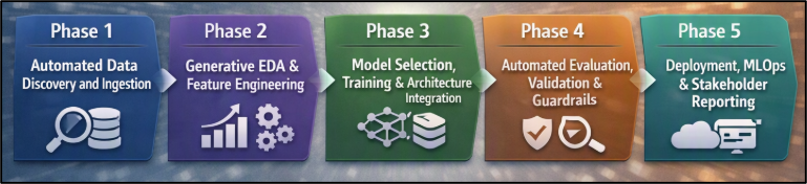
Phase 1: Automated Data Discovery and Ingestion
Every great data science pipeline starts with data ingestion, but real-world data is notoriously messy, unstructured, and fragmented across disparate enterprise silos. Traditional pipelines require brittle, hard-coded ETL (Extract, Transform, Load) scripts that break the moment a schema changes.
Intelligent Schema Mapping and Extraction
Modern data pipelines utilize generative AI and multimodal LLMs to dynamically interpret unstructured data sources. Whether processing legacy PDF reports, messy JSON APIs, or unstructured customer support chat logs, generative models can act as intelligent parsers. Instead of writing complex regular expressions for every new data format, data engineers use LLM-powered extraction functions that understand semantic intent, automatically mapping messy fields into clean, standardized database schemas.
Automated Documentation and Metadata Generation
As data flows into the pipeline, generative AI tools automatically catalog the assets. By analyzing data samples, distributions, and column names, LLMs generate comprehensive data dictionaries, update semantic layers, and tag sensitive Personally Identifiable Information (PII) before it enters downstream processing tables. This automated metadata enrichment ensures that data governance and compliance are embedded directly at the point of ingestion.
Phase 2: Generative Exploratory Data Analysis (EDA) and Feature Engineering
Once data is securely ingested, the exploratory phase begins. Traditionally, this involved writing extensive lines of plotting and statistical summary code to understand distributions, missing values, and correlations.
AI-Assisted Statistical Profiling
In a modern generative pipeline, autonomous data assistants can ingest dataset summaries and instantly surface hidden anomalies, skewness, and multi-collinearity issues that standard scripts might miss. Tools integrated into modern development environments can analyze a pandas DataFrame in real-time, instantly answering natural language queries such as, "What are the primary drivers of customer churn in this dataset, and are there any nonlinear interactions between user tenure and support ticket frequency?"
Automated Feature Generation
Feature engineering has historically been one of the most time-consuming bottlenecks in machine learning. Generative AI tools accelerate this by brainstorming and writing complex transformation functions. By understanding the business context of a predictive model (e.g., predicting user lifetime value or equipment failure), AI assistants can propose novel feature combinations, rolling aggregations, and interaction terms, automatically generating and testing the Python code required to materialize them in the feature store.
Phase 3: Model Selection, Training, and Architecture Integration
With clean data and rich features ready, the pipeline moves into model development. Today, data scientists rarely build models entirely from scratch; instead, they architect hybrid systems that combine traditional machine learning algorithms with generative AI and Retrieval-Augmented Generation (RAG) frameworks.
Intelligent Model Selection and Hyperparameter Tuning
Generative coding assistants help bridge the gap between traditional scikit-learn/XGBoost models and modern deep learning architectures. When provided with a specific prediction task, AI tools can evaluate constraints such as latency, interpretability, and resource limits, generating optimized training pipelines. Furthermore, they can write automated hyperparameter tuning scripts using frameworks like Optuna, dynamically adjusting search spaces based on intermediate evaluation metrics.
Synthetic Data Generation for Edge Cases
One of the most powerful applications of generative AI in data science is the creation of synthetic training data. In scenarios where historical data is scarce—such as rare fraud detection patterns or edge-case system failures with which generative models can synthesize realistic, privacy-compliant tabular and text data. This bolsters model robustness and prevents overfitting before models ever touch production environments.
Phase 4: Automated Evaluation, Validation, and Guardrails
Deploying a model without rigorous validation is a recipe for business failure. Modern data science pipelines incorporate automated evaluation frameworks that continuously test model performance, data drift, and safety guardrails.
Automated Unit Testing and Code Verification
Before pushing pipeline code to production, generative AI agents act as rigorous code reviewers. They scan training scripts for data leakage, verify that train-test splits are properly stratified, and automatically write unit tests to ensure pipeline reproducibility.
Continuous Drift Detection and Guardrails
Once deployed, pipelines must monitor incoming data for distribution shifts. Generative monitoring tools track feature drift and concept drift in real-time, automatically alerting data science teams when economic or behavioral shifts invalidate a model's underlying assumptions. Coupled with strict AI guardrails, these systems ensure that model outputs remain accurate, unbiased, and safe from malicious prompt injections or toxic responses.
Phase 5: Deployment, MLOps, and Stakeholder Reporting
The final phase of the pipeline bridges technical implementation with business value. A brilliant machine learning model is useless if its insights remain trapped in a developer's local environment.
Automated MLOps and CI/CD Pipelines
Generative AI tools streamline the deployment phase by generating Dockerfiles, Kubernetes manifests, and CI/CD configuration files (such as GitHub Actions workflows) tailored to the specific cloud infrastructure of the enterprise. This enables seamless integration with modern MLOps platforms, ensuring models scale effortlessly under variable workloads.
Translating Metrics into Business Insights
Perhaps the most significant shift in 2026 is the democratization of pipeline outputs. Generative AI reporting modules can automatically translate complex evaluation metrics—such as ROC-AUC scores, precision-recall curves, and F1-scores—into plain-language executive summaries and interactive product dashboards. Data scientists can now deliver narrative-driven insights directly to product managers and business stakeholders, accelerating data-informed decision-making.
AI Tools used for Building an End-to-end Data Science Pipeline
WIth AI making work a lot easier, there are a few dedicated AI tools used for building an end-to-end data science pipeline. However, before you learn about them, you need to know what to look for in an AI pipeline automation platform.
- Is the AI tool able to integrate with the existing databases, cloud storage, and business intelligence tools.
- Does the AI tool offer comprehensive lifecycle support that includes training, deployment, monitoring, and retraining.
- Is the AI tool easy to use that supports drag and drop tools and strong APIs.
- Does the tool support audit trails, role-based access, and built-in security features critical to regulated industries for governance and compliance.
- Is the tool scalable with cloud-native platforms with flexible pricing.
- Does the tool support human-in-the-loop oversight for automated transformations and AI-suggested mappings?
- Does the tool offer support for AI knowledge workflows with secure options to connect agents to governed data sets and unstructured documents using RAG.
Here are some popular tools used by data science engineers:
Amazon SageMaker
Amazon SageMaker, part of the Amazon Web Services (AWS) ecosystem, is widely used for building, training, and deploying machine learning models, but teams in multi-cloud environments may need extra work to unify governance and outputs across systems. It provides SageMaker Pipelines, a feature designed for workflow automation, experiment tracking, and continuous integration (CI) and continuous deployment (CD) for ML.
Google Cloud AutoML
Google Cloud AutoML makes machine learning more accessible for teams with limited data science expertise, though teams still often need added tooling for full pipeline automation. By automating model selection, architecture search, and hyperparameter tuning, AutoML reduces the complexity of developing accurate models.
Microsoft Azure Machine Learning
Azure Machine Learning is Microsoft's main AI development and deployment platform, though teams that need a single layer for data integration, metrics, and workflow automation may find they need additional tooling. It provides automated ML capabilities, reproducible workflows through Azure ML pipelines, and enterprise-ready MLOps features.
Databricks
Built on the Lakehouse architecture, Databricks unifies data engineering, analytics, and machine learning in one collaborative platform, though many teams still need separate layers for governed metrics and business workflows. It's known for MLflow, its open-source framework for managing the ML lifecycle, which includes tools for experiment tracking, model packaging, and deployment.
Conclusion
Building an end-to-end data science pipeline using generative AI tools is no longer a futuristic concept; it is the definitive standard for agile, high-performing engineering teams. By automating the friction points of data ingestion, feature engineering, validation, and deployment, organizations can drastically reduce time-to-market for predictive applications.
Ultimately, generative AI does not replace the data scientist. Instead, it elevates them. By removing the burden of manual coding and boilerplate generation, these tools empower data professionals to focus on what matters most: solving complex business problems, driving strategic product innovation, and unlocking enduring value from data.
Now that you have understood the nuances of how to build an end-to-end data science pipeline by harnessing generative AI tools, it is time for you to implement it in real-time through capstone projects. Eduinx, a leading edtech institute in India, offers an in-depth understanding of how modern data science with generative AI works. Our non academic mentors have over a decade of industry relevant experience. They can shape you into being an industry ready resource or help you with your entrepreneurial journey. Get in touch with us for more information on our course.
FAQs
What is an end-to-end data science pipeline?
An end-to-end data science pipeline is a series of connected steps that move a raw data source through data ingestion, data cleaning, exploration, feature engineering, model training, model validation, model deployment and model monitoring. It converts the random data and turns it into a model that is ready to use for production and provide business insights.
Why is generative AI important for the data science pipelines in 2026?
Generative AI eliminates the manual tasks that are taking the longest, like writing the boilerplate scripts, cleaning messy files, and working through training loops. It also assists teams to process unstructured data and scale more rapidly. About 88% of the organisations are at least adopting some of the business processes powered by AI, so it is the standard configuration to work with AI-fuelled pipelines.
What is the impact of the generative AI on the data scientist job?
It moves the data scientist from a manual coder to the strategic orchestrator. They don't handwrite all the scripts, they use the AI tools, then they review the output, validate the results and then they work on the business problem solving and decision making.
Will generative AI replace the place of data scientists?
No, the repetitive code, such as boilerplate, is not something that can be replaced by Generative AI. Data scientists are also still required to pose business questions, review and validate the code and features created by AI, ensure that the outcomes are unbiased, and interpret data strategically.
What are the different phases of a generative AI data science pipeline?
The 5 different phases are: Phase 1 – Automated Data Discovery and Ingestion, Phase 2 – Generative EDA and Feature Engineering, Phase 3 – Model Selection, Training, and Integrating Models into the Architecture, Phase 4 – Automated Evaluation, Validation, and Guardrails, and Phase 5 – Deployment, MLOps and Reporting for the Stakeholders.
How does generative AI help with data ingestion and ETL?
The multimodal LLMs are intelligent parsers that can read PDFs, messy JSON APIs and chat logs and map the fields to a consistent database schema. It replaces brittle regex and hard-coded ETL scripts which fail when there is a schema change, and it also auto-generates metadata and data dictionaries.
What are the methods used to test and validate pipeline code with AI agents?
The generative AI agents are similar to automatic code review tools. They check for training script data leakage, ensure train-test splits are stratified and create unit tests to ensure the pipeline can be reproduced in production.
What are some of the AI tools used to create an end-to-end data science pipeline?
The four popular ones are the Amazon SageMaker (automated ML workflows, experiment tracking, and CI/CD with SageMaker Pipelines), Google Cloud AutoML (automated model selection, architecture search, and tuning), Microsoft Azure Machine Learning (automated ML, reproducible pipelines, enterprise MLOps), and Databricks (a Lakehouse platform with MLflow experiment tracking, packaging, and deployment).
How to choose the best AI Pipeline Automation platform?
Use tools that integrate with your databases, cloud storage, and BI tools; Support with training, deployment, monitoring, and retraining; drag-and-drop tools and robust APIs for ease of use; Audit trails, role-based access, and security controls; Cloud-native scalable that allows for flexible pricing; Human-in-the-loop validation of AI-provided mappings; and RAG-based workflow over governed data.
How does the Generative AI help with Data Governance and Compliance within a pipeline?
It identifies sensitive Personally Identifiable Information (PII) on ingestion, creates data dictionaries and automatically updates semantic layers. Add the audit trails, role-based access and human-in-the-loop review, and this is compliance baked-in, from the get-go.
How can I learn to create AI Data Science Pipelines?
It is ideal for aspiring data scientists, data engineers, ML engineers, and product teams. It is a skill that is accessible to everyone who wants to go from writing scripts to producing intelligent, production-ready workflows, and a good place to begin a career in data science.