Imagine walking into a massive, multi-story library filled with millions of books, reports, and manuals. You walk up to the front desk and give the librarian a very short, vague instruction: "Fix network error."
The librarian looks at you, confused. Do you mean a Wi-Fi router error at home, an enterprise server crash, a database connection timeout, or a printer configuration issue? Is it because the request is short and lacks context? The librarian brings you a random book about basic computer networking that might have nothing to do with your actual problem.
This scenario plays out digitally every single day. When we build modern AI systems using
RAG (Retrieval-Augmented Generation), we ask computers to search through mountains of private company data to answer user questions. However, just like this confused librarian, standard search systems often struggle because user queries are short, vague, or phrased differently than the actual documents stored in the database. This is where HyDE (Hypothetical Document Embeddings) comes into the picture. It is an inventive technique designed to bridge the gap between what people type and what data looks like, completely transforming how semantic search works.
A brief on HyDE
When you type a question into an AI-powered search tool, the system takes your exact text phrase, converts it into a string of numbers called an embedding, and scans a database to find documents that look mathematically similar.
However, there could be a fundamental mismatch as Users ask questions, but databases contain answers.
A user's query is typically short—often just a few words like "remote work tax policy." On the other hand, the corporate document containing the exact answer is a multi-paragraph text block written in formal language, outlining eligibility criteria, country codes, and compliance clauses. Matching a short, messy question directly to a polished, lengthy document can lead to missed connections and poor search results. This is where HyDe hypothetical document embeddings come into the picture.
Given the above scenario, HyDE HyDE helps resolve the same by flipping the script. Instead of searching for the user’s question directly, HyDE asks an AI model to write a fake, hypothetical answer first.
HyDE RAG implementation is an advanced retrieval technique that improves search relevance by using an LLM to generate a fake "hypothetical" answer to a user's question before performing a vector search
Picture this, if a customer asks a complex question about a refund policy, HyDE does not search for the question. Instead, it tells a smart language model: "Pretend you know the answer. Write a short, mock paragraph or document that looks like the ideal answer to this question."
Although this generated document is "fake" and might contain minor hallucinations, it shares the exact vocabulary, tone, structure, and style of the real documents hidden inside your database. HyDE then converts this hypothetical document into an embedding and uses it to search the database. Because the fake document looks and sounds like the real documents, the search engine can find the correct files with startling precision.
The Process of Implementing HyDE for RAG
HyDE RAG implementation within a RAG pipeline might sound complex, but it follows a logical, step-by-step workflow. By breaking it down into manageable phases, enterprise development teams can easily integrate HyDE into their search architectures.
How HyDE Uses Hypothetical Documents
Did you know that implementing HyDE hypothetical document embeddings improves semantic search precision by 50%? Here’s a quick step by step look into the process of implementing HyDE and how it uses hypothetical documents to improve semantic search.
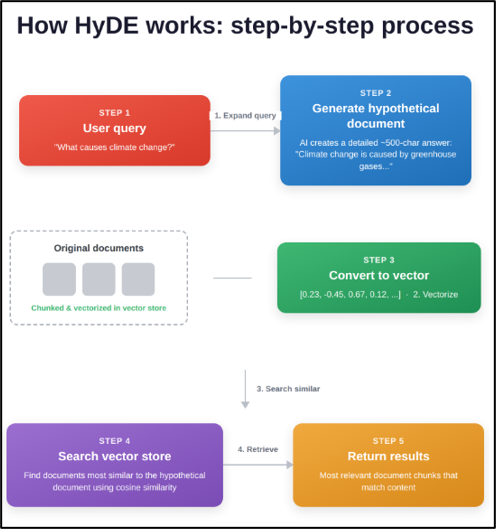
Source
Receiving the User Query
The process begins just like any standard search interaction. A user inputs a natural language query into the chat interface or search bar—for example, "How do I reset my multi-factor authentication if I lose my phone?"
Generating the Hypothetical Document
Instead of immediately sending this query to a vector database, the system routes the query to a language model (LLM). Equipped with a specialized prompt, the LLM is instructed to act as an expert and write a plausible, multi-sentence paragraph answering the user's question.
For multi-factor authentication example, the AI might generate something like:
"To reset your multi-factor authentication (MFA) device after losing your phone, you must submit an IT support ticket through the internal service portal. Once verified by your department manager, an IT administrator will temporarily revoke your old MFA token, allowing you to re-enroll your new device via the authenticator app during your next login."
Notice how this generated text contains rich industry terms, procedural steps, and contextual vocabulary ("IT support ticket," "service portal," "MFA token," "authenticator app") that were entirely absent from the user's original short question.
Creating the Embedding Vector
Once the hypothetical document is generated, the system passes this block of text through an embedding model. This model transforms the words into a mathematical vector—a string of numbers that captures the semantic meaning of the text. As the text is a fully formed paragraph rather than a brief sentence fragment, the resulting embedding is much richer, capturing a broader network of concepts and relationships.
Executing the Semantic Search
Armed with this rich vector representation, the system searches the enterprise vector database. It compares the vector of the hypothetical document against the vectors of all pre-stored real company documents, looking for the highest mathematical similarity score. As the hypothetical document closely mirrors the language style of the actual internal IT guides, the search engine successfully locates the exact, authoritative manual on password and MFA recovery.
Final Response Generation
Finally, the RAG pipeline takes the real, verified document retrieved from the database and passes it along with the original user query to the primary language model. The model reads the official policy and generates a concise, accurate, and completely factual answer for the user, complete with source citations. This is how response generation works.
Benefits of Using HyDE for RAG in Semantic Search
Integrating HyDE hypothetical document embeddings into your search and RAG pipelines offers several massive advantages over traditional keyword or direct-query vector search methods.
Overcoming Vague and Short Queries
Users are notoriously brief when typing search queries. They want quick answers and rarely write detailed paragraphs explaining their exact context. Traditional search engines struggle with short prompts because there simply aren't enough words to anchor a good semantic match. HyDE solves this by expanding a sparse query into a rich, fully articulated passage, supplying the missing context needed to guide the search engine accurately.
Bridging the Vocabulary Gap
A major headache in information retrieval is vocabulary mismatch. A user might search for "sick leave payout," while the official HR document uses the phrase "earned medical leave encashment." Standard keyword matching fails completely here. Because generative language models understand synonyms and conceptual relationships, a HyDE-generated hypothetical document will naturally weave in related terminology, ensuring the search engine finds the document even if the user didn't use the exact corporate buzzwords.
Enhancing Accuracy in Specialized Domains
In highly technical fields—such as legal compliance, medical research, or enterprise software architecture—general-purpose embedding models often struggle to recognize nuances. By leveraging an LLM that understands domain-specific language to draft the hypothetical document, HyDE acts as an intelligent translator. It translates a layman's clumsy question into professional industry jargon, leading to vastly superior document retrieval accuracy.
Better Context Grounding for RAG
At its core, a RAG system is only as good as the documents it retrieves. If the retrieval step brings back irrelevant files, the final AI response will be flawed or misleading. By boosting the precision of the initial search phase, HyDE ensures that the downstream LLM receives clean, highly relevant source material every single time, drastically reducing hallucinations and boosting user trust.

What Does the Future Hold?
As organizations continue to accumulate vast oceans of digital data, helping employees and customers find the exact information they need quickly has become a critical business challenge. Traditional search tools and basic RAG architectures often fall short when faced with short, ambiguous, or poorly phrased user queries.
HyDE hypothetical document embeddings represents a brilliant shift in perspective by asking a simple question: Instead of trying to match a messy question to a document, why not let AI generate an ideal answer first, and use that as our compass?
By transforming queries into hypothetical documents, bridging vocabulary gaps, and unlocking deeper semantic meaning, HyDE elevates enterprise search from a frustrating guessing game into a precise, reliable knowledge engine. For teams looking to build smarter, more intuitive AI applications, adopting HyDE is a powerful step toward turning trapped information into instant insights.
Now that you have understood the nuances of using hypothetical documents to Improve semantic search with HyDE. It is time for you to implement it in your business or organization. Here’s where Eduinx comes into the picture. As a leading edtech institute in India, our non academic mentors will guide you with their expertise in industry-led projects. We offer both virtual classrooms and offline learning for a holistic experience. Understand more about RAG and generative AI through our courses and land your dream job.
Frequently Asked Questions (FAQs)
1. What is HyDE in RAG?
HyDE (Hypothetical Document Embeddings) is an advanced retrieval method that enhances the relevance of search results by first asking an LLM to generate an (hypothetical) plausible answer to a user query before doing a vector search. This generated hypothetical document is a more similar word-for-word (and in word order) to the original documents in the database, and HyDE searches them without having to match the user's precise word-for-word query.
2. What problem does HyDE actually solve in semantic search?
The problem is that the way people ask questions is not how the answers are formulated; people type in short, vague questions and the answers may be in a long, formally-worded document. When a short question is matched directly to a polished document, there may be missing connections; HyDE alleviates this by creating a document-like passage before searching.
3. What does a "hypothetical document" looks like in HyDE?
Hypothetical document: An AI-produced passage that shows what a best possible answer to the user’s query might be.
For example, a user might ask:
Reset MFA?”
HyDE might produce a paragraph with words like:
- Multi-factor authentication
- Identity check
- IT service portal Support ticket
- MFA token reset Security administrator
These terms may not appear in the original query, but they are likely to appear in the organisation’s official IT support documentation.
The hypothetical document may contain factual inaccuracies, which is why it should be used for retrieval only and not as the final answer.
4. How is HyDE different from traditional keyword search?
Traditional keyword search retrieves documents containing the same or closely related words used in the query.
HyDE does not depend on exact keyword matches. It generates a richer, document-style representation of the user’s intent and searches for documents with similar semantic meaning.
This makes HyDE particularly useful when:
- The user uses informal language.
- The document uses specialised terminology.
- The query is short or ambiguous.
- The answer is spread across detailed technical documentation.
- The user does not know the exact name of a process, product, or policy.
5. Why does HyDE improve accuracy in specialized or technical domains?
For industries with specific needs—such as enterprise software architecture, medical research, or legal compliance—embedding models for the general purposes tends to lack the crucial aspects of the language. The use of domain-specific vocabulary by the LLM in the hypothetical document results in much more accurate document retrieval, effectively translating a layman's question into industry jargon.
6. Why does HyDE remove hallucinations in the final RAG response?
The quality of the final answer in a RAG system depends on the quality of the documents it retrieves: if it returns irrelevant documents, the generated answer will be incorrect. HyDE enhances the quality of prompt input into the downstream LLM by improving the accuracy of the first search step, thereby minimizing the risk of the LLM's output being inaccurate or misleading.
7. What is the step by step process of the HyDE process?
It begins by taking the natural language query from the user, and then sends it to an LLM to create a hypothetical document that addresses the query. This text is then embedded to be searched against the vector database for the most similar actual document in the authoritative collection, with the retrieved authoritative document then fed to the LLM to create the final, factual answer with citations.
8. How does HyDE create the hypothetical document given a user's question?
The system forwards the user's question to a language model that is trained with a unique prompt that makes it perform as an expert and generate a coherent, multi-sentence paragraph that answers the question. This is a rich industry term and process description paragraph that has been included deliberately in this paragraph that was not in the original short question provided by the user.
9. How does HyDE transform a hypothetical document to an embedding that can be searched?
After the hypothetical document has been created, it is fed into an embedding model that encodes the text into a mathematical vector that represents the semantic meaning. Because the input is a fully formed paragraph rather than a short fragment, the resulting embedding is richer and captures a broader network of related concepts than a bare query would.
10. What is the benefit of HyDE in terms of precision of semantic searches?
The use of HyDE hypothetical document embeddings has been demonstrated to achieve about 50% more precise semantic search results than traditional document-based search using the user's literal query. This improvement is mainly a consequence of reducing the vocabulary and structural difference between short user questions and long formally written source documents.
11. What happens after HyDE finds the appropriate document?
After successfully finding the real document in the database, the RAG pipeline forwards the document and the user input to the main language model. The model reads the official policy or document and then provides a brief, accurate and factual answer (with source citations), not an answer based on the hypothetical document.
12. What are some best practices for enterprise teams to begin integrating HyDE into their current RAG process?
Teams can also embed HyDE by adding a step to generate documents between the receipt of the user query and the execution of the vector search, with a step to generate a plausible expert answer from the LLM based on a prompt telling it to do so. Because this sits on top of the existing RAG workflow, it can easily be added to most enterprise search architectures without a significant rebuild.