With organizations swarming towards implementing AI at every touchpoint of their operations, structured RAG has gained a strong foothold in the current AI landscape. As an AI engineer, you need to know the nuances of structured RAG and its implementation in the current industry. Here’s a quick peek into the same.
In 2026, enterprise AI has evolved from experimentation to execution. Organizations are no longer asking if they should adopt AI—they’re asking how to make it secure, scalable, and intelligent across structured and unstructured data.
One of the most promising approaches is Structured RAG (Retrieval-Augmented Generation)—a hybrid architecture that combines SQL databases, APIs, and vector search to deliver precise, context-aware answers. It’s the next step in enterprise AI, bridging the gap between traditional data systems and modern generative models.
What Is Structured RAG?
Traditional RAG systems retrieve information from unstructured sources—documents, PDFs, or text repositories—and feed it into a large language model (LLM) to generate answers. But enterprises also rely heavily on structured data stored in SQL databases, CRMs, and APIs.
Structured RAG integrates these sources, allowing AI to query both structured and unstructured data simultaneously. Imagine an AI assistant that can pull HR policy details from a PDF, employee data from a SQL table, and real-time metrics from an API—all in one coherent response. According to McKinsey, enterprises that unify structured and unstructured data in AI workflows see up to 40% faster decision-making and 30% higher data accuracy.
Hybrid RAG Architecture
A hybrid RAG architecture combines multiple retrieval layers:
- Vector Search Layer – Handles semantic retrieval from unstructured data like documents and reports.
- SQL Query Layer – Fetches structured data from relational databases.
- API Integration Layer – Connects external or live data sources (e.g., CRM, ERP, or analytics dashboards).
These layers work together under a unified orchestration framework. When a user asks a question, the system determines which sources to query—vector embeddings for context, SQL for facts, and APIs for live updates. This hybrid setup ensures that enterprise AI doesn’t just “sound smart”—it’s factually grounded and contextually aware.
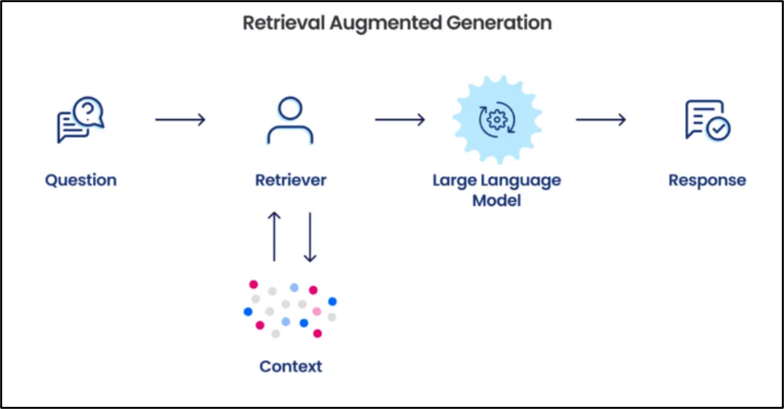
Source
Enterprise AI Data Retrieval
Enterprise data retrieval has traditionally been siloed. Structured data lives in SQL databases, while unstructured data sits in SharePoint, Confluence, or cloud drives. Structured RAG breaks these silos by introducing retrieval orchestration—a process that dynamically selects the right retrieval method based on query type. Here are a few examples:
- “Show me last quarter’s revenue growth” → SQL query.
- “Summarize customer feedback trends” → Vector search.
- “Get today’s sales metrics” → API call.
Enterprise AI data retrieval orchestration ensures that AI systems can handle both quantitative and qualitative questions seamlessly. A recent Gartner report predicts that by 2027,70% of enterprise AI deployments will use hybrid retrieval architectures to unify structured and unstructured data.
Structured Data Retrieval
Structured data retrieval is the backbone of enterprise operations. SQL databases store everything from employee records to financial transactions. In Structured RAG, the LLM doesn’t just generate text—it constructs SQL queries dynamically based on user intent. For instance, if someone asks, “Which products had the highest sales in Q2?”, the model can translate that into a precise database request.
The results are then combined with contextual insights from vector search, allowing the AI to respond with both numbers and narrative:
“Product A led Q2 sales with ₹12.4M, driven by strong demand in the southern region.”
Structured data retrieval and semantic retrieval makes enterprise AI responses accurate, explainable, and actionable.
SQL Database with RAG
Integrating SQL with RAG requires careful design. Enterprises typically follow these steps:
- Define Data Access Rules: Ensure the AI can only query authorized tables and columns.
- Use Query Templates: Predefine safe SQL structures to prevent injection or misuse.
- Embed Metadata: Tag each record with semantic context for hybrid retrieval.
- Combine Results: Merge SQL outputs with vector-based context before generation.
This approach ensures compliance and prevents data leakage—a critical concern for regulated industries like finance and healthcare. According to IDC, enterprises that integrate SQL into RAG pipelines report 25% fewer data errors and 20% faster query resolution times.
Vector Search Implementation
Vector search is the semantic engine behind RAG. It converts text into numerical embeddings that capture meaning rather than keywords. In Structured RAG , vector search complements SQL by handling contextual queries—those that require understanding rather than exact matches.
If a user asks, “What are our top-performing regions?”, vector search retrieves relevant reports and summaries, while SQL provides the actual numbers. Modern vector databases like Pinecone, Weaviate, and ChromaDB support hybrid queries that combine embeddings with filters (e.g., date ranges or departments). This allows enterprises to perform semantic + structured retrieval in one step.
AI-Powered Enterprise Search
Enterprise search has evolved from simple keyword matching to AI-powered contextual retrieval. Structured RAG enables this transformation by combining multiple data modalities.
Imagine an employee asking, “What’s our hiring trend over the past year?” The AI can:
- Query HR databases for hiring numbers (SQL).
- Retrieve internal reports on recruitment strategies (vector search).
- Pull live data from the HR API for current openings.
The result is a unified, conversational answer that blends facts, insights, and real-time updates. This capability is driving adoption across industries.
Here’s how Combining SQL, APIs, and Vector Search Empowers Enterprise AI
Enterprise AI initiatives often struggle when data and capabilities are siloed across disconnected systems. By combining SQL (structured relational data), Vector Search (unstructured semantic context), and APIs (external actions and real-time integration), organizations can build production-ready, highly accurate, and actionable AI workflows.
Unified Management of Structured and Unstructured Data
- SQL handles transactional records, relational metadata, numerical aggregations, and strict business logic.
- Vector Search handles semantic similarity, discovering conceptual intent within unstructured knowledge bases, PDFs, and documentation.
- The Synergy: Combining them allows applications to perform hybrid queries—enabling an AI system to filter semantic search results using exact relational criteria and business constraints.
Contextual Precision and Reduced Hallucinations
Standard AI models often produce errors or guesses when they lack precise corporate data context.
By supplying an LLM or agent with context retrieved via vector search and verified against operational facts queried through SQL, the model operates with factual accuracy. This ensures responses are grounded in real enterprise truth rather than generalized assumptions.
Turning Insight into Action via APIs
Retrieval and search give an AI system knowledge, but APIs give it agency.
Once an AI identifies a user need or processes data, API integration allows the system to execute live operational tasks—such as updating a CRM record, creating a support ticket, or triggering an external workflow—bridging the gap between static analysis and active execution.
Robust Enterprise Governance and Security
Enterprise environments require strict access control, auditing, and data governance.
Relational databases and SQL frameworks excel at enforcing row-level security and role-based permissions. Tying vector search and data retrieval directly to these governance policies ensures that AI agents or knowledge bots never expose restricted files or confidential records to unauthorized users.
Reduced System Complexity and Latency
Historically, organizations relied on fragile ETL pipelines to sync data across separate vector databases, data warehouses, and custom microservices.
Unifying or closely coordinating SQL engines, vector search indexes, and API connectors reduces system latency, prevents data duplication, and lowers maintenance overhead, transforming fragile AI experiments into scalable production systems.
Enterprise AI Architecture
Structured RAG fits naturally into modern enterprise AI architecture. A typical setup includes:
- Data Layer: SQL databases, document repositories, and APIs.
- Retrieval Layer: Vector search and query orchestration.
- LLM Layer: The generative model that synthesizes retrieved data.
- Security Layer: Access control, encryption, and audit logging.
- Interface Layer: Chatbots, dashboards, or voice assistants.
This modular design ensures scalability and compliance. Enterprises can plug in new data sources or swap models without disrupting the entire system. In Delloite, modular AI architectures reduce integration costs by up to 30% and improve deployment speed by 40%.
The Future of Structured RAG
By 2026, Structured RAG is becoming the default enterprise AI pattern. It’s not just about answering questions—it’s about connecting every data point in the organization through intelligent retrieval.
Future advancements will focus on:
- Real-time hybrid retrieval: Combining live API data with historical context.
- Self-learning retrieval orchestration: Systems that adapt query strategies automatically.
- Compliance-aware generation: Built-in data governance and audit trails.
Enterprises that adopt Structured RAG early will gain a decisive edge—turning fragmented data into unified intelligence. Structured RAG represents the next evolution of enterprise AI—where structured databases, APIs, and vector search converge to deliver precision, speed, and trust. It’s not just a technical upgrade; it’s a strategic shift toward data-driven decision-making. By combining SQL accuracy with semantic understanding, enterprises can unlock insights that were previously hidden in silos. In a world where information moves faster than ever, Structured RAG ensures that AI doesn’t just keep up—it leads.
Now that you have understood the nuances of creating a scalable Gen AI data science pipeline, it is time for you to deep dive into building one yourself. At Eduinx, a leading edtech institute in India, we offer both virtual classroom and offline learning to help you get familiarized with scalable generative AI. Take up our post graduate program in gen AI and data science and land your dream job. This course is also designed for business entrepreneurs as we guide you on how to build a scalable gen AI data science pipeline for your company. Get in touch with us to know more.
Frequently Asked Questions (FAQs)
1. What is a Structured RAG?
Structured RAG brings together the SQL databases, APIs, and vector search to deliver high-quality and contextually relevant answers in enterprise AI applications. Structured RAG lets the AI search multiple data sources, both structured and unstructured, at once, resulting in a consistent answer.
2. What is the difference between a traditional RAG and Structured RAG?
In the traditional RAG approach, data is extracted from unstructured sources such as documents, PDFs, text repositories, and passed to an LLM. Structured RAG builds on this by also linking SQL databases, CRMs and live APIs to retrieve HR policy data from a PDF, employee information from a SQL table, and real-time metrics from an API in a single response.
3. What is the hybrid RAG architecture made up of?
A hybrid RAG architecture uses three layers of retrievals that all work together within a single orchestration framework to answer a single query: Vector Search Layer (process semantic search of unstructured content), SQL Query Layer (retrieves structured data), and API Integration Layer (external or live data sources).
4. What does retrieval orchestration mean in enterprise AI?
Retrieval orchestration is the ability to dynamically match the right retrieval method with the right question, for example, translating the question "show me the last quarter's revenue growth" to a SQL query, or "summarize the customer's feedback trends" to a vector search, or "get today's sales metrics" to a live API call. This allows the AI systems to process both quantitative and qualitative questions without any hassle.
5. What is the function of the vector search in Structured RAG?
The semantic engine of RAG is a vector search, which translates the text into numerical embeddings to capture the meaning instead of exact words. In Structured RAG, it works alongside SQL to provide context to a query that SQL can't provide, such as fetching the appropriate report when it's asked for instead of a number.
6. Why does enterprises require a combination of structured and unstructured data retrieval?
Historically, enterprise data retrievals have been fragmented: structured data in SQL databases, unstructured data in SharePoint, Confluence, or cloud drives. Structured RAG helps to overcome these silos, and according to McKinsey, companies that integrate structured and unstructured data into AI workflows experience up to 40% faster decision-making and 30% more accurate data.
7. What makes Structured RAG better at minimizing hallucinations than Natural AI models?
Without accurate business data context, standard AI models may yield inaccuracies or guesses. The model will be able to provide a factual answer, as it will have been enriched with context provided by vector search, and double checked against operational facts from the SQL engine, leading it to provide answers based on real facts from the enterprise and not on generalisations.
8. How does an LLM convert a natural language question into a SQL query in Structured RAG?
Structured RAG is not just about generating text; it's about the LLM dynamically creating SQL queries based on the user's intent. A question such as "Which products had the highest sales in Q2?" is translated into an actual SQL query, and the results are then returned alongside other context-relevant information obtained from the vector search, to provide both a number and a narrative in the final result.
9. How to securely connect SQL to a RAG pipeline?
Usually, enterprises set up rules governing data access, part of which AI can only access authorized tables and columns; they also have a system of pre-designed query templates, which they don't want AI using to access data if they don't mean to; metadata is embedded to add semantic context to records; and SQL outputs are added to vector-based context prior to generation. IDC says businesses that do so experience 25% less data error and 20% shorter query resolution times.
10. How does a typical enterprise AI architecture with Structured RAG look?
The modular approach allows the organizations to integrate additional data sources or replace models without impacting the entire system. A typical setup consists of: Data Layer (SQL, APIs), Retrieval Layer (vector search, orchestration), LLM Layer (generative model), Security Layer (access control, encryption), and User-facing Service (chatbots, dashboards).
11. What do you think will be the trends of Structured RAG in the coming years?
Advancements are likely to include real-time hybrid retrieval which integrates live API data with historical context, self-learning retrieval orchestration that automatically adjusts query strategies and compliance-aware generation that incorporates built-in governance and audit trails. Gartner expects a hybrid retrieval architecture such as this to be deployed by 70% of enterprises by 2027.