

With the emergence of LLMs dominating every industry, industries are on the lookout for professional AI engineers who use LLMs with RAG to transform their business. Did you know that there are several new emerging roles related to generative AI and RAG engineers? This has parted ways for several new opportunities for young budding professionals as well as experienced professionals who are looking for a breakthrough in their career. Now, let us take a deep dive into how LLM evaluation metrics work.
Assessing the outputs of Large Language Models (LLMs) is crucial for anyone developing effective LLM applications. Whether you are fine-tuning for precision, improving contextual relevance in a RAG pipeline, or boosting task completion rates in an AI agent, selecting appropriate evaluation metrics is vital. However, evaluating LLMs is quite challenging—particularly regarding what to measure and the methods to use.
A Brief on LLM Evaluation Metrics
Large language model evaluation tools are on the rise and they have transformed the way industries look at data and process them. LLM evaluation metrics, including answer correctness, semantic similarity, and hallucination, are essential for scoring the output of an LLM system based on the criteria that matter to you. These metrics are vital for assessing LLM performance, as they provide a way to quantify how different LLM systems, including the LLM itself, perform.
Here are some common metrics that you need to gather before launching your LLM into production.
- Answer Relevancy: This metric assesses whether the output from an LLM effectively addresses the input in a clear and informative way.
- Task Completion: This metric evaluates whether an LLM agent successfully fulfills the task it was designed to accomplish.
- Correctness: This metric checks if the output from an LLM is factually accurate according to established ground truth.
- Hallucination: This metric identifies whether the output from an LLM includes fabricated or incorrect information.
- Tool Correctness: This metric determines if an LLM agent is capable of utilizing the appropriate tools for a specific task.
- Contextual Relevancy: This metric evaluates whether the retriever in a RAG-based LLM system can extract the most pertinent information to provide context for your LLM.
- Responsible Metrics: This category encompasses metrics like bias and toxicity, which assess whether the output from an LLM contains potentially harmful or offensive content.
- Task-Specific Metrics: This includes metrics such as summarization, which typically involves custom criteria tailored to the specific use case.
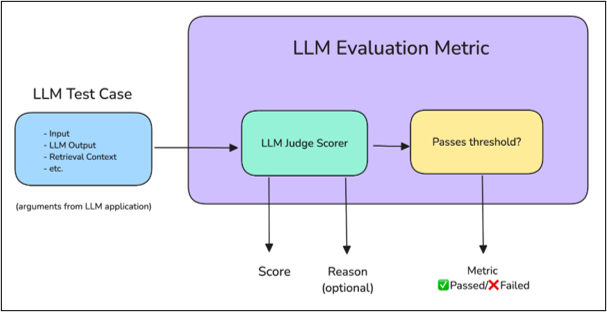
LLM Evaluation Metrics: The Key to Success
Your selection of LLM evaluation metrics should encompass both the evaluation criteria relevant to the LLM use case and the architecture of the LLM system:
- LLM Use Case: Tailored metrics that are specific to the task and remain consistent across various implementations.
- LLM System Architecture: General metrics (for instance, faithfulness in RAG, task completion in agents) that are contingent on the system's construction.
Here’s a quick brief on the essential evaluation metrics.
- Quantitative: Metrics must consistently generate a score when assessing the task at hand. This methodology allows you to establish a minimum passing threshold to evaluate whether your LLM application meets the required standards and enables you to track how these scores evolve over time as you refine and enhance your implementation.
- Reliable: Given the unpredictable nature of LLM outputs, the last thing you want is for an LLM evaluation metric to exhibit similar unpredictability. Therefore, while metrics assessed using LLMs (also known as LLM-as-a-judge or LLM-Evals), such as G-Eval and particularly for (Directed Acrylic Graph) DAG, tend to be more precise than conventional scoring techniques, they often lack consistency, which is where many LLM-Evals fail to deliver.
- Accurate: Trustworthy scores hold no value if they do not genuinely reflect the performance of your LLM application. In fact, the key to transforming a good LLM evaluation metric into an exceptional one is to ensure it aligns closely with human expectations as much as possible.
Choosing the Right Evaluation Metric
Once the objective is established, the subsequent best practice is to align the metrics with the specific task that the LLM is designed to execute. Various NLP tasks necessitate different metrics, and selecting the appropriate one guarantees a more precise and pertinent evaluation. Choose the right evaluation metrics based on accuracy, precision recall, Bi-lingual Evaluation Study (BLEU) score, and perplexity.
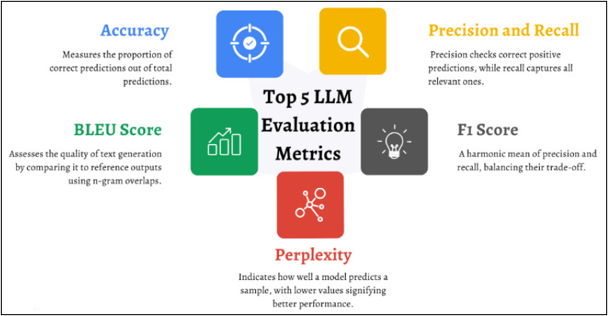
LLM evaluation metrics:Source
Although automated metrics are beneficial due to their speed and scalability, they do not always adequately capture the subtleties of language, context, and human expectations. Human evaluation is crucial to fill this gap, providing insights into subjective aspects that automated approaches might overlook.
In the evaluation of chatbots, human evaluators can assess whether the responses are empathetic, contextually appropriate, and engaging. In the realm of text generation, human reviewers can evaluate if the model’s output is coherent, natural, and relevant to the given prompt. While human review is labor-intensive and resource-demanding, it is vital for ensuring that the model adheres to established standards and expectations.
RAG in LLM Evaluation
RAG evaluation refers to the method of assessing the quality of a RAG pipeline’s components—the “retriever” and the “generator”—by utilizing metrics such as answer relevancy, faithfulness, and contextual relevancy to evaluate each part's impact on the overall response quality. RAG can be incorporated in AI agents for the most accurate results.
This evaluation process incorporates five essential industry-standard metrics:
- Answer Relevancy: The degree to which the generated response aligns with the provided input.
- Faithfulness: The extent to which the generated response accurately reflects the retrieval context without introducing hallucinations.
- Contextual Relevancy: The relevance of the retrieval context in relation to the input.
- Contextual Recall: The ability of the retrieval context to encompass all necessary information to generate the optimal output for a specific input.
- Contextual Precision: The accuracy of the ranking of the retrieval context, ensuring that more relevant information is prioritized for a given input.
Below is a brief overview of the steps involved in retrieval evaluation.
- Embedding the query: Transform the input into a vector format using a chosen embedding model (for instance, OpenAI’s text-embedding-3-large).
- Vector search: Employ this embedded query to explore a vector store that contains your pre-embedded knowledge base, retrieving the top-K most relevant text segments.
- Reranking: Enhance the initial results by reranking the retrieved segments, as raw vector similarity may not always accurately represent true relevance for your particular application.
LLM-as-Judge
LLM-as-a-Judge employs a specialized LLM to evaluate or grade the outputs generated by another LLM. You establish a scoring criterion through an evaluation prompt, after which the judge reviews both the input and output to assign a score or label according to that standard. There are two primary categories of LLM-as-a-Judge.
Single-output LLM-as-a-judge pertains to the assessment of an LLM output based exclusively on a single interaction, as outlined in your evaluation prompt template. These assessments can be either referenceless or reference-based.
In contrast to single-output, pairwise LLM-as-a-judge is considerably rarer due to the following reasons:
LLM’s Cost and Latency with Python
LLM calls in Python are considerably more costly and slower compared to standard API calls: they can incur significant expenses per request (based on token consumption) and may take between 0.5 seconds to 30 seconds, influenced by prompt size, model, and infrastructure. It is crucial to monitor both cost and latency for the effective scaling of AI applications.
- Range: 0.5–30 seconds per request, influenced by model size, prompt length, and backend setup.
- Comparison: Database queries are executed in milliseconds; Redis calls occur in microseconds. LLM calls are significantly slower by several orders of magnitude.
Factors Influencing Latency:
- Prompt length: Longer prompts lead to increased token processing duration.
- Model size: Larger models (e.g., GPT-4) exhibit greater latency.
- Infrastructure: In the absence of batching or caching, GPUs are not fully utilized, which hampers throughput.
Opportunities for enhancement:
- Continuous batching: Enhances throughput by 3–10 times.
- Speculative decoding: Lowers response time by anticipating multiple tokens in advance.
- Quantization: Reduces memory consumption by 2–4 times and accelerates inference by approximately 1.5 times.
Conclusion
Now that you have a brief understanding of LLM evaluation metrics, you need to understand how to implement it in real time. That’s where Eduinx comes into the picture. As a leading edtech institute in India, Eduinx has a team of non-academic mentors with over decades of experience in AI and applications in the industry. You can get a hands-on approach towards learning complex concepts and implementing them in real time through capstone projects. Reach out to us to know more about our applied generative AI course.
Frequently Asked Questions (FAQs)
1. What is an LLM agent evaluation framework, and why it is important?
LLM agent evaluation framework is a systematic method for evaluating an AI agent's performance in various tasks, including reasoning, usage of tools, decision-making, and achieving goals. It supports organizations to carry out pre-deployment and post-deployment measurement of reliability, accuracy and overall performance. By using a robust evaluation framework, teams can identify the weaknesses, reduce failures, improve the user experience, and continuously optimize their AI agents for even real-world applications.
2. Which LLM agent evaluation metrics are the most important to track?
The most critical LLM agent evaluation metrics includes the task completion rate, tool correctness, answer relevancy, and the rate of hallucination. These metrics combined create an indication of whether an agent is capable of reliably completing its intended tasks utilizing the appropriate tools. Monitoring these metrics consistently, is the key to building production-ready AI agents.
3. What is hallucination in LLMs, and how can it be measured?
Hallucination refers to instances where the LLM generates information that are fabricated or factually incorrect, even when it sounds confident. It is evaluated by contrasting the output of the model with a reliable ground truth or retrieved context, and identifying which claims are unsupported by the retrieved context. Reducing hallucination is one of the leading priorities when deploying these LLMs for mission-critical business applications.
4. What does LLM-as-a-Judge mean and what are the two major classifications of it?
LLM-as-a-Judge is a method of evaluating a LLM's output by using another LLM, with a specific evaluation prompt. There are two primary types: single-output evaluation (scores one response at a time); and pairwise evaluation (compares two outputs head to head). Single-output evaluation is more common as it produces quantitative scores which can be tracked over time.
5. What are the five key metrics used to evaluate a RAG (Retrieval - Augmented Generation) pipeline?
The five industry standard measures for evaluating RAG are: answer relevancy, faithfulness, contextual relevancy, contextual recall, and contextual precision. Each metric measures a different part of the pipeline, from whether the retriever surfaces the right documents to whether the generator stays faithful to those documents. Tracking all five will provide a full picture of where a RAG system excels or underperforms.


Akassh vijay
Share on Social Platform:
Subscribe to Our Newsletter
Recommended Articles

AI Product Managers: Roles, Responsibilities, and Future Scope
Did you know that a highly skilled product manager has the ability to increase
Learn More

Generative AI: A Deep Dive
Did you know that 75% of gen AI users are looking to
Learn More