
AI is changing how data scientists work. AI copilots can generate SQL from natural-language prompts, while Auto-EDA tools can automatically explore datasets, create visualizations, and identify patterns.
This raises an important question: Do data scientists still need SQL in 2026?
The answer is yes. AI can reduce the amount of SQL data scientists write manually, but it doesn't eliminate the need to understand how data is stored, queried, joined, filtered, and validated.
The continued relevance of data science itself is also reflected in the U.S. Bureau of Labor Statistics. BLS projects employment of data scientists to grow 35% from 2025 to 2035, with about 24,800 openings per year over the decade.
As AI becomes part of the data science workflow, SQL is evolving from a purely manual coding skill into an AI-assisted data analysis skill.
Do Data Scientists Still Need SQL in 2026?
Yes, data scientists still need SQL in 2026. SQL for data scientists is useful for retrieving data, combining tables, performing calculations, investigating data quality, and preparing datasets for analysis and machine learning.
AI tools can generate queries and automate repetitive tasks, but data scientists still need to determine whether the right data was selected and whether the resulting query answers the original question.
The key shift is:
- Writing every query manually → Using AI to generate queries → Reviewing and validating the results
Understanding SQL therefore remains valuable even when AI writes part of the code.
How AI SQL Copilots Are Changing Data Analysis
AI SQL copilots are making natural-language-to-SQL workflows more accessible.
Instead of manually writing a complex query, a data scientist can describe the required analysis in plain English. An AI assistant can then generate an initial SQL query that can be reviewed and refined.
For example:
"Which customer segment had the highest churn rate during the last quarter?"
The image below shows how an AI SQL copilot converts a natural-language business question into a SQL query and delivers the resulting data.
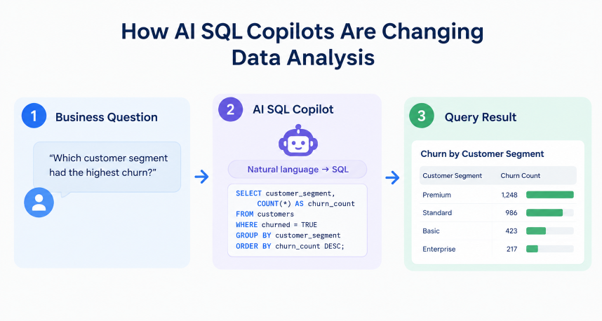
An AI SQL copilot can generate a query based on the available database schema.
This can reduce time spent on repetitive SQL writing, syntax errors, and query explanations. Google Cloud's BigQuery documentation, for example, describes Gemini assistance for generating, completing, explaining, and fixing SQL queries. Google also recommends reviewing generated output because AI-generated results may be incorrect.
This is why SQL and AI work better together than being treated as competing skills.
AI can generate SQL, but data scientists still need to understand what the SQL is doing.
AI-assisted SQL is part of a broader shift toward systems that can combine natural-language interaction with data retrieval and multi-step reasoning. For a deeper look at how these workflows are being designed, see From Chatbots to AI Employees: Designing End-to-End Agent Workflows with RAG.
What Can Auto-EDA Tools Automate?
Auto-EDA, or automated exploratory data analysis, uses software and AI to automate parts of the initial data exploration process.
Depending on the tool, Auto-EDA can help with:
- Summary statistics
- Missing-value analysis
- Data distributions
- Correlation analysis
- Outlier detection
- Basic visualizations
- Pattern discovery
These capabilities can make exploratory data analysis faster. However, automation does not remove the need for analytical judgment.
For example, an Auto-EDA tool may identify a strong correlation between two variables. A data scientist still needs to determine whether the relationship is meaningful, whether the dataset contains bias, and whether the finding is relevant to the business question.
The same principle applies to SQL: automated analysis is only useful when the underlying data and questions are correct.
5 Reasons SQL Still Matters for Data Scientists
Here are the 5 major reasons why SQL still matters for data scientists.
- SQL Provides Direct Access to Data
- SQL Helps Validate AI-Generated Queries
- SQL is Essential for Data Preparation
- SQL Helps Identify Data-Quality Problems
- SQL Improves Collaboration
Let us explore these in detail.
1. SQL Provides Direct Access to Data
Data used for analytics and data science is often stored in databases, data warehouses, and other structured systems.
SQL allows data scientists to retrieve the specific records and fields required for analysis.
Before building a model, a data scientist may need to determine which customers, transactions, time periods, or variables should be included. SQL provides a practical way to access and prepare this data.
2. SQL Helps Validate AI-Generated Queries
One of the most important data science SQL skills in the AI era is query validation.
An AI-generated query may contain an incorrect join, filter, aggregation, or assumption while still appearing technically valid.
For example, an incorrect join can duplicate records and produce misleading results. A data scientist with SQL knowledge can inspect the query and identify such problems before using the output.
3. SQL Is Essential for Data Preparation
Real-world datasets rarely arrive perfectly prepared.
Data scientists may need to filter records, combine tables, create calculated fields, aggregate transactions, or transform categories before analysis.
SQL features such as joins, CTEs, GROUP BY, CASE statements, subqueries, and window functions remain useful for these tasks.
AI can help write the syntax, but the data scientist still decides what transformation is actually required.
Data preparation can also involve creating or augmenting datasets when real-world data is limited. For a broader look at how synthetic data can support machine-learning workflows, see Synthetic Data Revolution: Boosting ML Model Accuracy.
4. SQL Helps Identify Data-Quality Problems
Poor-quality data can affect analytics and machine-learning results.
SQL can help investigate:
- Missing values
- Duplicate records
- Invalid dates
- Unexpected categories
- Null values
- Inconsistent records
- Unusual numerical values
AI can suggest data-quality checks, but humans still need to decide which checks matter and interpret the results.
5. SQL Improves Collaboration
Data scientists frequently work with data engineers, analysts, analytics engineers, product teams, and business stakeholders.
SQL provides a common way to discuss where data came from, how metrics were calculated, and how different datasets were combined.
As AI-generated SQL becomes more common, understanding the logic behind those queries can also make collaboration and review easier.
SQL vs. AI Copilots: What Should Data Scientists Learn?
SQL and AI copilots serve different but complementary roles across the data science workflow. The table below highlights where SQL remains essential and where AI copilots can help automate or accelerate common tasks.
| Data Science Task | SQL | AI Copilot |
|---|---|---|
| Query databases | Essential | Can assist |
| Generate basic queries | Useful | Can automate |
| Complex joins | Essential understanding | Can assist |
| Explain queries | Useful | Can assist |
| Validate results | Essential | Can assist |
| Data-quality checks | Essential | Can generate checks |
| Explore data | Useful | Can accelerate |
| Interpret business results | Essential | Can assist |
The emerging skill is AI-assisted SQL literacy.
Data scientists need to understand the question, identify the right data, guide the AI, review the generated SQL, and validate the result.
Which SQL Skills Should Data Scientists Learn in 2026?
Data scientists do not necessarily need to master every advanced database feature. However, a strong foundation in SQL for data science should include:
- SELECT, WHERE, and ORDER BY
- Aggregations and GROUP BY
- Inner and outer joins
- CTEs
- Subqueries
- CASE statements
- Window functions
- Date and time functions
- Data-quality checks
- Basic query optimization
The goal is not simply to memorize syntax. It is to understand how a query transforms data and how those transformations affect the final result.
For professionals looking to build broader data science and Generative AI skills alongside SQL, the Post Graduate Program in Data Science with Generative AI provides a structured learning path covering the wider technical ecosystem used in modern data science.
Will AI Replace SQL Skills in Data Science?
AI can reduce some manual SQL work. Data scientists may spend less time remembering syntax and more time describing analytical requirements, reviewing generated queries, and interpreting results.
However, replacing manual query writing is different from replacing SQL knowledge.
If an AI tool produces an incorrect join or calculates a metric incorrectly, someone still needs to recognize the problem.
For this reason, SQL remains a useful foundation for working effectively with AI-assisted data analysis.
The Future of SQL and Data Science
The modern data science workflow is increasingly AI-assisted:
Business question → AI-assisted SQL → Data validation → Exploration → Analysis → Insight
This shift is also connected to the growing use of AI closer to where data is generated. For more on how real-time processing is moving toward the data source, explore Edge AI Trends 2026: Real-Time Data Processing at the Source.
Natural-language interfaces can make data analysis more accessible, while SQL knowledge helps professionals understand and validate what happens behind the interface.
SQL is therefore not disappearing from data science. Its role is changing.
The combination of SQL fundamentals + AI tools + analytical judgment gives data scientists a way to work faster without giving up control over their data.
Conclusion
AI is changing how data scientists interact with data, but it is not eliminating the need for SQL.
The most practical approach is to combine SQL for data scientists with AI-assisted data analysis. Understanding SQL allows data scientists to use AI copilots and Auto-EDA tools more effectively while maintaining control over query logic, data quality, and analytical accuracy.
SQL is not dead. The way data scientists use SQL is simply evolving.
Frequently Asked Questions (FAQs)
1. Do data scientists still need SQL in 2026?
Yes. Data scientists use SQL to query databases, prepare datasets, validate AI-generated queries, investigate data quality, and work with structured data.
2. Is SQL necessary for data science?
SQL is an important data science skill because datasets are often stored in databases and warehouses that require querying and transformation before analysis.
3. Can AI replace SQL for data scientists?
AI can automate SQL generation, but data scientists still need SQL knowledge to review queries, identify errors, understand joins, and validate analytical results.
4. Will AI make SQL obsolete?
AI may reduce manual SQL writing, but SQL remains useful for understanding, transforming, validating, and working with structured data.
5. What SQL skills should a data scientist learn?
Data scientists should learn queries, joins, aggregations, CTEs, subqueries, window functions, conditional logic, date functions, and basic data-quality checks.
6. Can ChatGPT write SQL for data scientists?
Yes. AI assistants can generate SQL from natural-language instructions, explain queries, and suggest changes. Users should still verify the generated SQL before using its results.
7. What is Auto-EDA?
Auto-EDA means automated exploratory data analysis. It uses software or AI to generate statistics, visualizations, data-quality checks, and potential patterns from datasets.
8. Is SQL better than Python for data science?
SQL and Python serve different purposes. SQL is useful for querying and transforming database data, while Python is widely used for statistical analysis, machine learning, visualization, and programming.
9. How does AI help with SQL?
AI can generate SQL from natural-language questions, explain existing queries, complete code, identify potential errors, and help users explore data faster.
10. Should beginners learn SQL before AI tools?
Learning SQL fundamentals can help beginners understand AI-generated queries, recognize incorrect results, and use AI tools more effectively for data analysis.


