

Are you worried that AI will be replacing most leadership roles and raising the unemployment rate? Well, that seems to be a widespread misconception in everyone’s minds as AI is here to improve leadership.
When computers and the World Wide Web first appeared, many were concerned that they would make entire job functions redundant, leading to widespread anxiety. Although some positions did change or even vanish, these technologies ultimately created new opportunities, transformed industries, and became integral to our current work environment.
In this context, we observe a similar trend with AI in leadership. AI is a technology that enables computers and machines to replicate human learning, understanding, problem-solving, decision-making, creativity, and independence. Initial responses are often fueled by fear of the unfamiliar. However, as before, the focus should not be on resisting change; rather, it should be on learning to adapt. With careful implementation, AI can serve as a powerful partner: one that enhances human capabilities instead of replacing them, and opens up new avenues for working, thinking, and leading.
The Progress of AI in Recent Stages
As we move beyond initial skepticism and start to embrace the potential of AI, it is crucial to acknowledge the progress technology has made.
- ● Once confined to basic recommendation systems and simple chatbots, AI has developed into a comprehensive suite of tools that are transforming the contemporary workplace.
- ● ChatGPT has been instrumental in making AI more accessible to the general public.
- ● Tools like FeedHive, ClickUp, Tidio, Textio, and AdCreative, are optimizing operations across various sectors and redefining what is achievable.
The above tools provide just a snapshot of what is currently available in the AI landscape today, with many more offering distinct capabilities to address diverse business requirements.
AI is Redefining Leadership Roles
A recent survey conducted by Orgvue found that 82% of organizations have already made investments in AI, with 33% intending to boost their investment by more than 50% this year.
- ● However, in spite of this increasing enthusiasm, almost half of these organizations are still uncertain about how to effectively utilize AI in the workplace.
- ● This discrepancy between investment and understanding underscores a significant need not only for the adoption of technology but also for deliberate and compassionate leadership to steer teams through this change.
- ● As AI becomes more integrated into our work processes, the demand for considerate leadership, strategic vision, and a human-focused approach has never been more critical.
- ● To facilitate successful integration, leaders must possess a thorough understanding of AI’s potential and how it aligns with the objectives of the organization.
- ● Instead of perceiving AI as a threat to job security or leadership positions, it should be regarded as a supportive tool.
- ● When purposefully integrated, AI enhances rather than diminishes the human elements of work, such as communication, collaboration, and innovation.
How AI Transforms Modern Leadership
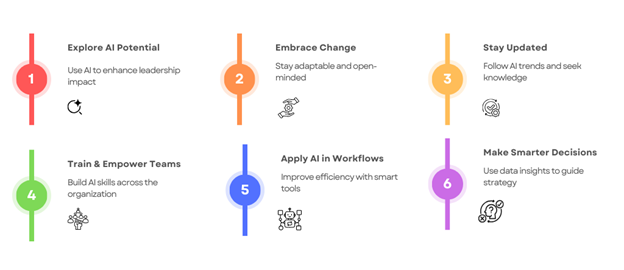
Source: technopark.in
AI does not Disrupt the Workflow
As a leader, you may have a lot of apprehensions on implementing AI in your organization's leadership. You may wonder:
- ● What if AI systems do not understand the organization’s motive?
- ● How will AI improve operations and help drive crucial decision making in the leadership sphere?
AI is not a universal solution, nor should it be perceived as a disruptive element to current workflows. Rather, it ought to be viewed as a strategic resource: a tool crafted to enhance operations and refine essential functions.
Change can be unsettling, and the integration of AI introduces additional complexity. Leaders may be concerned about whether their employees and teams will accept it or resist its adoption. However, it is essential to remain informed and receptive to new opportunities. With a proactive approach and appropriate strategies, leaders can navigate their teams through this transition, fostering a culture of adaptability and ongoing learning.
When implemented with care, AI in leadership enhances operational efficiency and productivity while providing data-driven insights that facilitate improved decision-making. It becomes an indispensable tool in the leadership arsenal, not only for addressing challenges but also for envisioning and shaping the future.
Challenges in Implementing AI
Embracing AI goes beyond merely selecting the latest technology. It involves ensuring that it stays relevant and aligned with the needs of the organization, while also being dedicated to its workforce, helping employees remain connected to the company’s fundamental values and feel supported during the transition. Similar to upgrading to the latest iPhone just to keep up with trends, leaders may experience pressure to adopt AI out of fear of lagging behind. However, without a strategic framework, this can feel more like a burden than a worthwhile investment.
This is why understanding your core values and business is crucial, while also keeping abreast of emerging trends, evaluating their significance, and preparing contingency plans to facilitate smooth transitions as technologies advance.
- ● Another significant challenge is bias. Since AI systems learn from data, they can unintentionally mirror or exacerbate existing inequalities.
- ● Leaders must oversee the implementation of AI with diligence. Human judgment should remain central, ensuring fairness, accountability, and ethical decision-making.
- ● Data security also becomes critical in the AI era. Leaders need to safeguard sensitive information such as intellectual property, customer data, and employee records.
- ● Establishing clear protocols and fostering a culture of compliance can serve as protective measures. Educating teams on responsible data practices is essential to maintain trust and promote ethical AI usage.
It is common for some employees to perceive AI as a disruption rather than a means of empowerment. To mitigate resistance, leaders should emphasize communication, transparency, and training. Providing resources and opportunities for skill enhancement can significantly contribute to building confidence and securing buy-in from the team.
Now that you have understood how to harness AI in leadership roles, you can upskill yourself in the industry by learning more about AI. As a leading edtech institute in India, Eduinx follows a hands-on approach in understanding AI and how it can be implemented in the leadership. You can get guidance from our non-academic mentors on essential AI concepts and transform leadership through virtual classrooms and offline classrooms. We also provide career support and placement assistance. Get in touch with us to know more about our generative AI course


