
Artificial Intelligence has moved to be an experimental technology and a basic part of contemporary product management. Currently, AI assists product managers in user behavior analysis, predicting trends, workflow automation, and upscale personalized experience. With organizations gearing up for an AI-enabled future, algorithms also play a greater role in product decision-making than intuitions do.
However, these lightning-fast uptakes also have ethical issues. Since AI-powered systems are shaping what people see, purchase, and experience, product managers need to make sure that innovation is responsibility-driven. The question is no longer whether to utilize AI, but how to utilize it in a legitimate manner that preserves the trust of its users and its long-term value.
Why Ethics Has to Matter in AI-Driven Products
Product management sits at the intersection of business strategy, technology, and user experience. As AI-based decision-making forms the core of the product development roadmap and feature prioritization, the effect of product decisions increases exponentially.
Unless AI is put in ethical guardrails, it can both lead to biased results and hidden decision-making and may cause unintentional damage to users. Ethical AI will make sure that the decisions that are made in products are transparent, inclusive, and are in line with human values. The future of work with AI will also see product managers not only provide output but also take responsibility for the way the results are generated.
Sustainable innovation is not limited by ethics; thus, it is a pillar of it.
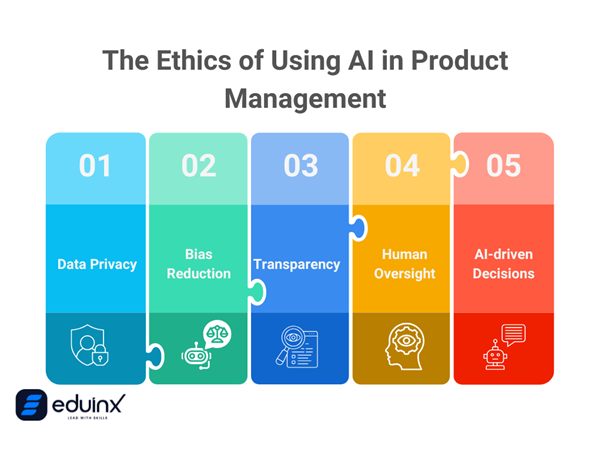
Data Privacy and Responsible Data Usage
AI is very dependent on the information provided by users in order to make insights and predictions. Although data can help create smarter and more responsive products, the misuse or excessive amount of data can easily destroy trust. Customers in an AI-powered future are becoming more conscious about the usage of their personal data and demand more openness and freedom.
There should be a balance between personalization and privacy in ethical product management. Information must be gathered with a good purpose and utilized in a way that will add real value to the user.
The responsible data practices include:
- ● Gathering data that only justifies product results.
- ● Indicating clearly the use and purpose of data.
- ● Providing meaningful control to users of their personal information.
In cases where privacy is not violated, AI experiences are empowering and not invasive.
Bias in AI and Fair Decision-Making
The AI systems learn based on the historical data, and that data often reflects existing social and economic biases. If left unchecked, AI-driven decision-making can reinforce inequalities instead of eliminating them.
In product management, bias can be in the form of recommendation engines, pricing models, content ranking, or automated approvals. Such consequences can unintentionally disadvantage certain user groups, affecting the fairness and inclusivity.
Product managers must actively question AI outputs rather than treating them as neutral truths. At least once a week, ethical teams test models on different user groups and check the results during the course of time.
To reduce bias, teams should:
- ● Use diverse and representative datasets
- ● Perform frequent bias audits and reviews.
- ● Engage cross-functional and varied opinions in assessments.
Fairness should be upheld throughout the period when AI systems evolve.
Transparency and Explainability in AI Systems
Transparency is needed as AI gets increasingly integrated into products. People should be informed about when AI is shaping their experience, particularly where this has an impact on the visibility, access, or outcome.
Ethical transparency is not about publishing the intricate algorithms, but rather it is about comprehensible exposition of decisions to the users. The future of work with AI will be based on trust, which will be determined by the clarity of organizational communication regarding the role of AI in decision-making.
Transparency helps by:
- ● Informing users when AI is involved.
- ● Elaborating on findings in the language of humans.
- ● Providing feedback or an explanation mechanism.
Once the users are aware of the decision-making process, their belief in the product will be enhanced.
Human Oversight in an AI-Powered Future
Although the AI is fast and scalable, it still lacks context, empathy, or moral judgment. This will require human control, especially as organizations proceed further into an AI-driven future.
Ethical product management makes sure that AI is used to aid in human decision-making and not to eliminate it. The option of having human review and intervention should always be included in high-impact decisions.
Successful human-in-the-loop systems involve:
- ● Manual reviews for critical or high-risk outcomes.
- ● Clear escalation paths for errors or edge cases.
- ● Defines specific criteria for when human judgment overrules AI.
Such a balance will avoid excessive automation and make AI not a self-governing power.
Accountability in AI-Driven Decision Making
Accountability is one of the most crucial ethical issues with AI. In cases of errors made during the functioning of AI systems, the issue of accountability cannot be transferred to the technology.
The product managers should make sure that AI features and results are owned. Accountability needs constant checking, evaluation of performance, and the capacity to take immediate action in case of problems. Accountability is what makes the automation responsible for innovation in AI-based decision-making.
Best practices on accountability are:
- ● Artificial intelligence features have clear ownership.
- ● Post-deployment modeling.
- ● Fast user impact response mechanisms.
Ethical alignment in the product lifecycle is guaranteed by accountability.
Ethics as a Competitive Advantage
Ethics is emerging as a competition in the new digital world. Responsible product use will encourage people to trust and interact with products that can use AI responsibly. Ethical management of products will be an outstanding organization in the future of work with AI.
Regulatory risk is minimized, brand reputation is safeguarded, and long-term customer loyalty is developed by ethical AI. More to the point, it makes innovation on par with user expectations and societal values.
Conclusion
AI is transforming the management of products, and it is making the digital product AI-driven. But ethics will decide whether such a transformation will help to benefit the users or destroy trust.
Product managers will be able to show responsible AI adoption by focusing on privacy, fairness, transparency, human oversight, and accountability. In the age of AI-assisted decision making, intelligent products will not only be successful, but they will also be trusted.