If you have used ChatGPT, generated images with diffusion models, or translated complex documents in seconds, you have experienced the power of the transformer architecture . Before transformers emerged, artificial intelligence struggled with natural language. Early models read text sequentially—word by word—making them slow, memory-intensive, and prone to losing context over long passages.
In 2017, a team of researchers at Google published a landmark paper titled "Attention Is All You Need." This paper introduced the transformer model and fundamentally reshaped modern artificial intelligence.
Today, understanding transformer architecture demystified is no longer just for academic researchers, it is an essential foundation for product managers, data scientists, software engineers, and tech enthusiasts building the next generation of AI-driven tools.
What Is a Transformer and What Are Its Uses?
To understand how modern generative AI works, you must first ask a fundamental question: What is a transformer?
At its core, a transformer is a deep learning model architecture designed to process sequential data, such as text, code, or audio. Unlike older neural network architectures—such as Recurrent Neural Networks (RNNs) and Long Short-Term Memory (LSTM) networks—transformers process entire sequences of text simultaneously rather than step-by-step.
How Transformers Differ from Legacy AI Models
Traditional models read sentences sequentially. Consider the sentence: "The dog ran after the ball because it was rolling down the hill."
An older RNN reads "The", then "dog", then "ran", carrying information forward step-by-step. By the time it reaches the word "it", it often forgets whether "it" refers to the dog or the ball. Transformers, however, ingest the entire sentence at once, using mathematical mechanisms to weigh the relationships between all words simultaneously.
Key Uses of Transformer Architecture in Generative AI
The introduction of transformer architecture in generative AI enabled the creation of Large Language Models (LLMs) and foundation models across various domains:
- Large Language Models (LLMs): Powering tools like GPT-4, Claude, and Gemini for text generation, summarization, and complex reasoning.
- Autonomous Code Generation: Powering coding assistants like GitHub Copilot to write, debug, and translate programming languages.
- Multimodal Generation: Combining text and visual spatial understanding in models like DALL-E, Midjourney, and vision-language transformers.
- Protein Folding and Biological Science: Driving breakthroughs like AlphaFold to predict 3D protein structures for drug discovery.
- Real-time Machine Translation: Translating languages with unprecedented fluency and contextual awareness.
Core Concepts: The Building Blocks of Transformers
To truly grasp how transformers achieve state-of-the-art results, you need to break down their internal components. The architecture relies on three primary concepts: Tokens, Embeddings, and Positional Encodings.
Tokens and Embeddings
Computers do not understand human words; they understand numbers.
- Tokenization: Before text enters a transformer, it is split into smaller units called tokens. A token can be a whole word, a prefix, or a suffix. For example, the word "unbelievable" might be split into ["un", "believ", "able"].
- Input Embeddings: Each token is converted into a dense numerical vector (a list of numbers) in a high-dimensional space. Words with similar semantic meanings—like "king" and "queen", or "car" and "vehicle"—are positioned closer together in this vector space.
Positional Encoding in Transformers
Because transformers process all tokens in a sentence simultaneously rather than sequentially, they inherently lose track of word order. Without a mechanism to track position, the model would view "The dog bit the man" and "The man bit the dog" as identical sets of words.
To fix this, researchers introduced positional encoding in transformers. Positional encodings add unique mathematical wave signals (sine and cosine functions) to the input embeddings. This embeds precise sequence order into each word vector, allowing the model to know both what the word means and where it sits in the sentence.
The Secret Sauce: The Self-Attention Mechanism Explained
If the transformer architecture is an engine, self-attention is its high-octane fuel. Understanding the self-attention mechanism explained in plain language reveals why generative models feel so shockingly intelligent.
What Is Self-Attention?
Self-attention allows a model to calculate how much relevance every word in a sequence has to every other word in that same sequence.
Returning to the previous example: "The animal didn't cross the street because it was too tired." When a transformer processes the word "it", the self-attention mechanism computes attention scores across all surrounding words:
- How related is "it" to "street"? (Low score)
- How related is "it" to "tired"? (Medium score)
- How related is "it" to "animal"? (High score)
By scoring these connections mathematically, the model accurately determines that "it" refers to the animal. If the sentence ended with "...because it was too wide," the self-attention scores would shift, instantly re-linking "it" to "street."
Multi-Head Attention in Transformers
To make these associations even richer, transformers do not perform self-attention just once per layer, they use multi-head attention in transformers.
Instead of viewing relationships through a single lens, multi-head attention splits the vector representations into multiple sub-spaces ("heads"). Each "head" focuses on a different aspect of language simultaneously:
- Head 1 might track grammatical structures (verb-object relationships).
- Head 2 might resolve pronoun references ("it" ➔ "animal").
- Head 3 might track emotional tone and semantic style.
By combining the outputs of multiple attention heads, the model builds a rich, multi-layered representation of context.
Architectural Deep Dive: The Encoder-Decoder Architecture in LLMs
The original transformer model featured a classic two-part pipeline known as the encoder-decoder architecture in LLMs.
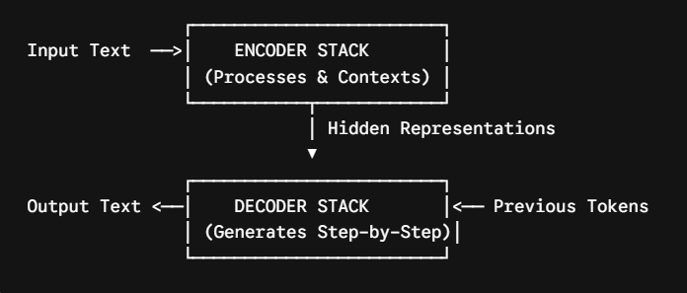 Transformer architecture explained
The Encoder Stack
The job of the Encoder is to read, digest, and understand the input sequence. It passes the text through self-attention layers and feed-forward neural networks to produce a rich numerical map (context vector) of the input.
- Key Strengths: Deep bi-directional comprehension (reading left-to-right and right-to-left simultaneously).
- Famous Encoder Models: BERT (Bidirectional Encoder Representations from Transformers), optimized for text classification, sentiment analysis, and search index understanding.
The Decoder Stack
The job of the Decoder is autoregressive generation—predicting the next token in a sequence, one step at a time, using the context provided by the encoder along with previously generated tokens.
To prevent the decoder from "cheating" by peeking at future words during training, it uses Masked Self-Attention, hiding subsequent tokens until they are officially generated.
- Key Strengths: Fluid, coherent text and content generation.
- Famous Decoder Models: The GPT series (Generative Pre-trained Transformer) and LLaMA models.
Encoder-Only vs. Decoder-Only vs. Encoder-Decoder
Over time, the AI community adapted the original architecture for specific tasks.
| Encoder-only | Decoder-only | Encoder-Decoder |
|---|---|---|
| Best for understanding and categorizing text (e.g., search ranking, spam detection). | Suitable for generative tasks, creative writing, and chat interactions (e.g., ChatGPT, Claude). | Suitable for sequence-to-sequence translation and abstractive summarization (e.g., T5, BART). |
Why Transformers Scale: Parallelization and Foundations of Generative AI
Before transformers, training massive neural networks on internet-scale data was computationally impossible. The true superpower of the transformer architecture lies in its ability to support parallel processing.
Transformers eliminate sequential dependency during training. Since the entire corpus of text is ingested simultaneously, thousands of GPU cores can calculate attention matrices in parallel. This scalability laid the foundations of generative AI, enabling models to train on trillions of tokens across massive supercomputing clusters.
Whether you are designing AI products, fine-tuning open-source LLMs, or executing an enterprise data strategy, mastering the basics of transformer architecture demystified in this guide equips you to make informed decisions in an AI-first world. As hardware accelerates and hybrid architectures emerge, the core principles of attention, embeddings, and context will remain at the heart of artificial intelligence for years to come.
Looking to kick start your career as an Gen AI engineer? Get in touch with us. As a leading edtech institute in India, Eduinx is here to guide you through your journey of landing the right job at a handsome salary package. Our post graduation program in generative AI will be a perfect choice for you. Understand concepts with our holistic and practical approach towards learning. Learn more about our courses here.
FAQs
What is a transformer in AI?
A transformer is a type of AI model that's really good at understanding text, code, and audio. Older models read a sentence one word at a time. A transformer looks at the whole sentence at once and works out how the words connect to each other. That's the idea behind tools like ChatGPT.
What is the difference between transformers and RNN and LSTM?
RNNs and LSTMs are the older style of AI model. There isn't much of a difference:
- RNNs and LSTMs process text one word at a time, making them too slow and prone to forgetting context from the beginning of a long piece of writing.
- Transformers read everything at the same time and verify how all the words relate to all the others.
Transformers are also trained significantly faster than the traditional models so they're able to learn from much more data.
Is BERT a transformer?
Yes. BERT is built from the "reading" half of the transformer. It looks at the context around the text to determine what the word it is looking for will mean. This makes it good at tasks like grouping the text into topics, determining if a review is positive or negative, and at answering search queries better. It wasn't designed to produce longer form content.
Is GPT an encoder or a decoder?
GPT is a decoder. It's what you get when you split a model in half: "reading" and "writing". It writes a small bit at a time, choosing what comes next by having a look at everything that came before. During training, it doesn't have access to what comes next when it learns to write, so it's been learning to predict, not copy, and so it writes so smoothly and is so good at chatting.
What are the T5 and BART, and how are they different from GPT?
T5 and BART have both sides of the transformer. One reads and interprets the input, the other part writes the answer. That's useful when you want to take a piece of text and turn it into something new; for example, translate it, or just generate a different version. GPT only uses the writing half and is mostly used for open-ended writing and chat.
How does ChatGPT use transformer architecture?
ChatGPT reads your message in small bits, and changes them into numbers. It remembers the order of the words and notes how they link together. It then writes back a reply one piece at a time and, for every new piece, this bit is based on your question combined with everything it has already written.
How do transformers help writing code for GitHub Copilot?
Code is just a strict set of rules for text, so a transformer can understand it in the same way that it understands a sentence. Github copilot uses this to write code, fix code, and translate code. It also figures out how code pieces connect to each other, even if they are hundreds of lines apart in the same file.
How do transformers work for machine translation?
Rather than translation by individual words, a transformer translates by considering the entire sentence at once. The traditional approach is to have one component reads the sentence and comprehends what it means, while the second one produces it using another language. This results in translation outputs that sound much more natural, than they used to.
Why do transformers need GPUs?
A transformer's math can be split into thousands of small jobs that run at the same time. GPUs are built to do exactly that. Without them, training a large model would take far too long to be practical.
How to explain a transformer to a complete beginner?
Picture the sentence, "The dog chased the ball because it was excited." How does a transformer help you decide what "it" refers to? It's a reader. It translates the words into numberings, looks at where the words are in the sentence, and uses its attention to decide which words to pick up on for context. So now, "it" in this example would refer to the dog.
What comes after the transformers?
Transformers are still the base of today's AI. Newer emerging mixed designs are starting to appear as the computer hardware gets faster. But the main ideas will probably stick around: paying attention to the right words, turning words into numbers, and understanding context. The new designs will most likely build on these ideas instead of replacing them.