In today’s fast-paced digital world, customer feedback is more than just a collection of opinions as it is a goldmine of insights. Every support ticket, chat message, and product review holds clues about what customers truly want. Yet, most organizations struggle to turn this raw feedback into actionable intelligence. That is where Voice of Customer automation comes in.
Powered by artificial intelligence, AI-powered VoC analysis helps businesses listen, learn, and act on customer feedback at scale. It transforms everyday interactions into strategic insights that drive product improvement, enhance customer experience, and strengthen brand loyalty. This blog explores how this transformation happens from understanding what VoC means to how AI product managers use it to shape better products.
What Is Voice of Customer (VoC)?
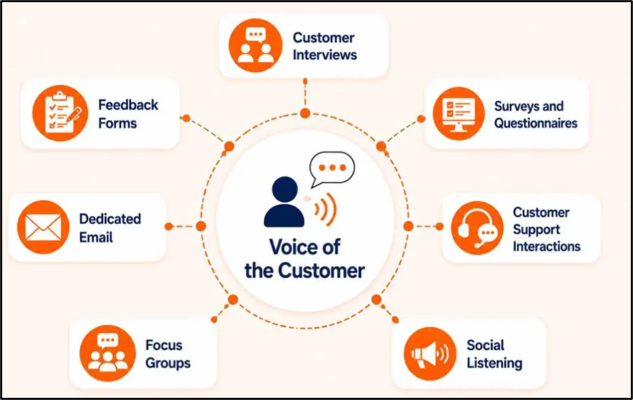
The Voice of Customer (VoC) refers to the process of capturing customers’ opinions, expectations, and experiences about a product or service. Traditionally, companies collected this data through surveys, focus groups, and feedback forms.
VoC includes digital touchpoints like support tickets, social media comments, chatbot conversations, and product reviews. These channels generate thousands of data points daily — far too many for manual analysis. That is where Voice of Customer automation steps in. Using AI, businesses can automatically collect, categorize, and interpret customer feedback in real time. Instead of reading every comment manually, AI systems identify patterns, detect sentiment, and highlight recurring issues. VoC automation helps companies listen to customers continuously and intelligently.
Why VoC Matters for Modern Enterprises?
Customer feedback is not just about satisfaction, it is about survival. In competitive markets, understanding what customers love or dislike can make or break a product. AI product managers use a strong VoC program to help businesses achieve the following.
- Improve products faster: Identify bugs, missing features, or usability issues early.
- Enhance customer experience: Spot pain points before they escalate.
- Boost loyalty: Show customers their feedback leads to real action.
- Drive innovation: Discover unmet needs and new opportunities.
With AI-powered VoC analysis, these benefits multiply. AI does not just summarize feedback as it predicts trends, uncovers hidden correlations, and recommends the next steps.
How to Build a VoC Program?
Creating a successful VoC program involves more than collecting feedback. It is about building a structured system that connects insights to action. AI PMs use a clear cut road map in the following ways.
Source
- Define Objectives: Decide what you want to learn, product usability, customer satisfaction, or feature adoption.
- Collect Data: Gather feedback from multiple sources like support tickets, surveys, social media, and chat logs.
- Centralize Information: Store all feedback in one place for easy access and analysis.
- Analyze with AI: Use customer experience analytics tools to detect sentiment, categorize topics, and identify emerging patterns.
- Act on Insights: Share findings with product, marketing, and support teams to drive improvements.
- Measure Impact: Track how changes affect customer satisfaction and retention.
A well-designed VoC program ensures that every piece of feedback contributes to continuous improvement.
How AI Product Managers Turn Support Tickets into Product Insights
Support tickets are often seen as a queue of problems waiting to be solved. AI PMs use AI for customer support, managers can automatically analyze thousands of tickets to identify recurring issues, feature requests, or usability challenges. Machine learning models categorize tickets by topic, urgency, and sentiment.
Support tickets are one of the richest, most under-used sources of product intelligence a company owns. Most of it never gets analyzed IDC research cited by Box estimates that roughly 90% of enterprise data, including the freeform text in service tickets, sits unstructured and largely unexamined. Did you know that the sentiment-analytics software segment alone grew at a 31.4% compound annual rate between 2025 and 2026? Here’s a quick brief on the flow of how PMs turn support tickets into product insights.
- Capture — Every ticket, chat log, and email thread is pulled into a single pipeline instead of living in scattered inboxes and spreadsheets.
- Classify — NLP models tag each ticket by topic, product area, and sentiment, replacing manual "bug" or "feature request" labels with consistent, scalable categorization.
- Cluster — Similar complaints scattered across hundreds of subject lines get grouped into one underlying issue, so a single friction point isn't miscounted as a hundred unrelated ones.
- Quantify — Each cluster is scored by volume, recurrence, and support cost, giving PMs a defensible way to rank problems instead of chasing the loudest customer.
- Route — The prioritized themes feed directly into sprint planning and roadmap reviews, closing the loop between support and product.
Sentiment Tracking Automation by PMs
AI PMs also use sentiment tracking automation to prioritize product updates based on real customer pain points. Sentiment tracking automation is used to continuously ingest, analyze, and translate unstructured customer feedback into objective roadmap priorities. Instead of relying on gut feelings, historical bias, or the loudest customer voices, PMs deploy automated pipelines to bridge the gap between user emotion and engineering execution. Here’s how they do it.
- Automated Data Ingestion Across Touchpoints: AI pipelines pull unstructured feedback streams from tools like Zendesk, Salesforce, Intercom, and social channels into a centralized repository. This eliminates blind spots by capturing what users say when they are actually experiencing friction in real-time.
- Sentiment Scoring and Emotion Classification: Machine learning models evaluate each piece of text not just for general polarity (positive, neutral, negative), but for specific emotional undertones like acute frustration, confusion, or delight. This allows systems to flag high-urgency pain points that standard keyword searches might miss.
- Semantic Clustering and Theme Extraction: Rather than reviewing thousands of individual tickets, AI algorithms group similar feedback into distinct thematic clusters—such as "checkout page latency" or "confusing onboarding navigation." Each cluster is automatically weighted by frequency, user tier, and overall sentiment intensity.
- Impact-Driven Backlog Prioritization: PMs integrate these sentiment clusters directly into product management tools like Jira or Productboard via API connectors. By combining sentiment volume with customer revenue data, AI ranks product updates objectively. A bug causing a minor annoyance for free users scores lower than a recurring friction point causing high-sentiment churn risk among key accounts.
- Closing the Feedback Loop: Once a prioritized product update is deployed, automated sentiment tracking measures the shift in user reaction, validating whether the fix successfully resolved the underlying pain point or if further iteration is required.
With the above methods AI PMs eliminate any form of guesswork and rely solely on product insights to draw conclusions.
Customer Experience Analytics: Seeing the Bigger Picture
While individual feedback is valuable, patterns across thousands of interactions reveal the bigger story. Customer experience analytics uses AI to aggregate and visualize these patterns.
Dashboards show trends like:
- Common issues by product version
- Sentiment changes after updates
- Correlation between support volume and customer churn
These insights help teams understand not just what customers say, but why they feel that way. After a new app update, analytics might show a spike in negative sentiment. AI PMs use AI tools to pinpoint the exact feature causing frustration, allowing teams to fix it quickly.
Predictive Feedback Systems: Anticipating Customer Needs
The next evolution of VoC is predictive feedback systems. Instead of reacting to complaints, AI predicts potential issues before they occur. By analyzing historical data, AI models can forecast which features might cause confusion or which customer segments are likely to face problems.
If users in a certain region consistently report connectivity issues, AI PMs use predictive systems to alert engineers to optimize performance there. This allows businesses to move from reactive support to proactive improvement.
Product Improvement with AI
AI does not just analyze feedback as it helps design better products. By combining VoC insights with usage data, PMs can make informed decisions about what to build next. Here’s how AI achieves it.
- AI identifies that users frequently mention “integration with other tools.”
- Product managers validate this trend with usage analytics.
- The next update includes new integrations, directly addressing customer demand.
This cycle of product improvement with AI ensures that every enhancement aligns with real customer needs and not assumptions.
Integrating VoC Automation Across Teams
VoC automation helps identify recurring feature requests, usability issues, or performance concerns by analyzing support tickets and reviews. This allows product managers to prioritize updates based on real customer pain points, accelerating product improvement with AI.
Marketing teams benefit by using customer experience analytics to understand what customers value most, enabling them to craft campaigns that resonate with authentic customer language and emotions. For example, if feedback highlights sustainability, marketing can emphasize eco-friendly messaging. Customer support and success teams leverage predictive feedback systems to detect churn risks early, allowing them to proactively engage with at-risk customers and improve retention. In the management front, leadership teams use aggregated VoC dashboards to gain a high-level view of satisfaction trends and market demands, aligning strategic decisions with customer expectations.
Future of VoC in AI
Voice of Customer automation is now becoming a cornerstone of enterprise strategy. Emerging technologies like generative AI and natural language understanding are making feedback analysis even more precise.
In the future VoC systems will help AI PMs and businesses to generate automated summaries of customer sentiment. It will recommend product improvements directly to PMs. It will integrate with predictive analytics to forecast satisfaction trends. From customer experience analytics to predictive feedback systems, AI for customer support, and sentiment tracking automation, the future of product development is deeply connected to how well companies listen to their customers.
Looking forward to kickstarting your career as an AI product manager? Eduinx is here for you. With industry thought leaders as mentors, we provide the right platform for you to learn all about VoC automation and how to harness it to turn support tickets into product insights. Our mentors have over a decade of experience in AI and product management and offer you a hands-on approach towards achieving your goals and landing the right job. We also provide placement assistance and assist you in building a portfolio through industry relevant capstone projects. Get in touch with us to know more about our AI product management course.
Frequently Asked Questions (FAQs)
What does the “Capture, Classify, Cluster, Quantify, Route” process mean in VoC automation?
This is the real practical process that AI PMs follow to convert raw tickets into actionable priorities:
- Capture — all tickets, chat logs, and email threads go into one pipeline instead of being spread out across inboxes.
- Classify — NLP models categorize each ticket by topic, product area, and sentiment.
- Cluster — if there are hundreds of reports with similar subjects, they're all combined into a single problem.
- Measure — each cluster receives a score based on volume, frequency, and support cost.
- Route — prioritized themes directly inform of sprint planning and roadmap review.
What does "semantic clustering" mean in terms of customer feedback?
Semantic clustering occurs when the AI systems categorize feedback into themed clusters based on their content, rather than viewing each ticket as an individual issue, like ‘checkout page latency' or ‘confusing onboarding navigation'. Every cluster is automatically weighted by the frequency, user tier, and overall sentiment intensity, providing the PMs with a more solid indication than when reading tickets individually.
What is impact-driven backlog prioritization in a VoC system?
Impact-driven backlog prioritization uses volume of sentiment as well as data on customer revenue to prioritize product updates in an objective manner instead of just based on who yells loudest about it. For instance, if you have a bug that is annoying to free users, that gets a lower rating, or a recurring friction point that increases the risk for churn for key accounts is given a higher rating.
What are the common tools that AI PMs use to centralize customer feedback?
Typically, the AI pipelines capture unstructured feedback and comments from tools such as Zendesk, Salesforce, or Intercom, along with social media, and integrate them into a central place. The sentiment clusters that are prioritized are then usually fed into product management systems through API integrations, which completes the product roadmap circle of raw feedback and action.
Why is it important to have a feedback loop after a product ships?
After a prioritized update, a mechanism is automatically triggered to check if the reactions of users have changed, to see if the actual pain point has been addressed or more iterations are necessary. If this step is not taken, then teams will not have any certainty whether a shipped fix was actually effective or whether it felt like it was supposed to be.
Why should PMs take into account revenue instead of volume for sentiment clusters?
Looking at the number of complaints alone can lead teams to focus on a large number of low value customers, and an inability to identify a smaller but more critical issue affecting a key customer. Sentiment volume paired with revenue data provides PMs a way to prioritize that which matters most—first to fix, first to get done—with a defensible and business-oriented perspective.
What does a customer experience analysis show as a relationship between the quantity of support interactions and churn?
Patterns, such as a correlation between increased support ticket volume and eventual customer churn, can be seen in a customer experience analytics dashboard that would be difficult to see manually with thousands of support interactions that are spread over time. When such a pattern is exhibited, teams can step in before churn can occur, instead of waiting to study after the event.
What are the differences between how marketing teams and product teams use insights from their VoC?
Product teams leverage VoC data to prioritize fixes or features, and marketing teams leverage the same customer experience insights to identify what is most important to customers and then create audience-specific campaigns in their voice. If the feedback continuously mentions sustainability, for example, marketing can cater to messaging that reflects the way customers are talking about the product.
What are leadership teams doing with aggregated VoC dashboards?
Leadership teams can keep a pulse on satisfaction trends and market demands from aggregated VoC dashboards without having to read individual tickets or reports. This ensures that strategic decisions at the executive level can be made based on real, current customer expectations and not on an assumption or anecdotal impression.
How will generative AI change VoC automation in the future?
Future improvements in the VoC are anticipated to benefit from new generative AI and natural language understanding features that will enable future systems to auto-generate customer sentiment summaries, suggest direct product improvements to PMs, and integrate with predictive analytics to better predict customer satisfaction trends. This shifts VoC out of the reporting phase and closer to an active strategic adviser.