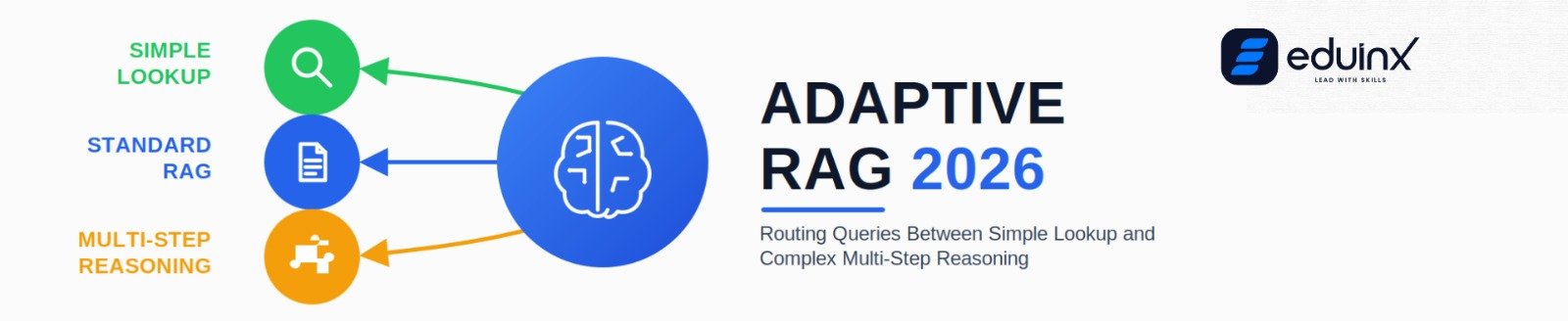
Most RAG systems work the same way when answering questions - retrieve documents, pass them to an LLM, and generate a response. While that process is fine for simple queries, it often fails when the queries need comparison, judgment, or multi-step reasoning.
This is where Adaptive RAG becomes useful.
With adaptive RAG, AI systems decide how much effort a query actually needs. A simple question may only need a quick lookup, but a complex query might need multi-hop retrieval, reasoning, and verification.
For professionals learning generative AI, LLMs, RAG, or AI product development in 2026, this is an important concept to understand. Adaptive RAG is not just about better search, but it is about building AI systems that know how to choose the right path before answering.
In this article, we break down how adaptive RAG decides which query requires a simple lookup or a multi-step processed answer.
What is Adaptive RAG?
Adaptive retrieval-augment generation (RAG) dynamically selects the right retrieval and reasoning strategy based on the user’s question. This is the fundamental difference between adaptive RAG and simple RAG.
In a basic RAG, the same pipeline is usually applied to every query. The system retrieves relevant chunks of information from a knowledge base, sends them to the LLM, and generates an answer.
Adaptive RAG adds one important step before retrieval: query understanding.
Before answering a query, the system asks questions like:
- 1. Is this a simple factual question?
- 2. Does it need one document or multiple sources?
- 3. Does it require comparison?
- 4. Does it need step-by-step reasoning?
- 5. Can the system answer directly, or should it retrieve more information?
Based on this, a question like “What is RAG?” can be answered with a simple explanation. However, a question like “Should a product manager learn RAG, fine-tuning, or prompt engineering first?” needs comparison, context, and recommendation.
Both queries are about AI, but their handling is completely different. That is the core idea behind adaptive RAG.
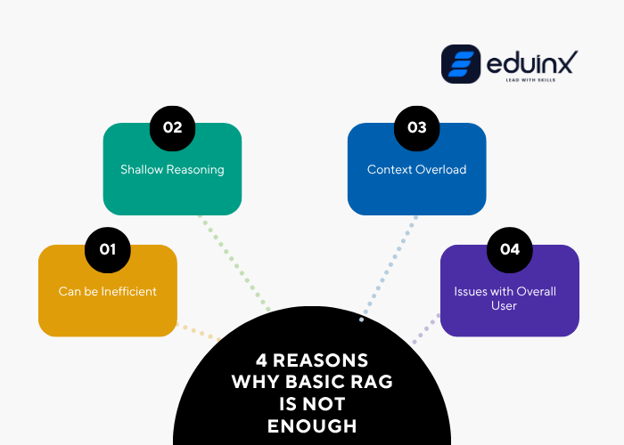
Why Basic RAG is Not Enough Anymore
Basic RAG is one of the best starting points for building AI applications that need access to external knowledge. This makes it still useful in 2026.
But as the use cases for RAG become more advanced, its limitations become clearer.
The first problem with basic RAG is that it can be inefficient. If the same query goes through the same heavy retrieval process, even answers to simple questions can become slower and more expensive.
The second problem is shallow reasoning. Some questions cannot be answered from one document or one retrieved chunk. They need information from multiple sources. They may also need comparison, summarisation, and logical reasoning. Doing all of this, while giving accurate and reliable answers, is simply not possible for basic RAG.
Context overload is the third problem with basic RAG. When too many irrelevant chunks are retrieved, the LLM may get confused or produce a weaker answer.
The fourth problem is user experience. A professional using an AI assistant does not want a generic answer. They want the system to understand whether they are asking for a definition, a recommendation, a comparison, or a decision.
This is why adaptive RAG matters. It helps the AI system become more selective, more efficient, and more useful.
The Simple Idea Behind Adaptive RAG
The easiest way to understand adaptive RAG is this:
Not every question deserves the same level of effort.
Think of how a human expert answers questions.
If someone asks, “What is the course duration?” you simply check the course page and answer.
But if someone asks, “I am a software engineer with two years of experience. Should I learn Data Science, Generative AI, or RAG to move into an AI engineering role?” you would not answer from one line of information. You would ask about their background, goals, current skills, and the difference between these learning paths.
Adaptive RAG tries to bring this kind of judgment into AI systems.
It helps the system decide whether a query needs:
- 1. A direct lookup
- 2. A standard RAG response
- 3. A comparison
- 4. A recommendation
- 5. Multi-hop retrieval
- 6. Step-by-step reasoning
- 7. A clarification before answering
This makes the AI experience feel more natural and reliable.
The Three Main Routes in Adaptive RAG
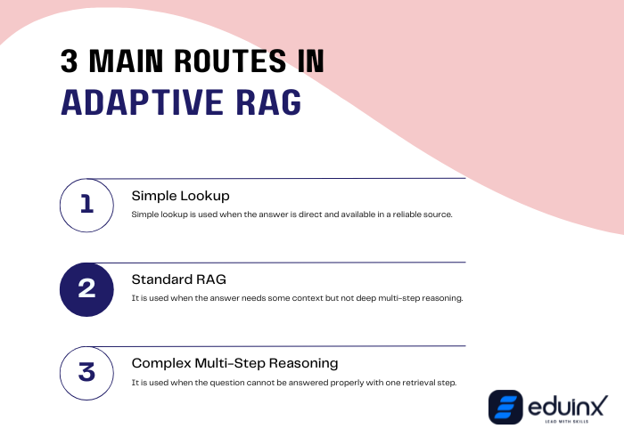
Most adaptive RAG systems route queries into three broad paths:
- 1. Simple lookup,
- 2. Standard RAG, and
- 3. Complex Multi-Step Reasoning
Let’s understand them in more detail:
1. Simple Lookup
Simple lookup is used when the answer is direct and available in a reliable source.
Examples include:
- “What is the deadline?”
- “What are the prerequisites?”
- “What is the course duration?”
- “What topics are covered in this module?”
These questions do not need deep reasoning. The system only needs to find the correct information and present it clearly.
Simple lookup is useful because it is fast, low-cost, and easy to validate. It works well for FAQs, policies, schedules, course details, support answers, and internal documentation.
For businesses, this route is important because many user queries are simple. Sending every small query to a complex reasoning pipeline is unnecessary.
2. Standard RAG
Standard RAG is useful when the answer needs some context but not deep multi-step reasoning.
Examples include:
- “How does a Generative AI course help working professionals?”
- “What skills will I gain from an LLM program?”
- “How can product managers use AI in their work?”
- “What are the career benefits of learning Data Science?”
Here, the system may retrieve multiple relevant sections from a knowledge base and generate a structured answer.
This route is helpful when the question needs explanation, but the answer does not require complex decision-making.
Standard RAG is commonly used in educational platforms, customer support systems, sales enablement tools, HR assistants, and internal knowledge bots.
3. Complex Multi-Step Reasoning
Complex multi-step reasoning is used when the question cannot be answered properly with one retrieval step.
Examples include:
- “Compare RAG, fine-tuning, and prompt engineering for building an enterprise chatbot.”
- “Which AI learning path is best for a product manager with no coding background?”
- “How can an edtech company use RAG, AI agents, and learner analytics to improve completion rates?”
These questions need more thinking.
The system may need to break the query into smaller parts, retrieve information from different sources, compare options, check trade-offs, and then generate a final answer.
This is where multi-hop retrieval RAG becomes valuable.
Multi-hop retrieval means the system retrieves one piece of information, uses that to guide the next retrieval step, and continues until it has enough evidence to answer properly.
This is closer to how humans research complex topics.
What is the Routing Layer in Adaptive RAG?
The routing layer is the part of an Adaptive RAG system that decides how a user’s question should be handled.
You can think of it like a traffic controller. When a question comes in, the routing layer checks what kind of question it is and sends it to the right path.
A simple question may go to a quick lookup. A slightly detailed question may go to standard RAG. A complex question may go to multi-step reasoning.
For example, if a user asks, “What is the duration of the course?”, the system does not need deep reasoning. It only needs to find the answer from the course page.
But if the user asks, “I am a product manager with no coding background. Should I learn Generative AI or AI in Product Management first?”, the system needs to understand the user’s goal, compare options, and give a thoughtful recommendation.
That is the job of the routing layer.
It helps the AI system avoid two common problems: overthinking simple questions and underthinking complex ones.
A good routing layer makes the system faster, more cost-efficient, and more useful for real users.
What Is the Decision Engine?
The decision engine is the logic behind the routing layer.
It decides which retrieval path should be used for a particular query. In a simple system, the decision engine may be rule-based.
For example, if the query asks “what,” “when,” or “where,” it may be routed to simple lookup. If the query asks “how” or “why,” it may go to standard RAG. If the query includes words like “compare,” “recommend,” “best,” or “which should I choose,” it may be routed to multi-step reasoning.
In more advanced systems, the decision engine may use a classifier or a smaller language model to identify query complexity. The system may classify a question as low, medium, or high complexity and then choose the right path.
This matters because not every query should be sent to the largest or most expensive model. A smaller model can handle routing, while a stronger LLM can be used only when deeper reasoning is required.
This improves speed, reduces cost, and makes the AI system easier to scale.
Adaptive RAG Architecture: A Practical View
A practical adaptive RAG architecture usually has a few important layers.
It starts with the user interface, where the question is asked. This could be a chatbot, learning platform, product dashboard, search assistant, or internal company tool.
Next comes the query understanding layer, which analyses the user’s intent, topic, complexity, and required answer type.
Then comes the routing layer, which decides whether the query should go to simple lookup, standard RAG, or multi-step reasoning.
After that, the retrieval system searches the relevant knowledge base. This may include vector search, keyword search, hybrid search, or graph-based retrieval.
A reranking layer may then improve the quality of retrieved results by pushing the most relevant information to the top.
For complex queries, the reasoning layer breaks the question into smaller parts and performs multi-hop retrieval.
Finally, the generation layer creates the answer, while evaluation and guardrails check whether the answer is useful, grounded, and safe.
A strong Adaptive RAG system does not simply generate a confident answer. It checks whether the answer is actually supported by available information.
Conclusion
Adaptive RAG is becoming an important architecture pattern for modern AI systems.
It solves a simple but powerful problem: not every query should be treated the same way.
Some questions need quick lookup. Some need standard RAG. Some need multi-step reasoning across multiple sources.
By adding a routing layer and decision engine, Adaptive RAG helps AI systems choose the right retrieval strategy before generating an answer.
For Indian professionals learning Generative AI, LLMs, RAG, Data Science, or AI product development, this is a concept worth understanding. It connects technical architecture with real business use cases.
As AI systems become more advanced in 2026, the ability to design intelligent, adaptive, and reliable workflows will become a strong career advantage.
Frequently Asked Questions (FAQs)
What is Adaptive RAG?
Adaptive RAG is a retrieval-augmented generation architecture that selects a different processing strategy based on the intent and complexity of a user’s query. A simple factual question may use direct lookup, while a contextual question may use standard RAG and a complex question may trigger query decomposition, multi-step retrieval or deeper reasoning.
In the Adaptive RAG, what is the query understanding layer?
Before any retrieval is made in an Adaptive RAG system, this is where the query understanding layer kicks in to analyse the user's intent, topic and complexity. It can identify whether a question is a factual, comparative or reasoning question and if it requires one or multiple sources. This analysis is fed into the routing layer and routing is sent down the right path.
What is the routing layer in Adaptive RAG?
The routing layer determines how each query should be processed. It may send a simple question to a direct lookup system, a contextual question to a standard RAG pipeline or a complex question to a multi-step reasoning workflow. Effective routing improves response speed and controls cost by avoiding the use of an expensive reasoning pipeline for every request.
Which of the following is the reasoning layer in Adaptive RAG?
The reasoning layer gets fired for more complex queries for which no single retrieval step can answer. It decomposes a question into smaller fragments, fetches information for each of these fragments, and conducts multi-hop retrieval by leveraging previously retrieved information to search for additional information. It is this layer that enables Adaptive RAG to process comparison questions, trade-off questions, or recommendation questions, not just factual lookups.
What is the generation layer for Adaptive RAG, and why is it necessary that it be evaluated?
While the generation layer is where the final answer is formed by retrieved and reasoned information, a robust Adaptive RAG solution doesn't end there. Evaluation and guardrail checks ensure that the answer generated is grounded in the retrieved evidence found, it is useful to the user, and it is safe, not an opinionated answer based on a confident-sounding response.
What is the difference between Adaptive RAG and Agentic RAG?
Adaptive RAG is about assigning a query to the appropriate effort level: lookup, standard RAG or multi-step reasoning. Agentic RAG takes it a step further by placing autonomous agents in the pipeline to automatically determine when to replay the retrieval step, when to call upon additional tools, or when they are too uncertain to move forward. Agentic RAG may be one of the methods an Adaptive RAG system sends complex queries to.
What are the common challenges when implementing Adaptive RAG in a real system?
Examples include designing a decision engine that is accurate enough to appropriately classify the complexity of a query, steering clear of routing errors that either over-complicate or over-simplify queries, and appropriately combining multiple retrieval methods (vector, keyword, graph) without increasing unnecessary latency. Teams must also construct evaluation and guardrail checks that will not compromise the reliability of the answers if they can route faster.
When to use standard RAG instead of simple lookup?
Standard RAG is used when there is a question that requires some backstory or explanation, but not multi-step reasoning - for example, why a course is beneficial to working professionals or what skills are taught in a program. It pulls information from a knowledge base, gathers several relevant sections and structures its response, which is frequently seen in educational websites, customer support systems, and in-house knowledge bots.
What is the cost savings of Adaptive RAG over basic RAG?
Instead of routing all queries to the biggest, or most expensive model, adaptive RAG uses a smaller model or rule-based logic for routing decisions. There is a constant speed difference between the speed of simple questions and the speed of the more powerful model, so that when a simple question arises, it is answered quickly, and the more powerful model is only used when truly needed. This selective approach helps to enhance the speed and to make the entire system scalable.
What are the main layers of an Adaptive RAG architecture?
A practical Adaptive RAG framework integrates a user interface, a query understanding layer to understand query intent and complexity, a routing layer to select processing path, a retrieval system (vector, keyword, hybrid, graph-based search), a reranking layer to surface the most relevant results, a reasoning layer to process complex queries, and a generation layer with evaluation and guardrails to check the accuracy of the answer generated.
What's the difference between quick answer and deep reasoning in Adaptive RAG?
The system takes those signals into account from the question itself, such as the question beginning with 'what', 'when', 'where' compared to 'compare', 'recommend', 'which should I choose'. Basic systems rely on a set of keywords to determine the complexity of the query, while the more sophisticated ones employ a lightweight language model or a classifier to assign a low, medium, or high score to the query and route it based on this score.
What kind of industries or platforms will be most impacted by the Adaptive RAG?
Where a combination of straightforward factual questions and more complex comparative questions come in from users, Adaptive RAG will come in handy, including for educational platforms, customer support systems, sales enablement tools, HR assistants, and internal knowledge bots. It's beneficial in any situation where you don't want to pass all the queries through the same expensive pipeline, or when you want to have a nuanced and judgment-based response for the user.
What skills are important for the professionals in 2026 for working with the Adaptive RAG?
Experts should be familiar with query routing, multi-hop retrieval, decision engine design, and an understanding of how retrieval, reranking and reasoning layers fit into the actual architecture. It applies to software engineers, data scientists, and product managers, as developing intelligent and adaptive AI workflows is increasingly a valuable cross-functional skill and as AI systems grow more intelligent, they grow more valuable.