
Most product teams agree that talking to customers every week is the right habit. Almost none of them actually do it. Recruiting takes days, scheduling takes longer, and synthesizing a stack of transcripts eats the one afternoon a PM had set aside for strategy. That gap between the ideal and the reality is exactly what continuous product discovery was designed to close, and it is exactly where AI user research tools are now making a measurable difference.
This is not about replacing researchers or product trios. It is about removing the labor tax that made a weekly research habit impossible to sustain. Below is a practical look at what continuous discovery means in 2026, how product discovery automation actually works, and how to implement continuous discovery with AI without losing the judgment that makes discovery useful in the first place.
What Continuous Product Discovery Actually Means
Continuous discovery is a habit, not a project. Product researcher and author Teresa Torres, who coined the term in her book Continuous Discovery Habits, defines it as at least weekly touchpoints with customers by the team building the product. The goal is a steady drip of evidence that shapes decisions in real time, instead of a quarterly research report that arrives after the roadmap has already moved on.
The framework rests on three pieces working together: a weekly interview cadence, an opportunity solution tree that maps a desired outcome to customer needs and possible solutions, and ongoing hypothesis testing before anything ships. None of that is new. What changed is the tooling underneath it.
Why Manual User Research Breaks Down at Scale
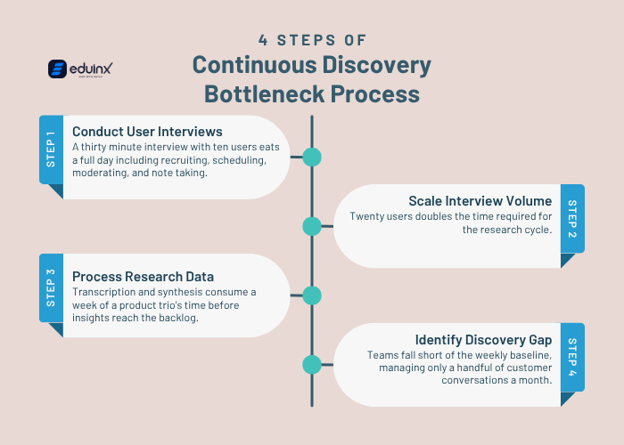
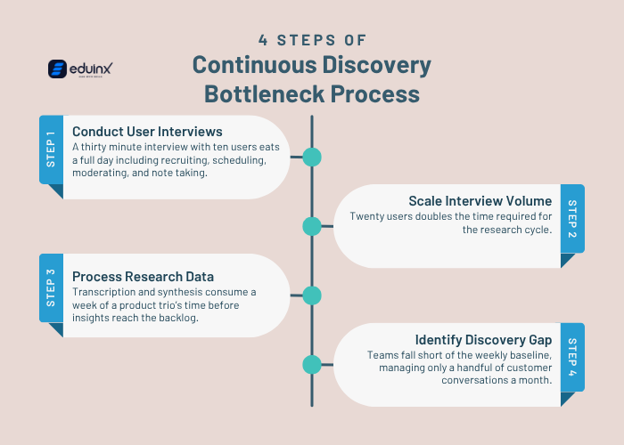
The honest reason most teams fail at continuous discovery is not resistance to the idea. It is math. A thirty minute interview with ten users eats a full day once you add recruiting, scheduling, moderating, and note taking. Twenty users doubles it. Add transcription and synthesis, and a single research cycle can consume a week of a product trio's time before a single insight reaches the backlog.
That bottleneck shows up in the data too. Most teams that describe themselves as running continuous discovery still fall well short of the weekly baseline the methodology calls for, often managing only a handful of customer conversations a month. The gap is not a commitment problem. It is a tooling problem.
How AI User Research Tools Change the Cadence
AI moderated interviewing removes the ceiling that recruiting and scheduling used to impose. Instead of a researcher personally conducting three to five conversations a week, an AI interviewer can run dozens in parallel, transcribe them automatically, and surface first pass themes before the trio even sits down to review.
The scale of that shift is significant. 2026 continuous discovery benchmarks show teams using conversational AI for discovery averaging 47 customer conversations per product manager per quarter, roughly twelve times the median across other research approaches, without adding a single researcher to headcount. That is the difference between a habit that survives a launch crunch and one that quietly dies the first time the calendar gets busy.
This same shift shows up in how product teams generally work with AI day to day. Adoption data on product management tools found that 73% of product managers now use AI tools weekly or daily, with customer feedback analysis as the second most common use case at 54%. Teams that used to spend an afternoon tagging themes in a spreadsheet now get a first pass synthesis in about twenty minutes.
Eduinx has covered how this same coordination challenge plays out across the wider product stack, including how teams are coordinating multiple AI agents across a product workflow without losing sight of who owns which decision.
🎯 Pro Tip: Treat AI conversation volume as a curiosity multiplier, not a headcount replacement. Use the extra capacity to run the same discussion guide against different segments in the same week, for example comparing enterprise and SMB users on one opportunity, instead of simply running more interviews with the same group.
Product Discovery Automation: What AI Actually Handles (and What It Doesn't)
It helps to be precise about where the automation boundary sits. AI is genuinely good at the volume work: recruiting participants from a panel, moderating a structured conversation, transcribing it accurately, and producing a first draft summary of themes, quotes, and outliers.
What it is not good at, at least not on its own, is deciding which questions matter, catching the contradiction between what a user says and what they actually do, or making the judgment call about which opportunity deserves a spot on the tree this week.
Teresa Torres has been direct about the risk of skipping that human step. Her own workflow is to synthesize an interview herself first, then compare her notes against an AI generated summary of the same conversation, specifically because the two catches are rarely the same. As she put it, teams that hand the entire analysis step to AI end up with something short of real discovery.
"If your team is running customer interviews but outsourcing the analysis entirely to AI, you're not doing discovery. You're generating summaries."
— Teresa Torres, author of Continuous Discovery Habits source
That distinction matters for anyone building a discovery practice around generative AI for user interviews. The AI should compress the six hours of manual work behind a single interview down to about thirty minutes of trio review time, not eliminate the review itself.
How to Implement Continuous Discovery with AI
A practical rollout does not require rebuilding your entire research stack in one sprint. It works better as a phased habit.
- Start with one outcome and one weekly slot. Pick a single measurable outcome the team is trying to move, and block a recurring weekly slot for the trio to review new conversations together. The slot matters more than the tooling at this stage.
- Let AI handle recruiting, moderation, and first pass synthesis. This is where most of the manual overhead used to live, and it is the part AI user research tools are genuinely reliable at today.
- Keep humans on interpretation and prioritization. The trio reads the AI generated summary, listens to a handful of raw clips for anything that feels off, and decides what moves on the opportunity solution tree.
- Feed findings straight into your existing product workflow. Whether that is a roadmap tool, a backlog, or a set of PM tools with decision-making agents already built in, the discovery output should land somewhere the team already works, not in a separate research archive nobody opens again.
- Review the habit itself every quarter. Check whether the weekly cadence actually held, and whether the opportunity solution tree reflects what customers said or what the team assumed they said.
🔍 Pro Tip: Run a synthesis comparison for the first month. Have one person on the trio synthesize a handful of interviews manually alongside the AI output. It builds trust in the tool faster than any vendor demo, and it will show you exactly where the AI tends to miss context.
Opportunity Solution Trees, Customer Journey Mapping, and Where AI Fits
The opportunity solution tree stays the backbone of continuous discovery, but AI changes how fast it gets built and pruned. Instead of a researcher spending days mapping interview quotes to opportunities, AI synthesis tools can cluster raw conversation data into candidate opportunities within minutes, which the trio then validates and slots into the tree.
Customer journey mapping benefits the same way. Feeding a batch of interview transcripts and support tickets into an analysis tool can surface friction points across a journey that would otherwise require weeks of manual tagging to notice. The output is not a finished journey map, but a strong first draft that a human researcher can refine and stress test against the actual product data.
Hypothesis Testing and Experimentation Frameworks in an AI-Assisted Loop
Every branch on the opportunity solution tree eventually needs a test. AI speeds up the front end of that process too: drafting the assumption test, generating variant copy for an experiment, and flagging which risks in a hypothesis are the ones worth testing first based on patterns across past experiments.
What AI cannot do is decide what counts as a meaningful result for your product, or override a genuinely surprising finding just because it does not match the pattern the model expected. Experimentation frameworks still need a human owner who understands the business context well enough to call a test early or let it run longer.
✅ Pro Tip: Log every AI assisted decision the same way you log a human one. Whether it is a synthesized theme, a drafted hypothesis, or an experiment recommendation, keep a record of what the AI suggested and what the trio decided. It builds an audit trail that makes the next quarter's retro far more useful.
Getting Started Without Losing the Human Judgment
Continuous discovery with AI works best as an upgrade to a habit that already has a clear owner, not a replacement for the habit itself. The teams getting real value in 2026 are not the ones that automated research away. They are the ones that used AI to clear the recruiting, scheduling, and transcription bottleneck so the product trio could spend its time on the part only humans can do well: asking the next good question and deciding what to do with the answer.
If you are building toward a product or data science career, understanding this shift matters beyond any single tool. It reflects a broader pattern across the product world, where routine execution is increasingly automated and human judgment concentrates on strategy, prioritization, and governance, a shift Eduinx has also traced in how agentic AI is reshaping product workflows.
Frequently Asked Questions
1. What is the difference between continuous discovery and traditional user research?
Traditional research is project based, running for a few weeks and ending with a report. Continuous discovery is a weekly habit where the same product trio talks to customers year round and updates a living opportunity solution tree instead of producing a one time deliverable.
2. Can AI completely replace human researchers in product discovery?
No. AI handles recruiting, moderation, transcription, and first pass synthesis well, but interpreting nuance, catching contradictions, and deciding what matters still needs human judgment from the product trio.
3. How many customer interviews should a product team run each week?
Teresa Torres recommends at least one interview per week per trio as the minimum baseline, though teams using AI interviewers now average closer to a dozen or more conversations in that time without added researcher headcount.
4. What is the opportunity solution tree in continuous discovery?
An opportunity solution tree is a way of visualizing a desired outcome and tracing it back to the underlying customer needs and possible solutions that might meet those needs. It is one of the three essential elements of continuous discovery, along with a weekly interview cadence and continuous hypothesis testing, and is not a deliverable but a living document that is continually refreshed as more customer evidence is gathered.
5. What tools are used for AI powered continuous discovery?
Common categories include AI moderated interview platforms, synthesis and tagging tools that cluster themes across conversations, and PM tools with decision-making agents built in that feed discovery findings directly into the roadmap.
6. What if a team completely relies on AI for its research analysis?
Product teams should not allow AI to handle the entire research-analysis process without human review. AI can generate summaries and identify patterns, but summaries are not the same as discovery. Teresa Torres recommends conducting a human analysis first and then comparing it with the AI-generated analysis to identify gaps, missed context and different interpretations.
7. How do I start implementing continuous discovery with AI on a small team?
Start with one measurable outcome, block a recurring weekly review slot, let AI handle the recruiting and first pass synthesis, and keep a human on interpretation and prioritization from day one.
8. What percentage of product managers currently use AI tools in their daily work?
Of the product management tools adopted, 73% are now using AI tools weekly or daily, followed by customer feedback analysis at 54%. This is a sign of the impact of AI beyond discovery alone in the workflow of product.
9. By how much has AI boosted the customer conversations that product teams can execute?
Teams employing conversational AI for discovery are performing an average of 47 customer conversations per quarter per product manager, which is about 12 times the median for other discovery methods, and doesn't require hiring one additional researcher per team. The trick for a weekly research habit is this scale.
10. What is the best way to use AI in continuous discovery?
The best approach is to use AI as a discovery assistant rather than an autonomous decision-maker. AI should handle high-volume activities such as transcription, tagging, summarisation and pattern detection, while the product team remains responsible for research questions, interpretation, prioritisation, experimentation decisions and updates to the opportunity solution tree.