Understanding what customers truly want has always been the go to for product development. Yet, many companies still struggle to uncover the deeper motivations behind customer behavior. Jobs-to-Be-Done (JTBD) framework is a powerful lens that shifts the focus from demographics and product features to the job a customer is trying to accomplish. And now, with the rise of AI, this research process can be faster, sharper, and more insightful than ever before.
If you find yourself feeling overwhelmed or uncertain about where to begin, you are not alone. Numerous businesses tend to approach AI in a reactive manner, acquiring tools without a defined purpose, which often results in wasted resources and disappointing outcomes. This article presents an alternative method — a systematic framework designed to assist you in creating a practical and effective AI integration strategy that is based on a clear understanding of your business's actual needs.
A Quick Brief on Jobs-to-be-Done
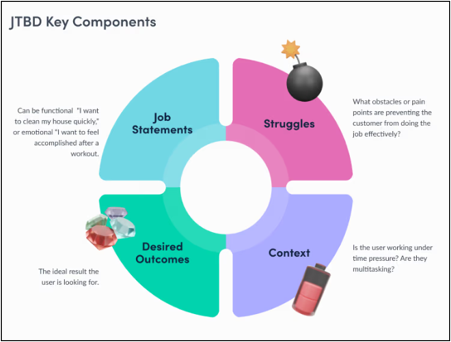
JTBD is about understanding the progress customers seek in their lives. Instead of asking who the customer is? JTBD asks, “What job are they hiring our product to do?” JTBD reframes products as tools customers “hire” to achieve outcomes. This perspective helps businesses move beyond surface-level features and into the realm of true customer value. Here is a quick peek into JTBD.
- A parent doesn’t buy a stroller just for wheels and fabric—they hire it to make outings with their baby easier and safer.
- A student doesn’t download a note-taking app just for digital paper—they hire it to organize thoughts and reduce stress before exams.
How AI Transforms JTBD Research
Think of AI as a research assistant that never sleeps, tirelessly scanning for signals of what customers truly want. JTBD research involves interviews, surveys, and hours of qualitative analysis. While effective, it’s often slow and resource-heavy. AI plays a crucial role in this as it helps in the following.
- Analyzing massive datasets quickly: AI can process customer reviews, social media posts, and support tickets to detect recurring themes.
- Spotting hidden patterns: Natural Language Processing (NLP) models can identify emotional drivers and unmet needs buried in customer language.
- Generating hypotheses: AI can suggest potential “jobs” customers are trying to accomplish, which researchers can then validate.
- Scaling insights: Instead of interviewing 20 customers, AI can analyze feedback from thousands in minutes.
Steps to Use AI for JTBD Research
As AI thrives on data, you can use this to your advantage by collecting raw customer data in the following areas.
- Customer reviews (Amazon, app stores, Yelp)
- Social media mentions (Twitter, LinkedIn, Reddit)
- Support tickets and chat logs
- Survey responses
With this information, AI can clean, scrape, and organize data automatically. Next, you can use Natural Language Processing (NLP) to reveal the “jobs” hidden in customer language. AI models can cluster similar statements that highlight recurring jobs customers are hiring products for.
JTBD is not confined to functional needs, it expands to both emotional and social needs, making it an ideal choice for categorizing customer needs which will help you categorize needs to design solutions that resonate on multiple levels.
Use AI to highlight gaps and unmet needs where current solutions do not work. Identify unmet needs in the following ways and use AI to implement opportunities for innovation.
- Frequent complaints about speed → unmet need for efficiency.
- Emotional frustration in reviews → unmet need for reliability.
- Social mentions of embarrassment → unmet need for status or identity.
You can also use AI-powered visualization tools to create the following.
- Job maps: showing steps customers take to complete a job.
- Heatmaps: highlighting pain points in customer journeys.
- Personas: generated from clustered data, representing different job archetypes.
Creative ways how AI Enhances JTBD
Imagine presenting not just charts, but AI-generated stories of customers struggling with unmet needs—powerful fuel for innovation. AI doesn’t just crunch numbers—it can spark creativity in research through the following ways.
- Conversational AI: Simulate customer interviews with AI chatbots to explore jobs in a safe, scalable way.
- Generative AI: Create “future scenarios” of how unmet needs might evolve, inspiring bold product ideas.
- Voice-of-Customer storytelling: AI can weave customer quotes into narratives that bring jobs to life for stakeholders.
Benefits of Using AI for JTBD to Find Unmet Customer Needs Faster
Incorporating AI into the Jobs-to-be-Done (JTBD) framework revolutionizes the identification of unmet customer needs by transitioning from slow, manual qualitative research to swift, data-driven exploration. By utilizing AI to analyze extensive amounts of feedback, you can more effectively reveal "struggle points" and underlying motivations compared to conventional approaches.
- Unmatched Speed: Traditional JTBD research processes—from gathering data to deriving actionable insights—often take months. In contrast, AI-driven platforms can analyze thousands of touchpoints (including support tickets, surveys, and social media feedback) to produce job insights within hours or days, offering a vital edge in rapidly evolving markets.
- Detailed "Job Step" Extraction: Cutting-edge AI methods, such as Named Entity Recognition (NER), can automatically dissect unstructured text to pinpoint specific job steps, customer requirements, and friction points. Achieving this level of granularity manually would demand considerable time and expertise, whereas AI accomplishes it consistently across extensive datasets.
- Revealing Hidden Patterns: AI's capability to process large volumes of data simultaneously allows it to discover previously unnoticed patterns in customer behavior. It can pinpoint emerging job categories and subtle "struggle points" that human analysts may miss during conventional focus groups or interviews.
- Enhanced Accuracy in Struggle Detection: Research indicates that AI-based approaches can attain over 90% accuracy in identifying customer struggle points and effort demands, greatly exceeding the effectiveness of manual analysis while also cutting processing time by 50% or more.
- Dynamic, Real-Time Insights: As fresh customer data enters your CRM or support systems, automated solutions can instantly incorporate these insights. This results in a "living" JTBD model that adapts in real-time, enabling your team to address evolving customer needs as they arise, rather than waiting for quarterly research reports.
A Glimpse into the Future of JTBD Research with AI
Jobs-to-Be-Done is a timeless framework, but AI gives it new wings. By combining human curiosity with machine intelligence, companies can uncover unmet needs faster, design products that truly matter, and stay ahead in competitive markets. You can also use generative AI and JTBD research to build a smarter user experience.
As AI evolves, JTBD research will become more dynamic in the following ways.
- Real-time monitoring of customer jobs through live data streams.
- Predictive insights into emerging unmet needs before they surface.
- Personalized product development, where AI tailors solutions to micro-jobs of individual users.
Whether you are a budding professional looking for a breakthrough in your career or an aspiring entrepreneur looking to expand your organization, Eduinx provides the right guidance for you. As a leading edtech institute in India with non academic mentors who have over a decade of experience in AI, Eduinx is here to make your AI learning journey flawless. We guide you through a practical approach that helps you understand complex concepts through simple teaching methods. We offer both online and offline classroom learning experience. Get in touch with us for more information.
Frequently Asked Questions
What is the Jobs-to-Be-Done (JTBD) framework?
The Jobs-to-Be-Done framework, also called JTBD, helps businesses understand what progress a customer is trying to make. Instead of focusing only on customer demographics or product features, JTBD focuses on the real problem the customer wants to solve.
For example, a parent does not buy a stroller only because it has wheels. They buy it because it helps them carry their child safely, comfortably, and easily while going out.
How does AI help in Jobs-to-Be-Done research?
AI helps in Jobs-to-Be-Done research by analyzing large volumes of customer data quickly. It can study reviews, support tickets, social media comments, surveys, and chat conversations to identify common pain points, emotional triggers, buying reasons, and unmet customer needs.
Where does the customer data for AI-driven JTBD research come from?
Examples of common data sources include customer reviews on platforms such as Amazon, app stores, and Yelp, social media mentions on Twitter, LinkedIn, and Reddit, support tickets, chat logs, and survey responses. This raw data can be automatically cleaned, scraped and organized with the help of AI before data analysis.
What are some of the AI tools for visualization to help with JTBD research?
AI can create job maps to understand how customers go about performing a job, heatmaps to identify pain points throughout the customer journey, and personas created from clustered data that are representative of different job archetypes. The visuals help to communicate research findings to stakeholders.
In what ways can Conversational AI be applied in JTBD research?
Conversational AI can also replicate customer interviews by using the Chatbot feature to provide a scalable and stress-free environment for customers to explore their jobs. This can provide some qualitative information without having to conduct each interview individually and manually, thus speeding up the early discovery process.
How generative AI helps in JTBD research.
In this regard, generative AI can be leveraged to “create future scenarios,” or, in other words, imagine how the unmet needs of the customers would develop in the future, thus helping brainstorm ideas for products and innovations. Also, the use of generative AI in JTBD research can help make the results more compelling to the stakeholders by bringing the actual quotes from the customers into the narrative.
Why should one choose AI for JTBD research?
Considering that the conventional JTBD research can take months before a single useful insight is extracted, and even more time before any action is taken on its basis, it becomes apparent that AI-based approach, which is capable of analyzing thousands of customer touchpoints, be it tickets, surveys, or social media posts, in a matter of hours or days, will fundamentally change the way such research is conducted. In addition, the ability of AI to process such data in a much shorter time than people can provide teams with tangible competitive advantages.
How accurate is AI in identifying customer struggle points?
The way in which AI processes data allows it to identify customer struggle points and effort requirements with an accuracy of over 90%, cutting the time spent on such research by between 50% and more than half. Therefore, AI-driven JTBD research can be significantly faster and more accurate than any qualitative research.
What is a “living” JTBD model?
As the name suggests, a “living” JTBD model refers to the continuous update of JTBD based on the data provided by the customers in real time, as opposed to static, quarterly updates based on dedicated research. Thus, a “living” JTBD model allows a company to respond to the changing needs of its customers in a timely manner.
Can AI help predict the customers’ future or emerging needs?
Talking about “predicting customers’ future or emerging needs,” in my opinion, with the development of the industry, AI will become capable of doing it. With the ability to analyze thousands of mentions or documents in real-time, AI can detect patterns emerging within the needs of the customers before they appear for the first time, thus allowing companies to address them right when the moment arrives.
How can product managers use AI for JTBD research?
Product managers can use AI for JTBD research to analyze customer feedback, identify high-priority problems, create job statements, map customer journeys, discover feature gaps, and prioritize product opportunities.