Introduction
With a wide range of opportunities rising in the field of LLM optimization and generative AI, you can be the next industry thought leader by learning all about it. Kick start your career as a leading gen AI industry expert by understanding RAG evaluation. Here is a quick overview of RAG pipeline evaluation.
A RAG pipeline (Retrieval-Augmented Generation) is an AI workflow that links a Large Language Model (LLM) with external knowledge sources, allowing it to produce accurate, context-sensitive answers based on real data instead of solely relying on its training memory. It serves as the foundation for contemporary enterprise AI systems that require current, factual responses from internal or live databases.
RAG systems may face errors at any of the three essential stages: retrieving pertinent information, enhancing that information, and generating the final output. By methodically evaluating and optimizing each element, you can ensure a dependable and contextually appropriate GenAI application that fulfills user requirements.
Why is RAG Evaluation Required?
During the generation phase, hallucination is a significant concern where the LLM may disregard the context and invent information. This can result in responses that lack a basis in reality. Furthermore, the generation of biased answers is problematic, as the responses produced by the LLM can occasionally be harmful, inappropriate, or convey an unsuitable tone, thereby presenting risks in various applications and interactions.
The augmentation process encounters challenges such as outdated information, where responses might contain data that is no longer relevant. Another challenge is the existence of contextual gaps, where there is insufficient relational context between the retrieved documents.
In the retrieval phase, lack of precision is an issue while searching as not all retrieved documents are pertinent to the query. This challenge is exacerbated by poor recall, meaning that not all relevant documents are effectively retrieved.
What is RAGAS? A Quick Look
A RAG(Retrieval-Augmented Generation) assessment measures the effectiveness of an AI application that integrates a document search engine with a generative language model. It evaluates the precision with which the system retrieves pertinent information and the accuracy with which the AI utilizes that information to respond to user inquiries. It uses a dataset of questions, ideal answers, and relevant context to compare a RAG system’s generated answers with the ground truth. It provides metrics like faithfulness, relevance, and semantic similarity to assess retrieval and answer quality.
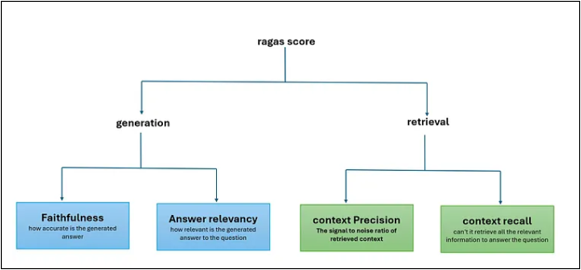
RAGAS (Retrieval-Augmented Generation Assessment) presents a variety of metrics that offer a comprehensive assessment of RAG models, emphasizing elements such as faithfulness, answer relevance, context precision, and context recall.
- Faithfulness evaluates the factual correctness of the generated response in relation to the retrieved documents.
- Context Precision gauges the accuracy of the retrieved documents in delivering pertinent information to the query.
- Context Recall examines the extent to which the retrieved documents encompass all relevant facets of the query.
Evaluating RAG Pipeline
Measuring a Pipeline, Not a Model – A RAG system has two probabilistic subsystems: retrieval and generation. Measuring their interactions matters just as much as evaluating their individual performance. This requires component-level metrics and end-to-end metrics, making evaluation elaborate and complex.
Retrieval Quality Isn’t Binary – Developers often discover that “relevant vs. irrelevant” is a naive framing. In real workloads they deal with partially relevant chunks, redundant top-k items, overly broad contexts, and missing but critical details. Each of these affects downstream generation differently. Two queries may show similar recall@k but produce wildly different answer qualities.
Ground-Truth Data Is Painful to Create – There’s rarely a clean dataset containing {query, gold_context, gold_answer} triples. Most domains don’t have labeled data, so devs rely on manual annotation, heuristic relevance scoring, synthetic generation (which introduces bias) and weak labeling via similarity thresholds. The lack of high-quality ground truth makes automated benchmarking noisy and unreliable.
Hallucinations Can Mask Retrieval Issues – Even when retrieval is flawless, the LLM may still fabricate details. Subtle hallucinations are hard to detect automatically. String-matching metrics like ROUGE (Recall-Oriented Understudy for Gisting Evaluation ) or BLEU (Bilingual Evaluation Understudy) completely miss factual fidelity. This means you need unit tests for truthfulness, adversarial examples, or log-prob analysis to catch errors, adding layers of complexity.
Context Engineering Complicates Evaluation – Developers underestimate how chaotic context-window behavior is. Small tweaks like chunk size, overlap, ordering, or compression can cause big swings in performance. Longer contexts sometimes reduce accuracy due to attention dilution. This makes it hard to isolate whether failures are model-related or context-construction related.
Domain Knowledge Is Not Portable – A retrieval strategy that works great in technical documentation may fail in legal text or time-sensitive financial data. Embeddings encode semantic similarity differently across domains, so “relevance” becomes domain-specific. Developers might end up building multiple evaluation pipelines per domain or per customer.
Latency–Accuracy Tradeoffs Make Metrics Multidimensional – Better retrieval usually means larger vector stores, deeper reranking, cross-encoder scoring and more tokens fed into the LLM. All of these increase latency and cost. A “better” answer isn’t always better for production. Devs must evaluate accuracy, latency, and cost together.
No Single Metric Captures “Good RAG” – Traditional NLP metrics don’t sufficiently reflect factual correctness or evidence alignment. For RAG you need faithfulness tests, answer-grounding metrics, context attribution scores, relevance distribution analysis. Teams often end up creating custom evaluation scripts or proprietary scoring systems because standard metrics simply don’t map accurately enough to real quality.
User Intent Makes Scoring Ambiguous – Ambiguity kills deterministic evaluation. A single question may have multiple valid answers, multiple correct contexts, or different acceptable levels of depth. Developers often rely on LLM-as-judge, but that introduces its own biases.
Data Freshness and Index Drift Break Long-Term Evaluations – RAG systems operate on dynamic knowledge bases. As documents update embeddings drift, indexes need rebuilding and chunk boundaries shift. This means evaluation scores degrade over time even if the model hasn’t changed. Long-term benchmarking becomes a moving target.
Several companies have succeeded by evaluating their RAG pipeline. One such example is of Nvidia, a leading video card and chipset manufacturer who has used RAG evaluation to transform their applications with multimodal RAG capabilities.
Conclusion
Now that you have understood the process of evaluating the RAG pipeline it is time for you to understand its practical implications through Eduinx’s course on applied generative AI. As a leading edtech institute in India, Eduinx offers both online and offline learning classrooms for both working professionals and budding entrepreneurs. We have a team of non academic mentors with over a decade of experience in AI, data science, and LLMs. We help you land your dream job through placement assistance.
Frequently Asked Questions (FAQs)
1. What is a RAG pipeline?
A Retrieval-Augmented Generation, or RAG, pipeline is an AI workflow that combines a large language model with external knowledge sources. It retrieves relevant information from documents, databases or live systems and uses that context to generate accurate, relevant and up-to-date answers.
RAG pipelines are commonly used in enterprise chatbots, knowledge assistants, customer-support systems and internal search applications.
2. Why is it important to evaluate a RAG pipeline?
Evaluating a RAG pipeline helps identify problems across retrieval, context augmentation and answer generation. A RAG system may retrieve irrelevant documents, miss important information or generate claims that are not supported by the retrieved context.
Regular evaluation helps reduce hallucinations, improve answer completeness, maintain factual accuracy and ensure that the system continues to perform reliably as its data changes.
3. What is the need to evaluate a RAG pipeline?
RAG systems can fail at multiple stages: retrieval, augmentation, or generation, so there is a need for evaluation to detect potential errors, such as hallucination, biased responses, out-of-date information, and poor document retrieval, prior to impacting the user. A systematic analysis of each stage promotes the continuity and context of the system's reliability.
4. What does it mean for a RAG system to hallucinate and why does it occur?
In the generation phase, hallucination occurs when an LLM ignores the retrieved context and generates information that is not grounded in reality. This is one of its main purposes to identify a risky response: a response that is confident-sounding yet is not the truth, and can be difficult to identify without some testing.
5. What is RAGAS?
RAGAS is a framework for evaluating the capability of an AI application in integrating document search with a generative language model. Compares the answers produced by a RAG system with a set of questions, ideal answers and relevant context to generate metrics such as faithfulness, relevance and semantic similarity to assess retrieval and answer quality.
6. What is faithfulness in RAG evaluation?
Faithfulness measures whether the claims in a generated answer are supported by the retrieved context.
A highly faithful answer does not introduce unsupported facts or contradict the source information. A low faithfulness score may indicate that the model is hallucinating, making assumptions or relying on information outside the retrieved documents.
7. What does context precision mean in the context of RAG evaluation?
The accuracy of the retrieved documents for information relevant to the user's query is the measure of the context precision. High context precision implies that the system does not pay attention to chunks that do not relate to the topic and, thus, could not lead to a good answer.
8. What does the term context recall mean in the context of RAG?
Context recall looks at whether all the information that is relevant to an answer to a query was retrieved. A system may be very accurate but low recall, because it is able to retrieve relevant information, but not every aspect of the query needed for the complete answer.
9. How can retrieval quality not just be "relevant vs. irrelevant"?
In real workloads, retrieval quality is not a simple distinction between what is relevant and not, but encompasses partially relevant chunks, redundant top-k items, overly broad contexts, and missing, but critical details. Evaluating is more subtle than it appears at face value, because two queries may have the same recall score, but yield quite different quality of answers.
10. Do the hallucinations occur when retrieval is perfect?
Yes - the LLM can hallucinate information even if it is retrieved perfectly, and these subtleties are hard to detect automatically when generating information. Factual fidelity is not captured by traditional string-matching metrics such as ROUGE or BLEU, so teams should find more specific truthfulness checks, adversarial testing or log-probability analysis.
11. What are the reasons for the inverse relationship between latency and accuracy in RAG systems?
There are four main approaches that yield better retrieval results: increasing vector store size, running more depth reranking, using a cross-encoder to score the results, and feeding more tokens into the LLM - all of which increase latency and cost. While a technically "better" answer may be better, it can't be judged on the accuracy alone, the latency, and cost also must be considered.
12. Even if the model is not changed, why does the RAG evaluation change over time?
RAG systems are built on a dynamic knowledge base, meaning that embeddings move over time, so do chunks boundaries, and indexes must be rebuilt as documents change. This implies that evaluation indication scores can drop simply because of the freshness of data and that long-term benchmarking is never a one-off, but an ever-evolving process.