AI-driven retention engineering is the practice of using machine learning to predict which customers are likely to churn, then automatically triggering targeted interventions to stop them from leaving before they go. In 2026, this shifts from batch scoring to real-time signals and agentic action.
For too long, retention has been reactive: a customer cancels, and the win-back campaign fires days later. By then, the decision is mostly made. The teams winning in 2026 have inverted that sequence, predicting the exit before it happens and intervening while the relationship is still salvageable.
Retention economics have long been used to justify investment in existing customers. Widely cited Harvard Business Review research suggests that acquiring customers can cost substantially more than retaining existing ones, while improvements in retention can have a significant impact on profitability.
What Is AI-Driven Retention Engineering?
Retention engineering is a strategy of shifting the focus from churn to a problem that can be solved with engineering instead of just viewed as a inevitable business cost. It has three features that were previously in different silos:
- Prediction: customer segmentation software that categorizes customers based on their risk of churning.
- Timing: survival analysis that estimates the time that customer is at risk, not only if they are at risk.
- Action: automated, personalized interventions triggered the moment risk is detected.
Why Churn Prediction Matters in 2026
The "why now" is a convergence of three forces that simply didn't exist a few years ago. Here they are.
- Real-time data: Behavioral signals like login frequency, feature adoption, support tickets, and usage dips are now available in streams, not weekly batches. That's the raw material prediction needs.
- Cheaper compute and better models: Online learning and LLM-assisted analysis make sophisticated churn models accessible beyond the enterprise data-science teams that once owned them.
- Agentic action: Models no longer just produce a score; they trigger the intervention. An agent can draft a personalized outreach email, surface an in-app guide, or route a high-risk account to a human, all without a campaign manager in the loop.
This is a natural extension of the zero-shot analytics approach we covered earlier in this series, and it connects directly to continuous product discovery with AI, anticipating what users need before it becomes a problem.
How AI Predicts Churn: The 3-Layer Model
Think of a modern churn system as three connected layers, each feeding the next. Here are those.
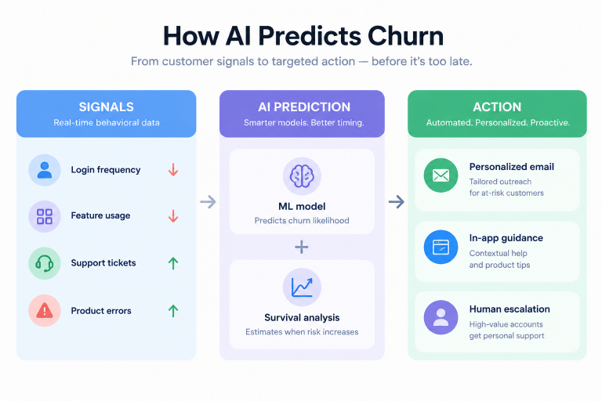
Signal Layer: Real-Time Behavioral Data
The foundation is data quality. The most predictive signals are behavioral: declining login frequency, stalled feature adoption, rising support tickets, shrinking usage of core features.
To know which signals matter, start by mapping the customer journey with AI to identify the touchpoints where churn risk first appears. In telecom research, factors like call failures and customer complaints are among the strongest predictors of churn; the same pattern holds in SaaS with product errors and unresolved tickets.
Prediction Layer: Beyond Binary Logic
The biggest methodological shift is moving beyond a simple "will they churn?" binary. Research increasingly combines machine learning with survival analysis, specifically Cox Proportional Hazards models, to estimate not just if a customer will leave, but when. This temporal dimension is what turns a prediction into a schedule for intervention.
A hybrid three-stage pipeline has proven especially effective:
- Segmentation: unsupervised clustering (k-means, agglomerative) identifies different groups of customers, addresses population heterogeneity.
- Classification: Classified as supervised models (Logistic regression, Neural networks, decision trees) with churn status predicted forward, only the instances that are correctly classified are passed forward, which helps filter out the noise.
- Survival analysis: Testing for hazard rates and which covariates affect the timing of churn: CoxPH.
Action Layer: Agentic Interventions
The score does not make any changes. The next step is determined by the action layer, whether that's an automated, personalized email to a "silent churner", a targeted offer to a high-risk segment, or a human escalation to a high-value account. This is where AI moves from analytics to retention engineering.
Traditional Churn System vs. Real-Time Retention System
Here's how traditional churn system and real-time retention systems compare for churn prediction:
| Dimension | Traditional churn system | Real-time retention system |
|---|---|---|
| Data | Scheduled/batch | Streaming + event-based |
| Prediction | Periodic risk score | Continuous risk updates |
| Decision | Rule/campaign driven | Context-aware decisioning |
| Intervention | Manual campaigns | Automated or human-assisted |
| Measurement | AUC, precision, recall | Uplift, incremental retention, ROI |
The shift isn't just technical; it's philosophical. Classic models answer "who is at risk?" Modern systems answer "who, when, and what do we do about it right now?"
How to Build a Churn Prediction Pipeline (Step-by-Step)
The following are the steps to build a churn prediction pipeline.
- Define churn: what actually counts as churn for your product? Cancellation? Downgrade? A 30-day inactivity threshold? Be explicit.
- Collect and label signals: gather behavioral data and historical outcomes. Watch for class imbalance; churners are typically a small minority, so techniques like SMOTE oversampling prevent biased predictions.
- Select features deliberately: use LASSO regression to cut redundant variables and manage multicollinearity, keeping only the most impactful predictors.
- Train and validate: build the hybrid model, and hold out data you never train on to test honestly.
- Set the intervention threshold: this is a precision/recall tradeoff. Too aggressive, and you annoy customers who weren't leaving; too conservative, and you miss the ones who were.
- Trigger and measure interventions: track uplift: did the intervention actually prevent churn compared to a control group?
- Close the loop: feed outcomes back into the model so it learns what actually works.
What are the Common Pitfalls and Guardrails in Retention Engineering
Here are some of the typical mistakes that occur in retention engineering, and how to avoid these mistakes:
- False positives: Precision/recall is a trade-off that exists. Wasting budget and driving down trust by over-triggering interventions on non-leavers.
- Data bias: models get the biases of the data they were trained on. Audit segments for fairness, particularly prior to automatic responses.
- Over-reliance on the model: the best systems keep humans in the loop for high-value accounts. The model flags; the human decides.
Conclusion
Retention engineering in 2026 is no longer about reacting to cancellations; it's about predicting them before they happen. The playbook is clear:
- Predict: use survival analysis to know when and why customers leave, not just if.
- Act: trigger targeted, personalized interventions the moment risk appears.
- Improve: feed outcomes back so your model gets smarter with every cycle.
The tools are increasingly capable. The challenge is building the data, experimentation, and intervention systems needed to turn predictions into measurable retention gains.
Ready to put this into practice? Join our AI in Product Management course and learn how to apply predictive models to real product decisions, step by step. Enroll today and start preventing churn before it costs you another customer.
Frequently Asked Questions (FAQs)
1. What metrics predict customer churn?
The strongest predictors are behavioral: declining login frequency, stalled feature adoption, rising support tickets, and shrinking usage of core features. In telecom data, call failures and complaints are top indicators; the SaaS equivalents are product errors and unresolved tickets.
2. How does AI predict churn before it happens?
Machine learning models rank every customer's likelihood of churning based on their behavior and survival analysis algorithms predict a time to the peak of the risk. Automated interventions are triggered before the customer takes any action when the score goes over a certain level.
3. What's the difference between churn prediction and retention engineering?
Churn prediction identifies who's at risk. Retention engineering is the full loop: prediction, timing, intervention, and measurement. Prediction is one layer; engineering is the whole system.
4. Which model is best for churn prediction?
No single model wins. A hybrid three-stage pipeline-segmentation, then classification, then survival analysis- consistently outperforms standalone models. In a recent telecom-sector study, the K-means + Logistic Regression + Cox configuration achieved 88.24% accuracy on the evaluated dataset.
5. How do you prevent churn once it's predicted?
Deploy targeted, personalized interventions: proactive outreach for silent churners, tailored offers for high-risk segments, in-app guidance to reduce friction, and human escalation for high-value accounts.
6. What data is needed for AI-driven retention engineering?
AI-driven retention engineering typically uses behavioral data such as login frequency, feature usage, session activity, support tickets, product errors, and subscription history to identify changes that may indicate churn risk.
7. Can AI predict when a customer will churn?
Yes. Machine learning can identify churn risk, while survival analysis can estimate the likely timing of churn. This helps teams intervene before the customer leaves.
8. What is the best metric for measuring retention interventions?
Uplift is one of the most useful metrics because it compares customers who received an intervention with a control group. It shows whether the intervention actually reduced churn.
9. Can small businesses use AI for churn prediction?
Yes. Cloud-based analytics and AI tools make churn prediction accessible to smaller teams. Businesses can start with basic behavioral signals and gradually add more advanced models as their data grows.
10. How often should a churn prediction model be updated?
The update frequency depends on how quickly customer behavior changes. For products with frequent activity, models may need near-real-time or daily updates, while slower-moving businesses may update them weekly or monthly.