In 2026, customer experience has become the ultimate differentiator. Products can be copied, prices can be matched, but the way a brand makes customers feel—that is what builds loyalty. Whether you are looking for a career breakthrough or building your first ventures, understanding Customer Journey Mapping with AI is no longer optional. It is the key to designing experiences that resonate, convert, and retain.
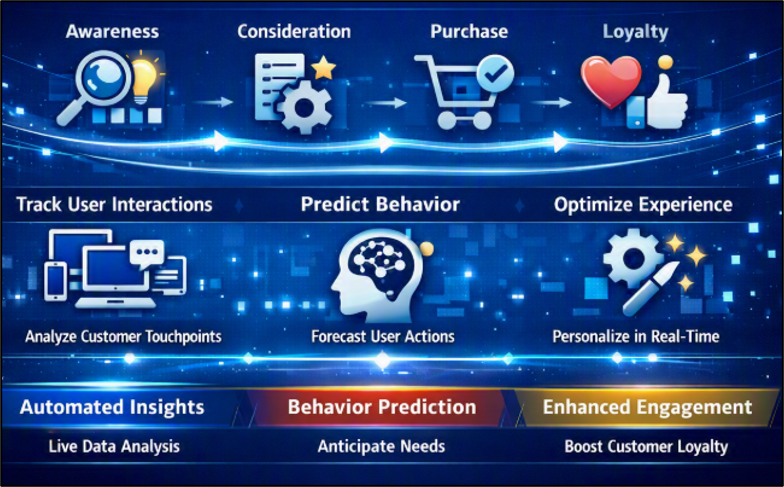
Artificial Intelligence (AI) is revolutionizing how businesses visualize and understand the customer journey. Instead of relying on manual mapping and guesswork, AI now enables companies to automatically track, analyze, and optimize every touchpoint—from discovery to purchase and beyond.
Brief on Customer Journey Mapping with AI
Customer Journey Mapping with AI traditionally involves plotting the steps a customer takes when interacting with a brand—researching, comparing, purchasing, and engaging post-sale. It helps businesses understand pain points, motivations, and emotions at each stage.
However, manual mapping is time-consuming and often static. It relies on surveys, interviews, and assumptions that quickly become outdated. AI changes this by making journey mapping dynamic and data-driven.
With AI, businesses can visualize journeys in real time, using data from multiple sources—web analytics, CRM systems, social media, and customer support logs. The result is a living map that evolves as customer behavior changes. You need to master a skill that blends empathy with analytics. You also need to build customer-centric businesses that adapt instantly to market shifts.
Understanding AI User Journey Mapping
AI-powered journey mapping uses machine learning to analyze millions of interactions and identify patterns automatically. It does not just show what customers do, it reveals why they do it. AI User Journey Mapping can detect that users who read product reviews spend 30% more time on the website before purchasing. It can also identify friction points, such as pages where users drop off or features that cause confusion. These insights help Product Managers and marketers redesign experiences that are smoother and more intuitive. Instead of guessing what customers want, AI provides evidence-based recommendations.
Professionals who understand AI journey mapping can lead cross-functional teams with confidence, while entrepreneurs can use it to refine their go-to-market strategies and improve conversion rates.
AI-Powered Customer Experience Solutions
AI-powered customer experience (CX) solutions have now become mainstream. Platforms like Salesforce Einstein, Adobe Sensei, and Microsoft Dynamics 365 use AI to unify customer data and generate actionable insights. These systems can automatically segment customers based on behavior, predict their next actions, and personalize experiences at scale.
For instance, if a user frequently browses eco-friendly products, AI can tailor recommendations and marketing messages around sustainability. AI also enhances omnichannel experiences. It ensures that whether a customer interacts via email, chat, or social media, the brand’s tone and context remain consistent.
AI Customer Experience Management Platforms
Customer Experience Management (CXM) platforms powered by AI are the backbone of modern journey mapping. They collect and analyze data from every customer interaction, creating a unified view of the user experience. These platforms can help in the following:
- Visualize customer journeys across channels.
- Identify bottlenecks that affect conversion or satisfaction.
- Recommend optimizations using predictive analytics.
An AI CXM platform might notice that customers abandon carts after viewing shipping costs. It can then suggest offering free shipping thresholds or clearer pricing transparency. Professionals who can interpret these insights become invaluable to organizations. Entrepreneurs can use CXM platforms to make data-driven decisions that improve customer retention and lifetime value.
AI Customer Behavior Prediction
One of AI’s most powerful capabilities is predicting customer behavior. By analyzing historical data, AI can forecast what customers are likely to do next—whether they’ll make a purchase, churn, or upgrade.
Predictive models use variables like browsing patterns, purchase history, and engagement frequency to assign probabilities to future actions. This allows businesses to act proactively rather than reactively. If AI predicts that a customer is likely to churn, the system can trigger personalized retention campaigns—discounts, loyalty rewards, or targeted communication.
Understanding predictive analytics opens doors to strategic roles in marketing and product management. It helps organizations in anticipating customer needs and staying one step ahead of competitors.
The Future of Customer Journey Mapping with AI
AI has evolved from a support tool to a strategic partner. The future of customer journey mapping lies in autonomous experience orchestration where AI not only visualizes journeys but also optimizes them in real time.
Imagine an AI system that detects a drop in engagement and automatically adjusts messaging, UX design, or pricing to re-engage users. This level of automation will redefine how businesses operate.
With the rise of Agentic AI, AI systems act as intelligent agents capable of reasoning, planning, and executing tasks independently. In customer experience, this means AI can manage entire campaigns, analyze feedback, and refine strategies without human intervention. This future demands adaptability and continuous learning for you. Understanding AI-driven CX will be as essential as knowing marketing fundamentals. It also provides an opportunity to build agile, customer-first businesses that thrive on innovation.
Bringing It All Together
Customer Journey Mapping with AI is not just about technology, it is about empathy at scale. It allows businesses to see customers as individuals, not data points. By combining AI’s analytical power with human creativity, both working professionals and entrepreneurs can design experiences that feel personal, intuitive, and memorable.
Success will belong to those who can harness AI to visualize the full user experience automatically; this turns insights into action and data into delight. The evolution of customer journey mapping reflects a broader truth: the future of business is customer-centric and AI-driven.
AI does not replace human intuition, it amplifies it by helping professionals to make smart decisions and entrepreneurs build stronger brands. As AI continues to advance, customer journey mapping will become more predictive, personalized, and autonomous. For those ready to embrace this shift, the opportunities are immense. Whether you are climbing the corporate ladder or launching your next venture, mastering Customer Journey Mapping with AI will be your gateway to success in 2026 and beyond.
Now that you have understood the importance of customer journey mapping with AI, it is time for you to implement it in real-time according to industry standards. Here’s where Eduinx is here to help. As a leading edtech institute in India, we have a team of non-academic mentors with over decades of experience in AI and automation. Take up our course on AI product management to learn more. We also offer placement assistance in helping you land the right job. Get in touch with us and land your dream job at an attractive salary package.
Frequently Asked Questions (FAQs)
What is the AI-powered Customer Journey Mapping?
The automated tracking, analysis and visualisation of all the touchpoints a customer interacts with a brand starting from the discovery to purchase and beyond is AI customer journey mapping. AI construction can generate a living map from real data from sources like web analytics, CRM systems, social media and support logs; manual mapping needs surveys and estimates.
What is the difference between traditional journey mapping and AI-powered journey mapping?
The traditional journey mapping approach is based on manual research, interviews, and assumptions which rapidly become outdated after the fact of being created. AI journey mapping, on the other hand, is constantly updated with real-time customer data, it reveals the actions customers take at each step and why, and they can see patterns in millions of interactions.
What can AI actually detect within a customer journey that manual mapping misses?
Manual mapping cannot reveal the certain patterns, patterns that can be uncovered using AI-powered journey mapping, including:
- Users who read product reviews spending 30% more time on a website before purchasing
- Specific pages and/or features that users are regularly lost or confused at
- Points in the journey where friction quietly reduces conversion
What are AI-powered customer experience (CX) platforms?
Customer Experience (CX) platforms such as Salesforce Einstein, Adobe Sensei, and Microsoft Dynamics 365 leverage the power of AI to seamlessly bring all the customer data together and provide actionable insights. These systems can categorise the customers according to their behavior and anticipate their next moves, after which they can tailor the interactions at scale throughout the channels such as email, chat, and social media.
What does an AI Customer Experience Management (CXM) platform does?
Each and every interaction with the Customer is recorded and analyzed on the AI based Customer Experience Management platform, giving a 360-degree view of the Customer journey. They are often made use of to:
- Visualize how customers will navigate through various channels.
- Define the specific bottlenecks affecting the conversion or satisfaction
- Make recommendations for optimization based on the predictive analytics, such as recommending free shipping thresholds based on cart abandonment due to shipping costs
What is AI customer behavior prediction?
The AI customer behavior prediction analyzes historical data - which includes the browsing patterns, purchase history, and engagement frequency, to forecast what a customer is likely to do next, whether that is making a purchase, churning, or upgrading. This allows the businesses to act proactively, such as triggering a retention campaign before a customer actually churns.
What made customer experience the crucial differentiator in 2026?
Product features and pricing are easy to emulate. But how a brand makes its customer feel is far more difficult. Hence, customer experience became the main differentiator and this is precisely the reason why AI-powered journey mapping and CX tools became absolutely essential.
Why AI uncovers motivations, not actions of the customer?
AI analyzes behavior across millions of interactions and therefore allows revealing the "why" behind actions, rather than "what". For instance, not only it shows that there is a drop off on some stage but also finds a root cause of this particular behavior.
How AI gathers multi-source data and builds a customer journey map?
AI collects data not only from web analytics but also from CRM, social media, customer support etc. Combining different data sources allows AI to obtain a fuller picture of the customer behavior across channels instead of focusing on any one single siloed data source.
How an AI CXM platform identifies friction points in customer journeys?
An AI CXM platform constantly analyzes the behavior of customers along the customer journey and highlights the patterns of behaviors, such as drop off during the cart abandonment at a particular step (revealing shipping fees). After identifying a particular friction point, it offers a solution, such as establishing a free shipping limit or showing the price earlier in the flow.
How does AI ensure the consistency of experience across different channels?
AI-powered CX systems allow maintaining consistency of a tone and context of the interaction regardless of what channel the customer uses to communicate with the brand - email, chat, social media etc. Omnichannel consistency is ensured by unification of customer data and interaction history across all channels.
How agentic AI is expected to change customer journey mapping in the future?
Agentic AI allows for autonomous experience orchestration which means that the system not only visualizes the customer journey but optimizes it in real-time. For instance, if the system detects a drop of engagement, it automatically adjusts the strategy of the company (changes messaging, UX design or pricing). Eventually, agentic AI may enable management of entire campaigns.