AI regulation is no longer a problem for product teams to wait until the product is launched. The regulatory landscape around AI is changing, with governments enacting regulations around AI risk, transparency, data, human oversight, and automated decision-making, making AI regulatory compliance a key component of product strategy for product managers.
For product managers, it's about awareness of relevant AI legislation, risk classification of AI products, documentation of AI systems, introducing transparency to user interactions, and tracking AI post-deployment.
The EU AI Act is currently one of the most important regulatory frameworks to understand. Its rules will be implemented progressively, with AI literacy requirements, rules against prohibited practices, and transparency requirements beginning to apply in 2026 and the high-risk requirements following later.
What Is AI Regulatory Compliance for Product Managers?
AI regulatory compliance requires planning, designing, building, and operating AI products in compliance with applicable laws, regulations, and governance.
For product managers, this can include:
- Identifying AI systems and their intended use
- Assessing regulatory and product risks
- Protecting personal and sensitive data
- Providing required AI disclosures
- Designing human oversight
- Maintaining technical documentation
- Testing for accuracy, bias, safety, and security
- Monitoring AI performance after launch
The key shift is moving from treating compliance as a legal review to treating it as a product-lifecycle requirement.
Why Does AI Compliance Matter for Product Managers in 2026?
The use of AI can impact hiring and lending, student admissions, health care choices, customer choices, service recommendations, and more. Therefore, the regulatory considerations can have a direct influence on the product requirements, UX, technical architecture, launch plans, and post-launch monitoring.
For instance, the EU AI Act mandates transparency regarding specific types of AI systems, such as when it comes to informing users about being interacting with AI systems and labelling some synthetic or manipulated content. These transparency provisions became applicable from 2 August 2026.
For product managers looking to strengthen their understanding of how AI affects product strategy, development, and decision-making, the AI in Product Management Fast-Track Programme is one way to build these skills alongside practical product knowledge.
Product managers therefore need to ask not only “Does this feature work?”, but also “Is this feature permitted, explainable, documented, and appropriately governed?”
EU AI Act: What Product Managers Need to Know
The EU AI Act uses a risk-based approach, making risk classification one of the first questions product teams should answer.
Unacceptable Risk
Certain AI practices are prohibited because of their potential threat to fundamental rights. Examples include certain forms of manipulation, social scoring, and prohibited biometric practices.
High-Risk AI
High-risk systems can affect areas such as employment, education, biometrics, critical infrastructure, and other sensitive applications.
Product teams can anticipate risk management, data governance, technical documentation, human oversight, accuracy, robustness, and cybersecurity.
Transparency-Risk AI
Some of the systems are required to comply with particular transparency requirements. For example, users may need to know when they are interacting with AI, while deepfakes and certain AI-generated content must be appropriately labelled or marked.
Minimal or Lower-Risk AI
Many everyday AI applications, such as basic spam filtering, generally face fewer mandatory requirements under the AI Act, although organisations can still apply voluntary governance practices.
EU AI Act Timeline Product Managers Should Know
The EU AI Act is being implemented in phases, with key compliance requirements taking effect on the following dates:
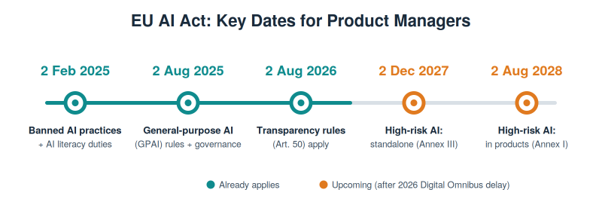
The European Commission currently confirms the 2 December 2027 and 2 August 2028 dates for the relevant high-risk categories following the revised implementation timeline.
How Global AI Laws Affect Product Managers
The EU is not the only jurisdiction developing AI regulation. The major challenge for global products is that regulatory approaches differ.
| Region | General approach | Product focus |
|---|---|---|
| EU | Risk-based regulation | Risk classification, transparency, human oversight |
| US | Federal + state requirements | Consumer protection, disclosure, automated decisions |
| UK | Principles-based approach | Safety, transparency, accountability |
| India | Evolving governance framework | Responsible and inclusive AI |
In the US, for example, states are developing their own requirements. Colorado's SB26-189, enacted in May 2026, addresses automated decision-making technology used in consequential decisions.
India's AI governance environment is also evolving, with the government developing governance guidelines and responsible-AI initiatives.
This makes a jurisdiction-aware compliance process essential for product teams serving international users.
7 AI Compliance Steps Every Product Manager Should Follow
Product managers can make AI compliance part of the product lifecycle by following seven practical steps:
- Create an AI Inventory
- List every AI model, API, automated decision system, and AI-powered feature used by the product.
- Record its provider, purpose, data sources, users, deployment environment, and version.
- Classify the AI Risk
- Determine whether the system is prohibited, high-risk, transparency-sensitive, or lower risk under applicable regulations.
- This assessment is easier when product teams continuously evaluate user needs, use cases, and potential risks during development. Continuous product discovery with AI can help teams identify changing requirements and potential product risks earlier rather than waiting until the launch stage.
- Map Applicable Regulations
- Consider where your company operates, where users are located, and where the AI system is placed on the market or deployed.
- Add Compliance to the PRD
- Turn legal requirements into product requirements.
- For example: Regulation → Product requirement → Technical control → Test → Evidence
- This makes compliance measurable instead of leaving it as a vague legal objective.
- Document the AI System
- For high-risk EU AI systems, technical documentation is a major requirement. The supplied research highlights documentation covering the system's purpose, architecture, data governance, risk management, testing, lifecycle changes, conformity, and post-market monitoring.
- Test and Monitor AI Performance
- Track accuracy, bias, safety, security, hallucinations, performance drift, and unexpected outcomes.
- NIST's AI Risk Management Framework recommends managing AI risks throughout the lifecycle using four functions: Govern, Map, Measure, and Manage.
- Establish Post-Launch Governance
- AI compliance does not end at deployment.
- Use a continuous cycle: Monitor → Detect → Review → Remediate → Document
- This is particularly important when models, datasets, prompts, vendors, or deployment contexts change.
How to Build AI Compliance Into the Product Roadmap
Compliance should follow the same lifecycle as the product:
| Product stage | Compliance activity |
|---|---|
| Discovery | Identify AI use case and risk |
| Design | Define transparency and human oversight |
| Development | Establish data and model controls |
| Testing | Test safety, accuracy, and bias |
| Launch | Complete documentation and disclosures |
| Post-launch | Monitor performance and incidents |
For high-risk systems, treat documentation as a living product artifact, not a one-time document. This approach also reduces the risk of losing critical evidence when models or product configurations change.
As AI products become more complex and involve multiple models, APIs, and intelligent agents, product teams also need to understand AI orchestration in product development and how different AI components work together across the product lifecycle.
Common AI Compliance Mistakes Product Managers Should Avoid
- Treating compliance as only a legal team's responsibility
- Waiting until launch to assess AI risk
- Failing to inventory third-party AI APIs
- Not documenting model and data changes
- Assuming every AI system has the same regulatory obligations
- Ignoring human oversight for consequential decisions
- Failing to monitor AI after deployment
- Confusing ethical AI principles with actual legal requirements
AI compliance is also a cross-functional responsibility. Product managers need to work closely with engineering, data, security, legal, and other stakeholders throughout development. This makes building an AI product team an important part of creating responsible and well-governed AI products.
A useful supporting framework is ISO/IEC 42001, which provides requirements for establishing and continually improving an AI management system.
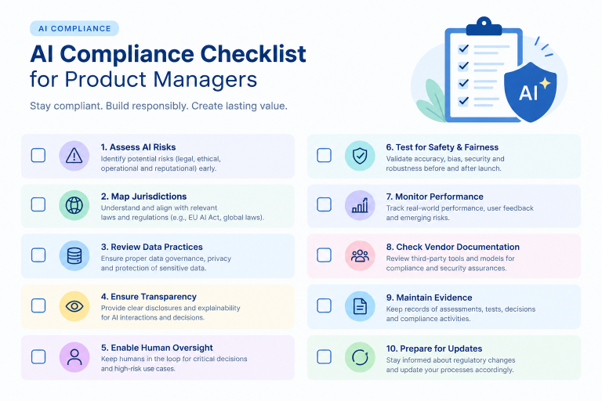
AI Compliance Checklist for Product Managers
Before launching an AI feature, ask:
Conclusion
AI regulatory compliance for product managers is becoming a core part of modern product development. The strongest approach is not to bolt compliance onto an existing product at the end, but to build risk assessment, transparency, documentation, human oversight, testing, and monitoring into the product lifecycle from the beginning.
For global AI products, frameworks such as the NIST AI RMF and ISO/IEC 42001 can provide useful governance structures alongside mandatory laws. NIST's AI RMF is voluntary and was developed with input from more than 240 contributing organisations, making it a credible reference point for operationalising AI risk management.
For professionals looking to develop these capabilities more deeply, the Advanced AI Product Management & Product Leadership Program can provide a broader foundation across AI product management and product leadership.
In 2026, the product manager's role is increasingly about balancing innovation, user value, and regulatory responsibility, without slowing innovation unnecessarily.
FAQs About AI Regulatory Compliance for Product Managers
What is AI regulatory compliance?
AI regulatory compliance is the process of ensuring an AI product meets applicable legal, regulatory, transparency, privacy, safety, and governance requirements.
What does the EU AI Act mean for product managers?
It means product managers may need to classify AI risks, build transparency and oversight into products, maintain documentation, and support ongoing compliance.
Does the EU AI Act apply to companies outside the EU?
It can. The Act has an international scope that can affect organisations placing AI systems or certain AI outputs on the EU market or operating within its regulatory scope.
What are the main AI compliance requirements?
They can include risk management, data governance, transparency, human oversight, technical documentation, testing, cybersecurity, record-keeping, and post-market monitoring.
What are high-risk AI systems?
High-risk AI systems are applications subject to stricter requirements because they can significantly affect health, safety, or fundamental rights. Examples include certain employment and biometric applications.
When did the EU AI Act become applicable?
The Act entered into force in 2024 and applies progressively. Prohibitions and AI literacy rules began applying in February 2025, while broader provisions apply progressively through 2027 and 2028.
What AI regulations should product managers know in 2026?
Product managers should monitor the EU AI Act, relevant US federal and state requirements, UK AI governance developments, and emerging requirements in markets such as India.
How can product managers build AI compliance into a roadmap?
Map regulatory requirements to product requirements, technical controls, testing criteria, documentation, launch gates, and post-launch monitoring.
Who is responsible for AI compliance?
Compliance is cross-functional. Product, engineering, data, security, legal, compliance, and leadership teams may all have responsibilities depending on the AI system and jurisdiction.
How can product managers keep up with AI regulations?
Maintain a regulatory watchlist, review official regulator updates, assign ownership for regulatory changes, and periodically reassess AI products as laws and guidance evolve.
What should product managers do to ensure AI compliance?
Product managers should identify AI systems, assess their risk, map applicable regulations, document requirements, implement human oversight, and continuously monitor AI performance.
How does the EU AI Act affect AI product development?
The EU AI Act can affect product requirements, risk assessment, transparency, documentation, human oversight, testing, and post-market monitoring depending on the AI system's risk category.
What are the biggest AI compliance challenges for product managers?
Common challenges include keeping up with changing regulations, classifying AI risks, documenting systems, managing third-party AI providers, and maintaining compliance after deployment.