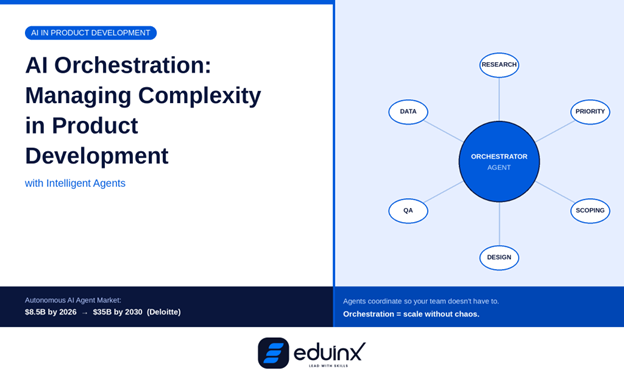
Product teams are shipping faster than ever, but the complexity behind modern digital products is growing at the same pace. Feature backlogs stretch for months. User feedback floods in from a dozen channels. Engineering, design, data, and business stakeholders all need to align, and the cost of a wrong prioritization decision is high. AI orchestration is changing how product teams manage this complexity: not by automating away judgment, but by giving professionals a coordinated intelligence layer that keeps every part of the process moving intelligently.
What Is AI Orchestration, and Why Does It Matter Now?
At its core, AI orchestration is the coordination of multiple AI agents working toward a shared goal. Think of it like a project management layer for AI, a system that knows which agent to assign a task to, in what order, and what to do when something goes wrong.
A single AI agent is useful for isolated tasks: summarizing a support ticket, generating a user story, or drafting a feature brief. But real product development doesn't work in isolation. Discovery feeds into scoping, which feeds into roadmap planning, which feeds into sprint cycles, which feeds into user testing, and the loop repeats. When you chain multiple AI agents across this workflow, with an orchestration layer managing their handoffs and decisions, you get something meaningfully more powerful: a system that can handle the full complexity of AI in product development.
This isn't theoretical anymore. Gartner reported a 1,445% surge in multi-agent system inquiries from Q1 2024 to Q2 2025, and the market projections reflect the shift. Market estimates suggest the autonomous AI agent market could reach $8.5 billion by 2026 and $35 billion by 2030.
The challenge, though, is that most teams jumping into this space get the architecture wrong early and pay for it later. Let's make sure you don't.
How Multi-Agent Systems Actually Work in Product Teams
Understanding how AI orchestration works means understanding the coordination problem it solves.
The Limits of Single-Agent AI
A single agent, no matter how capable, hits context limits fast in a real product environment. Product development requires holding multiple contexts simultaneously: business goals, user personas, technical constraints, competitive data, sprint commitments. When one agent tries to handle all of it, quality degrades. It drops context, hallucinates constraints, or produces outputs that are disconnected from what adjacent teams are doing.
Single-agent architectures break not because the model is unintelligent, but because one agent trying to hold diverse logic simultaneously starts losing context quickly.
Multi-agent systems solve this by specialization. A research agent pulls competitor intelligence and user feedback. A prioritization agent maps it against OKRs and business impact scores. A scoping agent translates prioritized features into high-level technical briefs. An orchestrator sits above all of them, managing sequencing, resolving conflicts, and deciding when a human needs to step in.
Orchestration Patterns for Product Work
Orchestration layers implement self-healing properties, including automatic retries, anomaly-gated circuit breaking, and fallback mechanisms, so when one agent in your pipeline stalls, the system doesn't collapse.
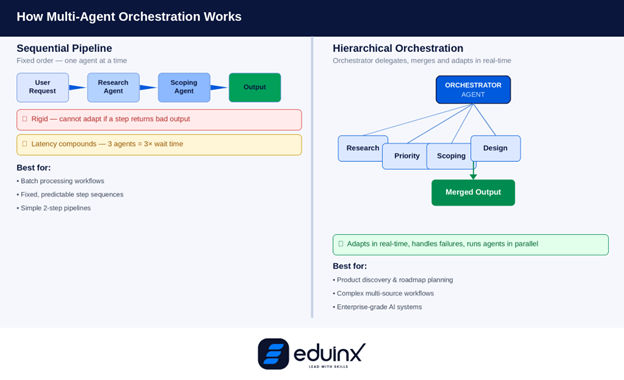
The two most common orchestration patterns for product use cases are:
- Hierarchical orchestration: One orchestrator agent decomposes a request, assigns sub-tasks to specialist agents, and merges results. This works well for roadmap generation, sprint planning prep, and feature discovery workflows where you need a clear chain of reasoning.
- Sequential pipelines: Each agent's output becomes the next agent's input. Useful for structured workflows like requirement → spec → test case → acceptance criteria generation. The risk is rigidity; pipelines struggle when a step earlier in the chain returns unexpected results.
For most product teams, hierarchical orchestration is the safer starting pattern. It handles complexity better and degrades more gracefully.
💡 Pro Tip: Start with 2-3 Agents, Not 10
One of the most common mistakes teams make is over-engineering their orchestration setup from day one. Start with a small crew of 2-3 agents covering your highest-friction workflow. Measure, then expand. A 150-line orchestrator with explicit handoffs is often easier to debug than any framework's abstractions.
AI Orchestration in Product Development: Real Workflow Examples
AI-Driven Roadmap Planning
One of the highest-value applications of multi-agent systems for product teams is AI-driven roadmap planning. The typical workflow involves several agents working together: a data ingestion agent that pulls from user interviews, NPS surveys, support tickets, and product analytics; a synthesis agent that identifies themes and maps them to business goals; and a prioritization agent that scores items against a framework like RICE or WSJF.
The orchestrator manages the flow, ensuring outputs from each agent are validated before being passed to the next. The result is a structured, evidence-backed prioritization draft that a PM can review and edit, not a blank page that requires starting from scratch.
This isn't just about speed. It's about reducing the cognitive load that comes from processing hundreds of signals across dozens of sources, which is where product decisions most often go wrong.
Generative AI in Product Design
Multi-agent systems are also changing how product and design teams collaborate. A generative AI workflow might involve a user research agent summarizing interview themes, a persona agent updating user personas from that data, and a product design agent drafting wireframe briefs from those personas.
Instead of teams acting as the glue between systems, AI agents take that role, delivering faster processes and real savings. Organizations implementing enterprise automation strategies report 30-50% process time reductions. For product designers, this means the hours spent manually synthesizing research into personas and flows can shift to AI, while humans focus on the judgment calls that require taste and experience.
🎯 Pro Tip: Map Your Handoffs Before Picking a Tool
Before choosing an AI orchestration platform, map out where information gets handed from one person (or team) to another in your current product workflow. Those handoff points are where agents add the most value, and also where most orchestration failures happen. Document them first, then automate them.
What Are AI Orchestration Platforms? A Practical Overview
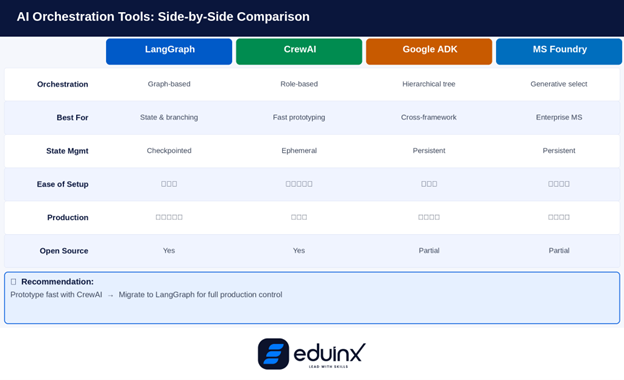
You don't need to build your own orchestration layer from scratch. Several production-grade AI orchestration tools exist today, each with different strengths.
LangGraph
Built on LangChain, LangGraph uses a graph-based model for managing agent state. It provides a visual roadmap of agent connections and lets developers monitor state transitions and identify exactly where an agentic loop might stall. If your team has Python developers and needs precise control over agent state and branching logic, LangGraph is the strongest production choice.
CrewAI
CrewAI uses a role-based model where agents are defined by their roles, goals, and tools, similar to how you'd describe a human team member. It's faster to prototype with and requires less upfront infrastructure. If you need to ship a working agent workflow in a week, CrewAI gets you there with less setup friction.
Microsoft Foundry / Copilot Studio
Microsoft's Agent Framework combines enterprise stability with innovative orchestration patterns, with built-in observability, identity, governance, and autoscaling. For enterprise product teams already on Microsoft's stack, this is the natural fit.
Google ADK
Google's ADK provides a hierarchical agent tree and natively supports the Agent-to-Agent (A2A) protocol, enabling communication between agents built on different frameworks, important for teams that want interoperability across tools.
The right platform depends on your team's technical depth, existing stack, and how much control you need over agent behavior versus how fast you want to move. There's no universal right answer here, but there is a wrong one: picking a platform before you've defined what specific product workflow you're trying to orchestrate.
AI Governance in Product Systems: What You Can't Ignore
AI orchestration in product development isn't just a technical problem. It's a governance one too.
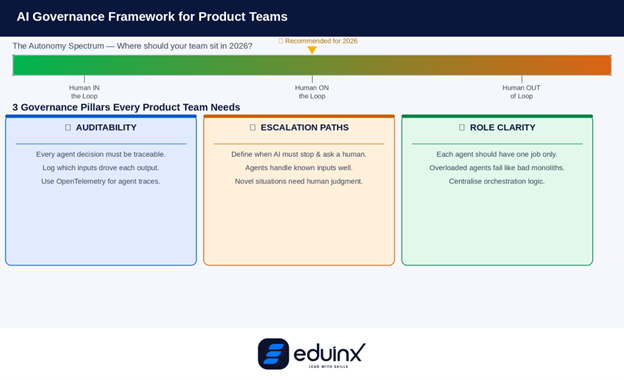
A progressive autonomy spectrum is emerging: humans in the loop, on the loop, and out of the loop, based on task complexity, business domain, workflow design, and outcome criticality. For most product teams in 2026, the right default is "human on the loop": AI agents run the coordination, but humans review outputs before they drive major decisions like roadmap commits or feature prioritization.
Inter-agent communication protocols, state management across agent boundaries, conflict resolution mechanisms, and orchestration logic become core challenges that didn't exist in single-agent systems. Product leaders need to think about these not as engineering problems alone but as product quality and risk questions.
Three governance principles matter most for product teams:
- Auditability: Every AI agent decision should be traceable. When an orchestrated system recommends dropping a feature or reprioritizing a sprint, you need to know which inputs drove that output. Production systems require rigorous tracking of agent interactions to manage costs and debug non-deterministic behavior.
- Escalation paths: Define clear rules for when the system should stop and ask a human. AI agents handle expected inputs well; they struggle with genuinely novel situations. Build escalation into your orchestration design from the start.
- Role clarity: Multi-agent systems work best when agent roles are specific. An agent doing too many things becomes as unreliable as a single-agent architecture. Define each agent's purpose clearly, and keep orchestration logic centralized.
If you're looking at how leading teams approach real-time AI deployment, the Operational Data Integration: Real-Time RAG Systems for Enterprise AI post covers patterns directly applicable to orchestration observability.
🧠 Pro Tip: Treat Observability as a Product Feature
Your AI orchestration system is itself a product that needs monitoring. Budget for logging, tracing, and dashboarding your agents' behavior from day one, not after something breaks in production. Teams that skip this step spend far more time debugging later than those who built it in early.
Connecting AI Orchestration to Agentic Product Thinking
If you've been following the shift toward agentic AI, orchestration is where that conversation gets concrete for product professionals.
The Agentic AI in Product Management covers how agentic systems are already reshaping how PMs manage their workflows end to end. AI orchestration is the architectural layer that makes agentic product thinking scalable.
And as you scale, the retrieval layer underneath your orchestration matters enormously. The RAG Evolution explains how retrieval-augmented generation architectures are evolving to support the kind of real-time, context-rich reasoning that multi-agent product systems demand.
Conclusion
AI orchestration is how product teams manage the growing complexity of modern software development without losing coherence or quality. By coordinating specialized AI agents through an intelligent management layer, product teams can automate high-friction coordination work, accelerate discovery and roadmap planning, and free up human judgment for decisions that actually need it.
The path forward is practical: identify your highest-friction handoff point, build a small orchestrated workflow around it, measure the outcome, and scale from there. The tools are mature enough. The frameworks are proven in production. What product teams need most now is the clarity to start in the right place.