Did you know that automating up to 70% of manual data collection, parsing unstructured buyer feedback, and cutting time-to-insight by roughly 60%. In today’s fast-paced business environment, staying ahead of competitors is no longer about quarterly reviews or annual strategy sessions. It is about real-time intelligence. For working professionals seeking a career breakthrough and budding entrepreneurs aiming to scale their ventures, mastering AI for Competitive Intelligence is becoming a critical skill. Artificial Intelligence (AI) is reshaping how Product Managers (PMs) monitor rivals, detect market shifts, and anticipate trends, turning competitive analysis into a dynamic, continuous process.
AI Competitor Monitoring
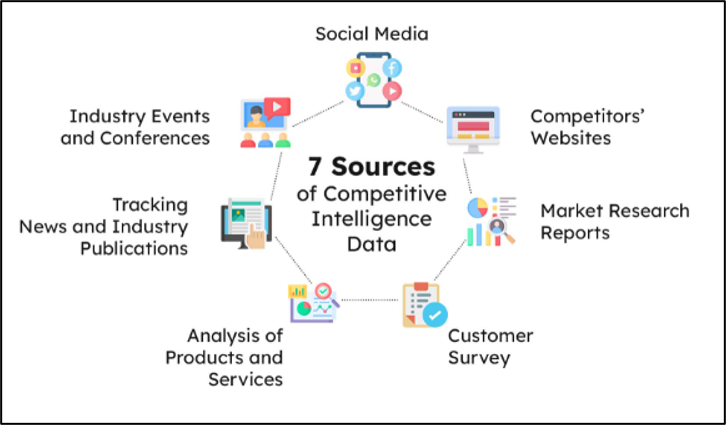
Traditional competitor monitoring relied on manual research, analyst reports, and occasional benchmarking. While useful, these methods were slow and often outdated by the time insights reached decision-makers. AI changes this by automating competitor tracking across multiple channels like social media, press releases, product updates, and customer reviews.
Source
AI-powered tools can scan thousands of data points daily, flagging competitor moves such as new product launches, pricing changes, or shifts in customer sentiment. For professionals, this means less time spent gathering data and more time interpreting insights. Entrepreneurs benefit by spotting opportunities early, whether it’s a gap in the market or a competitor’s weakness. You can also learn how AI helps with competitive intelligence.
Role of Product Managers
Product Managers are at the heart of competitive intelligence. Their role is not just to define product features but to ensure those features align with market needs and outperform rivals. AI empowers PMs by providing real-time visibility into competitor strategies and customer expectations.
Instead of relying on intuition alone, PMs can now base decisions on live data streams. For example, if a competitor introduces a new feature, AI can instantly analyze customer reactions across social platforms and forums. This allows PMs to decide whether to respond with a similar feature, improve an existing one, or pivot entirely. Understand the top AI competitor monitoring tools in 2026 .
For professionals seeking career growth, mastering AI-driven competitive intelligence positions them as strategic leaders. For entrepreneurs, it ensures their products remain relevant and differentiated in crowded markets. Learn about Competitive Intelligence for Product Managers.
How Product Managers Track Rivals and Trends
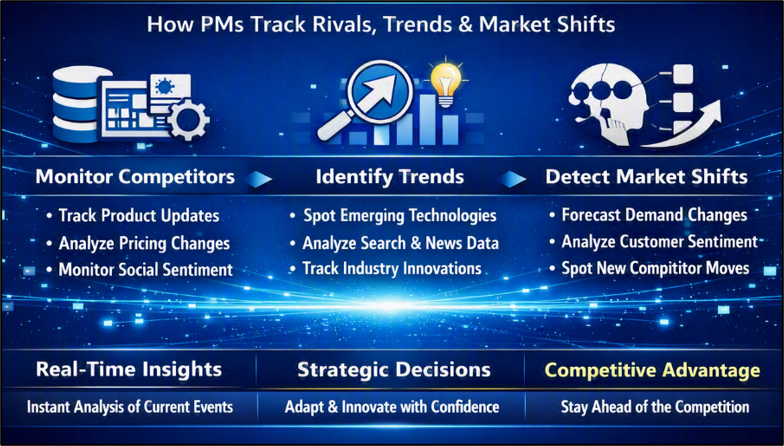
Tracking rivals and trends is no longer about static reports—it’s about dynamic monitoring. AI enables PMs to:
- Analyze competitor websites and product updates in real time.
- Monitor social media sentiment to gauge customer reactions.
- Track pricing changes across e-commerce platforms.
- Identify emerging trends by analyzing search queries, industry news, and patent filings.
These insights help PMs anticipate competitor moves and align their product strategies accordingly. For instance, if AI detects rising interest in sustainability features, PMs can prioritize eco-friendly product enhancements before competitors catch up.
For professionals, this skill translates into career advancement—being the person who spots trends before they become mainstream. For entrepreneurs, it means building products that resonate with evolving customer needs.
How Product Managers Detect Market Shifts in Real Time
Market shifts can be subtle yet transformative. AI helps PMs detect these shifts by analyzing large datasets that humans alone cannot process quickly. Examples include:
- Customer sentiment analysis: AI can detect changes in tone or emotion in customer reviews, signaling dissatisfaction or excitement.
- Demand forecasting: By analyzing purchase patterns, AI predicts shifts in demand before they appear in sales reports.
- Competitive positioning: AI identifies when competitors are moving into new markets or targeting different customer segments.
For professionals, this means being able to advise leadership on market changes before they become obvious. For entrepreneurs, it means pivoting strategies quickly to seize opportunities or avoid risks.
Future Scope
The future of AI in competitive intelligence is expansive. As AI systems become more sophisticated, they will not only monitor competitors but also simulate scenarios—predicting how rivals might respond to new product launches or pricing strategies.
We are moving toward Agentic AI systems, where AI does not just provide insights but actively recommends actions. Imagine an AI that not only detects a competitor’s new feature but also suggests how your product roadmap should adapt.
For professionals, this future means new career opportunities in AI-driven product strategy. For entrepreneurs, it means building businesses that are agile, data-driven, and resilient. AI for Competitive Intelligence is no longer optional, it is essential. For Product Managers, it transforms their role from reactive to proactive, enabling them to track rivals, trends, and market shifts in real time. For professionals seeking a career breakthrough, it’s a skill that sets them apart in a competitive job market. For entrepreneurs, it’s the difference between leading the market and playing catch-up.
By embracing AI competitor monitoring, leveraging real-time insights, and preparing for the future of agentic AI, both professionals and entrepreneurs can position themselves at the forefront of innovation. Competitive intelligence powered by AI is not just about surviving, it is about thriving in an ever-changing business landscape.
Whether you are a budding entrepreneur or a working professional,Eduinx , a leading edtech institute in India, will guide you. Our team of industry leaders and thought leaders will guide you through their expertise. We offer a holistic and practical approach towards learning concepts. We also offer guidance on completing industry led capstone projects, making you prepared to face real-time challenges in your job. Learn how to track rivals, trends, and market shifts in real time through our Get in touch with us to learn more.
Frequently Asked Questions (FAQs)
1. What is AI competitor monitoring?
AI competitor monitoring refers to the practice of using AI tools to automatically follow competitors on various platforms, such as social media, press releases, product releases, and customer feedback. Rather than culling from books, cursing through web pages, or even trying to guess this information, AI tools monitor thousands of points every day, and highlight what actions are taking place among the competition, like new product releases, pricing changes, or even consumer sentiment shifts.
2. What is the role of a product manager in competitive intelligence?
Competitive intelligence is not just used by intuitive product managers—it's used to make sure that the features you're offering are in line with market needs and outperform the competition. With AI, PMs can gain real-time insights into competitors' strategies and customer expectations, making decisions on top of live data streams rather than static, outdated reports.
3. How does AI-driven market shift detection work?
Market shifts can be detected by AI because it can analyze vast amounts of data too quickly for humans to do by themselves. This includes: Sentiment analysis for customers to identify shifts in sentiment or emotion in reviews, and Forecasting demand - anticipating demand changes in advance of them appearing in sales reports, Competitive positioning - knowing when the competition is moving into new markets and/or different customer segments.
4. What is it that AI can observe with regards to the monitoring of competitors and marketplace patterns?
PMs can monitor numerous competitive indicators with AI in real-time, such as: The appropriate website for competitors and product information. Sentiment on social media to track customer reactions. The pricing changes on various e-commerce websites. Changing prices on e-commerce websites. Trends in search, industry news and patent filings provide insight into emerging trends.
5. What will be Agentic AI's impact on the future of competitive intelligence?
Agentic AI systems are expected to go beyond just giving out insight to recommending action, for example, when detecting a competitor's new feature, recommending what the product roadmap should look like. This is a change from AI as an observation to AI as an active player in making strategic decisions.
6. What are the reasons why traditional competitor monitoring is ineffective now?
The traditional approach to competitor monitoring was more of a “Research, Analyst Report and then, maybe” method, which had its merits, but was time-consuming and outdated by the time the information actually reached the decision-makers. A slow market can allow this delay to create opportunities and risks that are not noticed in time to act on.
7. How can AI-powered competitive intelligence solutions help overcome the barrier of relying on intuition for PMs to make better decisions?
As a competitor introduces a new feature, AI can also analyze social media reactions and forum discussions in real time, giving PMs a real-time data-driven sense of how customers are reacting, thereby guiding their next step – whether to pursue a similar feature, improve an existing one, or take a different course of action. This will eliminate the guesswork and will instead give proof-based evidence direct from the mouths of true customers.
8. How can product managers leverage AI for competitor and trend monitoring for day-to-day operations?
Using AI to analyze competitor websites, ecommerce platform pricing trends, social sentiment and search query analysis of industry trends, PMs can stay ahead of the curve by recognizing new trends and making informed decisions. For example, if AI detects that people are more interested in sustainability improvements, PMs can work on sustainability improvements before it's too late.
9. Where does AI get it from to predict what a customer will perceive before they even see the sales data?
AI examines tone and emotion in customer reviews and social mentions to detect signs of increases in dissatisfaction or excitement much sooner than formal sales or churn data. This is an early warning indicator and a time to take action before it becomes a bigger issue or lost opportunity for PMs.
10. Why is AI a good thing for PMs to respond to a competitor launch?
AI can scan through social media signals and forum feedback essentially instantaneously, giving PMs the ability to make quick decisions on how to respond. This is a quick feedback loop in place of weeks of manual monitoring and guesswork.
11. What will be the impact of agentic AI on competitive intelligence processes?
The more advanced the AI system, the more it will be able to go beyond competitor monitoring to simulate scenarios, predict how competitors will react to a new product introduction or price change. This indicates the direction AI will move in the future; not merely "how is it going" but "what should we do about it" when it comes to the product roadmap.
12. What impact can AI competitive intelligence have on a professional's career?
By identifying trends sooner than others, using AI-driven insight instead of late-breaking reports, professionals become strategic leaders in their organizations. This skill set is now becoming more and more expected of candidates in a competitive job market as AI is changing the game for the PM from reactive to proactive.