Artificial Intelligence has entered a new era where data, not just algorithms, defines success. In 2026, the focus of innovation has shifted toward data-centric AI in 2026, emphasizing the importance of data quality, synthetic data generation, and feedback loops to build smarter, more reliable large language models (LLMs). As generative AI applications become mainstream, the foundation of their intelligence lies in how well their data is curated, cleaned, and continuously improved.
The Rise of Data-Centric AI
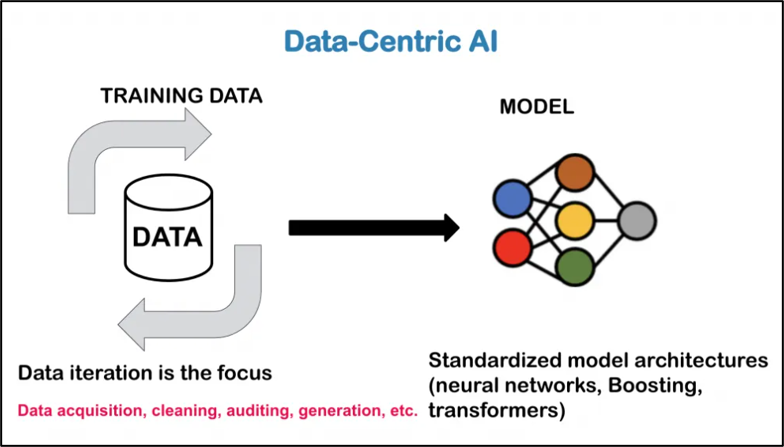
AI development has been revolving around improving model architectures like bigger networks, more parameters, and faster training. However, as models like GPT, Claude, and Gemini matured, researchers realized that performance gains increasingly depend on the quality of data rather than the complexity of algorithms. This shift gave rise to data-centric AI in 2026, a philosophy that prioritizes refining datasets over endlessly tweaking models.
Source
In this approach, the goal is not just to collect more data but to ensure that the data feeding AI systems is accurate, diverse, and representative. High-quality data helps models generalize better, reduces bias, and improves interpretability. For LLMs, this means fewer hallucinations, more factual consistency, and better contextual understanding.
Why Data Quality Matters for LLMs
Data quality for LLMs is the cornerstone of reliable AI performance. Large language models learn patterns, semantics, and reasoning from massive text corpora. If the underlying data is noisy, biased, or outdated, the model’s outputs will reflect those flaws.
Companies are investing heavily in AI data management strategies to ensure their models are trained on clean, well-labeled, and ethically sourced datasets. Data validation pipelines now include automated anomaly detection, deduplication, and bias correction. For example, enterprise AI systems use data quality metrics like completeness, consistency, and relevance to evaluate training datasets before model updates.
Better data quality translates directly into better user experiences. When LLMs are trained on curated, factual, and diverse data, they produce responses that are more accurate, context-aware, and trustworthy which are essential for applications in healthcare, finance, and education.
Synthetic Data Generation with GANs
One of the most transformative trends in data-centric AI in 2026 is the rise of synthetic data generation. Instead of relying solely on real-world data, AI systems now create artificial datasets that mimic real patterns while avoiding privacy risks.
Synthetic data helps overcome challenges like data scarcity, confidentiality, and imbalance. For example, in medical AI, synthetic patient records can be generated to train diagnostic models without exposing sensitive information. In retail, synthetic customer behavior data helps simulate purchasing patterns for predictive analytics.
Generative models such as GANs (Generative Adversarial Networks) and diffusion models are at the heart of this revolution. They produce realistic text, images, and even tabular data that enrich training sets. This approach not only improves model robustness but also accelerates experimentation thereby allowing data scientists to test hypotheses without waiting for real-world data collection.
Feedback Loops: The Engine of Continuous Improvement
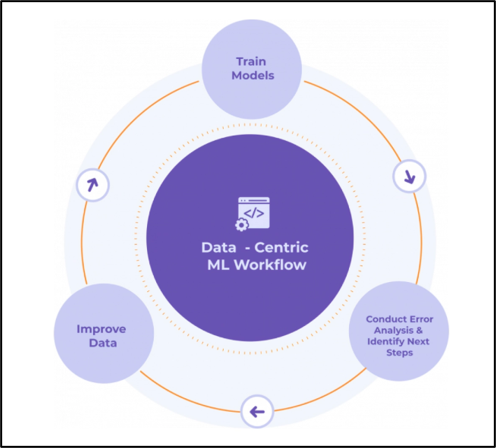
The third pillar of data-centric AI in 2026 is the integration of feedback loops in AI models. Feedback loops enable AI systems to learn from user interactions and continuously refine their outputs.
In the context of LLMs, feedback loops work by capturing user corrections, preferences, and engagement signals. These insights are then used to retrain or fine-tune the model, ensuring that it evolves with real-world usage. Reinforcement learning from human feedback (RLHF) is a prime example — it allows models to align their responses with human values and expectations.
For enterprise applications, feedback loops are embedded into workflows. Customer support bots, for instance, analyze satisfaction ratings and conversation outcomes to improve future responses. Similarly, content generation tools use user edits as implicit feedback to enhance tone, accuracy, and relevance. This dynamic learning process ensures that AI systems do not stagnate. Instead, they become adaptive, contextually aware, and increasingly aligned with user needs.
Building Better LLM Apps with Data-Centric Principles
The combination of data quality for LLMs, synthetic data generation, and feedback loops in AI models forms the backbone of next-generation LLM applications. Developers and data scientists are now designing systems that treat data as a living asset that are constantly monitored, enriched, and optimized.
Here’s how these principles translate into better LLM apps:
- Enhanced Accuracy: Clean, validated data reduces hallucinations and factual errors.
- Personalization: Feedback loops enable models to adapt to individual user preferences.
- Scalability: Synthetic data expands training possibilities without privacy concerns.
- Ethical AI: Transparent data sourcing and bias correction improve fairness and accountability.
By applying AI data management strategies, organizations can ensure that their LLMs remain reliable and compliant with evolving regulations.
Real-World Applications of Data-centric AI in 2026
Across industries, data-centric AI in 2026 is driving innovation:
- Healthcare: Synthetic medical data supports predictive diagnostics while maintaining patient privacy.
- Finance: Feedback-driven models improve fraud detection and risk assessment.
- Education: LLMs trained on high-quality educational content deliver personalized learning experiences.
- Retail: AI systems use feedback loops to refine product recommendations and customer engagement.
These examples highlight how data-centric principles are reshaping AI from static tools into dynamic, learning ecosystems.
Ethical and Regulatory Considerations
As data becomes central to AI development, ethical and regulatory challenges grow. Ensuring transparency in data sourcing, maintaining privacy, and preventing bias are critical. In 2026, global frameworks like the AI Act and emerging data governance standards emphasize accountability in AI data management strategies.
Synthetic data offers a partial solution by reducing dependence on personal information, but it must still be validated for realism and fairness. Similarly, feedback loops must be designed to avoid reinforcing biases or misinformation. Responsible data practices are now a competitive advantage — companies that prioritize ethical AI gain trust and long-term sustainability.
The Future of Data-Centric AI
Data-centric AI in 2026 is just the beginning. The next frontier involves autonomous data curation — AI systems that can assess, clean, and optimize their own datasets. Advances in self-supervised learning and data labeling automation will make this possible.
The integration of synthetic data generation and feedback loops in AI models will lead to self-improving LLMs capable of adapting to new domains without manual retraining. These models will continuously refine their understanding of language, context, and user intent, making them indispensable in every industry.
In this future, data scientists will focus less on model architecture and more on data orchestration by managing pipelines that ensure quality, diversity, and ethical integrity. The mantra of AI development will shift from “bigger models” to “better data.”
Source
The evolution of data-centric AI in 2026 marks a turning point in how we build and deploy intelligent systems. By prioritizing data quality for LLMs, leveraging synthetic data generation, and embedding feedback loops in AI models, organizations can create LLM applications that are not only smarter but also more ethical, adaptive, and reliable. The success of large language models will depend less on their size and more on the integrity of the data that shapes them.
The future of AI lies in mastering the art of data by curating it, generating it, and learning from it. With robust AI data management strategies and a commitment to continuous improvement, data scientists and developers will unlock the full potential of generative intelligence, paving the way for a new era of innovation and trust in artificial intelligence.
Now that you have understood the nuances of data centric AI and its potential for growth in the current industry. It is time for you to take a deep dive and harness the power of data centric AI to become an indispensable resource in the industry. At Eduinx, a leading edtech institute in India, we provide a hands-on approach towards learning industry relevant concepts and implementing them in real time. Our non academic mentors have over decades of experience and are thought leaders in the industry. You can get the right guidance from them to perform capstone projects and showcase them to potential employers for landing the right job. Get in touch with us to learn more about our courses.
Frequently Asked Questions (FAQs)
What is the RLHF and how does it become part of the feedback loops of the LLMs?
The RLHF (Reinforcement Learning from Human Feedback) is a particular method that involves adjusting the model's output in response to the human feedback on the quality, helpfulness, or desired alignment of the responses. It's a great illustration of a feedback loop at work as a model is allowed to adapt over time to increase the likelihood that it will behave in the manner similar to humans, rather than optimizing on the original training data.
What are the metrics used to assess training sets in the enterprises?
Before models can be updated on an enterprise AI system, several key metrics are usually evaluated of the data set:
- Completeness — verifying if there are any missing fields or missing data in the data
- Consistency—Conflicting and/or contradictory records caught
- Validity — whether the data is suitable for the model's learning goal
They enable teams to identify issues before they can be passed down to a model's outputs, as opposed to finding them after deployment.
What is autonomous data curation?
With the advent of AI technology such as self-supervised learning and automated data labelling, autonomous data curation involves the AI systems analysing, cleaning, and optimizing their training sets with minimal human oversight. It's referred to as the next frontier of data-centric AI, as it removes the need for manual data pipeline management and replaces it with one that is self-governing.
What is the difference between Data-centric AI and Model-centric AI?
The two ways make use of different levers to make the performance better:
- AI based on models can also enhance outcomes, by making models larger, increase the number of parameters, or make improvements to the training process, without changing the data scale.
- Rather than complex models, data-centric AI focuses on enhancing the data itself: making it more accurate, diverse and representative, and assuming that better data will lead to better performance.
How synthetic data can address data scarcity and imbalance?
In situations where real data is scarce, has skewed distributions across categories, or is too sensitive to be used directly, synthetic data generation can be used to generate artificial datasets with similar statistical patterns as the original data. This lets the data scientists expand and balance a training set — for example, generating more examples of an underrepresented category — without waiting for more real-world data to be collected.
Why is it important to validate the synthetic data for realism and fairness?
While the synthetic data may not contain the actual personal data, it can be derived from, or perpetuate biases in, the data it was generated from if it is not examined with care. If the synthetic data is validated for realism and fairness, then it would represent the performance and not just put in patterns that would subconsciously be negative for reliability.
What makes it necessary for feedback loops to be designed carefully to prevent their introduction of bias?
A feedback loop that only collects the feedback of a small or unrepresentative subset of users can result in the model being optimized for those users, but not for the wider accuracy or fairness. Having a few seconds of careful design involves assessing where the feedback is coming from and making sure the feedback does not subtly reinforce the user engagement skew over the time.
How do the feedback loops actually contribute to improving the customer support bot's response?
The customer support bots can continuously listen to and analyze customer satisfaction and conversational success metrics to continuously adjust their responses, without having to undergo a full training cycle each time. This enables it to develop over time according to real-life conditions where it is used.
What are some of the examples of educational LLM applications that can be developed using data-centric AI?
When trained on well-curated educational content, the quality of the educational content in LLM training directly affects the reliability of the responses, allowing LLM to provide more individualized and accurate learning experiences.In this way, the importance of data curation in ed tech is no less than in other critical fields, such as healthcare and financial.
What is data orchestration? Why will it be more important than model architecture?
Data orchestration is the ability to support a high-quality, diverse and ethically sourced training data pipeline that will keep your model's input data consistent over time, not just as a one-off setup. With data centric AI becoming more common, data scientists should expect to spend more time on this level of pipeline management, and less time on modifying the model architecture because data integrity can actually affect performance more than the complexity of the model.
How is data considered as a "living asset" in data-centric AI, and not just a static resource?
Instead of collecting data once and allowing it to sit static after the initial model training, treating data as a living asset means that it is continually monitored, enriched, and optimized over time. This change of perspective is an important part of data-centric AI, as continuous data quality (not just a snapshot at a particular time), is what ensures that an LLM application always remains accurate and relevant in the real world.