Every time you open Netflix, it already knows what you want to watch. Every time you land on Amazon, the homepage looks like it was built just for you. That is not a coincidence, that is AI-driven personalization working in real time, processing hundreds of signals before you even type a single word.
For businesses building products today, hyper-personalization is no longer a feature. It is the expectation. According to McKinsey, 80% of consumers are more likely to buy from a company that offers personalized experiences. The question is no longer whether to personalize, but how to do it at scale without losing speed or accuracy.
This blog breaks down how AI for customer experience actually works, the core technologies powering it, and what it means for product team and data professionals.
From Segmentation to Individuation: What Changed
Traditional personalization was built on segments. Marketers divided audiences by age, city, and purchase history, then crafted messages for each bucket. The problem: two people in the same segment could behave completely differently, and the system had no way to tell them apart.
AI changed the unit of analysis from “a group that looks like you” to “specifically you.”
Modern AI-driven personalization pulls in behavioral data personalization signals that older systems simply could not handle: time of day, device type, scroll depth, hover duration, etc. It then builds a dynamic profile for each user that updates continuously, not once a month.
The result is what practitioners call a “1:1 experience at scale”, something that was theoretically appealing but operationally impossible before machine learning made it viable.
💡 Pro Tip: Start with Behavioral Events, Not Demographic
When building a personalization system, skip demographic fields first. Set up event tracking on user actions: clicks, searches, scrolls, session length, and return visits. Behavioral signals produce far more accurate models than age or location alone.
The Tech Stack Behind AI-Powered Product Customization
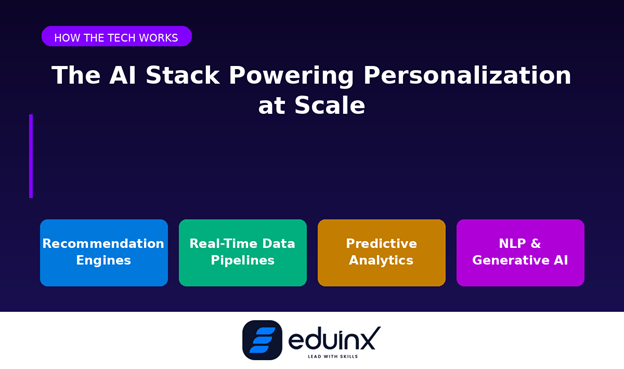
Understanding hyper-personalization requires understanding what actually runs underneath it. There are four core technologies doing the heavy lifting.
Recommendation Engines
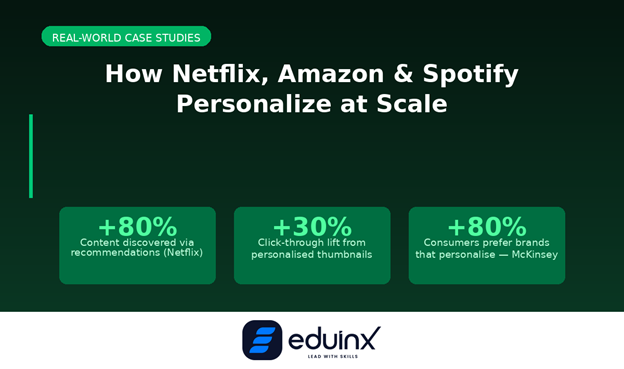
These are the most visible face of AI-powered product customization. Netflix's recommendation engine uses collaborative filtering — it identifies users with similar viewing patterns and surfaces content that matched users in that cluster have watched. According to Netflix, over 80% of content watched on the platform is discovered through its recommendation system, not search.
Amazon takes a related but distinct approach. Its system uses deep learning to analyze purchase history, browsing behavior, and product co-purchase relationships in real time. Every time you browse a product on Amazon, its algorithms are updating what they show you on the very same session — not waiting for your next visit.
Spotify combines content-based filtering (what a track sounds like) with collaborative filtering (what listeners similar to you enjoy) to generate playlists like Discover Weekly. The signal set includes not just song plays but also skips, replays, shuffle behavior, and playlist additions.
Real-Time Customer Data Analytics Pipelines
The personalization you experience is only as good as the data flowing into it. Real-time customer data analytics infrastructure typically involves event streaming platforms like Apache Kafka or AWS Kinesis, which can process millions of user events per second without delay. These feed into feature stores — centralized repositories that hold precomputed user attributes so that the model does not have to recalculate everything from scratch on each request.
This matters because speed is everything. Traditional systems would update customer segments once a month. Modern AI personalization systems adjust recommendations while you are still on the page.
Predictive Analytics
Predictive models go beyond reacting to what you just clicked. They forecast what you are likely to want next, based on patterns across your entire history and the behavior of similar users. This is how a wellness brand like Hydrant can identify customers at risk of churning before they actually leave — and serve them a personalized retention offer at exactly the right moment.
In e-commerce, predictive analytics powers inventory decisions, promotional targeting, and even pricing strategies personalized to individual willingness to pay.
Natural Language Processing (NLP) for Personalization
Generative AI and LLMs have added a new dimension to AI for customer experience. Companies now use NLP to craft personalized email subject lines, dynamic product descriptions, and chatbot responses that are calibrated to each user's communication style and history. Amazon Personalize, for instance, can generate email subject lines tailored to individual customers — improving open rates meaningfully over generic copy.
The reason LLMs can do this so effectively is that they understand context, not just keywords — and the way generative AI moves from language understanding to real-world application is what makes this kind of dynamic, user-specific content generation possible at scale.
💡 Pro Tip: Use a Feature Store to Unify Your Data
One of the most common bottlenecks in AI personalization is fragmented data — user behavior in one system, purchase history in another, support tickets somewhere else. A centralized feature store (Tecton, Feast, or even a well-structured data warehouse) ensures your model always has a complete view of the customer. Without it, you are personalizing on incomplete information.
How Leading Companies Are Actually Doing This
Netflix: Personalizing Everything, Including the Thumbnail
Netflix does not just personalize what it recommends. It personalizes how content is presented. The thumbnail image you see for a title is chosen by an algorithm based on your viewing history. Two users looking at the same show might see entirely different artwork — one optimized for drama, one for comedy — because the system has inferred what visual style resonates with each person. Personalized thumbnails have been shown to increase click-through rates by 30%.
Netflix also runs continuous A/B testing across its interface, using real-time customer data analytics to determine whether a layout change, content placement, or notification type improves engagement. Nothing in the UI is static.
Amazon: The Homepage That Belongs to You
Every Amazon homepage is unique. The platform dynamically assembles what you see based on your real-time session behavior — not just your past purchase history. If you spent five minutes looking at yoga mats, the product rail on the next page immediately shifts toward athletic accessories. Deep learning models are doing this inference in milliseconds.
This is AI-powered product customization at its most commercially effective — a direct result of investing in real-time behavioral data infrastructure.
Operational AI in Enterprise: Not Just for Giants
The misconception is that this level of personalization is only achievable for tech giants with billion-dollar data teams. That is increasingly untrue. Cloud-native tools like AWS Personalize, Google Recommendations AI, and Vertex AI make it possible for mid-sized product teams to deploy real-time recommendation systems without building from scratch.
The key is getting your operational data to flow into these systems in real time — which is a data integration challenge as much as an AI one. The same real-time data integration principles that power enterprise AI retrieval apply directly to building live personalization pipelines.
The Data Ethics Problem You Cannot Ignore
Hyper-personalization runs on customer data. That creates real responsibilities.
Regulations like GDPR and India's Digital Personal Data Protection Act place strict requirements on how companies collect, store, and use personal data. The shift toward first-party and zero-party data — information users intentionally share — is not just a compliance trend. It is becoming the foundation for sustainable personalization.
Brands doing this well are building consent-based data strategies: asking users their preferences directly, explaining how data will be used, and giving them control. This also yields cleaner signals. A user who actively tells you they prefer action films gives you a more reliable input than one whose watch history was influenced by someone else on the same account.
There is also the filter bubble problem to manage. Recommendation systems optimized purely for engagement can trap users in narrow loops. Good personalization systems build in diversity deliberately — surfacing things users might not have discovered on their own, which is a stronger long-term retention mechanism.
"AI capabilities are now reaching a level that enables enterprises to move from limited tailored responses to continuous personalized interactions. The challenge has always been that true personalization requires knowing the customer deeply, acting on that knowledge in real time, and doing so across thousands or millions of interactions simultaneously."
— CX Today, CX Trends 2025 Part 3 Report
What Hyper-Personalization Trends Mean for Your Career
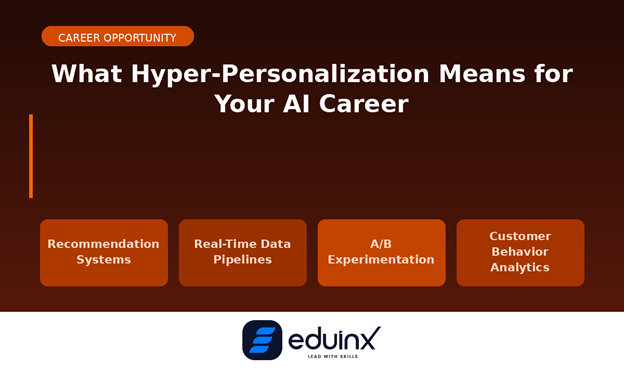
If you are a data professional or someone transitioning into AI/ML, hyper-personalization is one of the most commercially in-demand skill sets right now. Product companies across fintech, edtech, e-commerce, and healthtech are hiring at the intersection of machine learning, data engineering, and product thinking.
The skills that matter most: building and evaluating recommendation systems, designing real-time data pipelines, working with feature stores, running A/B experiments, and understanding customer behavior tracking tools like Segment, Amplitude, or Mixpanel.
Companies want people who can take a behavioral dataset, build a working personalization model, and ship it into a product pipeline. That requires both technical depth and an understanding of the business outcome you are optimizing for.
One area worth investing time in is understanding how LLMs get fine-tuned for specific domains — because personalization systems increasingly rely on models adapted to a particular product context, not just general-purpose ones. Parameter-efficient fine-tuning strategies are directly relevant to anyone building production-grade AI personalization.
💡 Pro Tip: Build a Personalization Portfolio Project
Do not wait for a job to start building in this space. Take a public dataset — MovieLens for collaborative filtering, or a retail dataset from Kaggle — and build a full recommendation system. Document your feature engineering, model choices, and evaluation metrics (NDCG, precision@k, coverage). A working GitHub project with clear results gets noticed far faster than a certification alone.
Conclusion
AI-driven personalization has crossed from competitive advantage to table stakes. Customers now expect products to know them — to surface the right content, product, or message at the right moment without making them work for it.
The opportunity is not limited to tech giants. What separates companies that scale personalization effectively from those that struggle is not team size — it is the quality of their data strategy, the rigor of their experimentation, and the technical talent they bring to the problem.
If you are building skills in this space, you are working on one of the most commercially relevant problems in AI today.