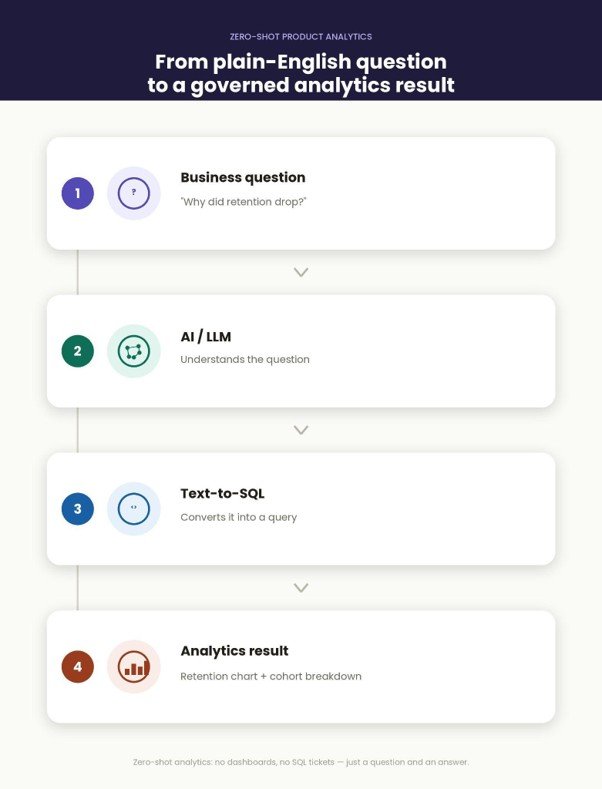
Zero-shot product analytics is a technology that lets you ask business questions in plain English and get data-driven answers without writing SQL, Python, or other code. For example, a product manager can ask, "Why did retention drop for new signups last month?" and instantly get a breakdown by cohort, plan tier, and onboarding step. In 2026, AI is making product analytics increasingly conversational, allowing teams to explore data through natural-language questions.
If your team still waits days for dashboard refreshes and ad-hoc SQL tickets, this article shows you how zero-shot analytics turns data into a conversation and what you need to do to make the answers trustworthy.
What Is Zero-Shot Product Analytics?
Zero-shot means the system can interpret and answer a new analytics question without being given task-specific examples for that question. Zero-shot product analytics is a conversational approach to analyzing product data that lets users interact with data using natural language rather than predefined dashboards. Traditional BI is built around filters, fixed views, and scheduled reports; zero-shot analytics is built around interaction, follow-up questions, and instant answers.
Two technologies make this possible:
- Text-to-SQL automatically translates a natural-language question into a structured SQL query that runs against your warehouse.
- Large Language Models (LLMs) understand intent, context, and nuance; they interpret synonyms, vague phrasing, and follow-up questions. Combined, they turn data analysis into a conversation. You don't need to know table names, join conditions, or query syntax; you just ask.
The twist in 2026 is that it is no longer just text-to-SQL. AI agents do more than just static dashboards; they can help product teams analyze anomalies, compare segments, and uncover patterns that can drive product decisions. This same approach can also support AI for competitive intelligence in product management by helping teams analyze market and competitor information more efficiently.
Why Zero-Shot Analytics Is Exploding in 2026
Analytics is becoming more conversational. Teams can increasingly use natural-language interfaces to sift through data and ask questions regarding it, rather than relying entirely on dashboards and technical queries. Mixpanel's 2026 State of Digital Analytics report, built on 22+ billion user actions across eight industries, identifies this as one of the defining shifts of the year: AI has become the front door to data, and analytics can no longer just explain what happened. It has to help teams decide what to do next.
Retention is also becoming an increasingly critical area for teams to focus on when considering long-term product growth, the report notes. With complex user journeys, product teams require quick methods to recognize shifts in user behavior and to understand the motivating factors. Natural-language analytics can help make that exploration easier.
The Architecture of Trust: Semantic vs. Context Layers
Here's where zero-shot analytics becomes more than simply connecting an LLM to a database. The model needs to understand not only what data exists, but also what that data means and how it should be used.
Two layers are particularly important:
| Layer | Function | Core Components |
|---|---|---|
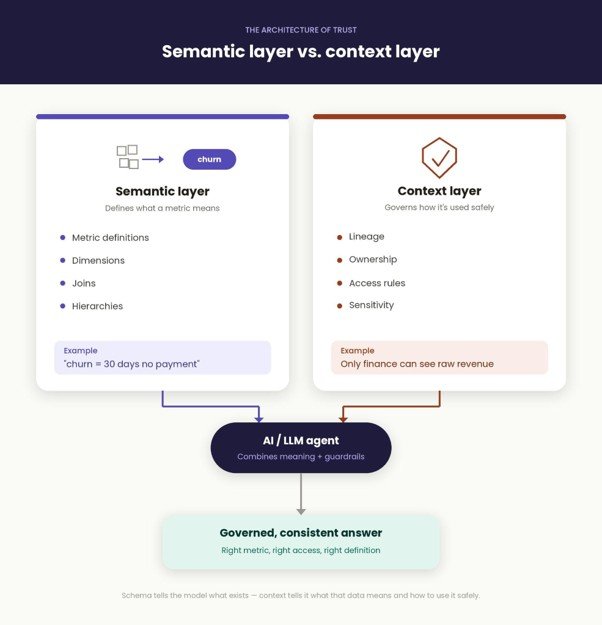
| Semantic Layer | Defines and translates raw data into governed business metrics | Metric definitions, dimensions, joins, hierarchies, calculations |
| Context Layer | Provides the business and operational context needed to use those metrics correctly | Lineage, ownership, policies, sensitivity, business rules, temporal validity |
The semantic layer specifies the meaning of a metric. For instance, a company could set the "churn" metric as any customer who skips a payment for 30 days in a row.
The context layer provides the context that an AI agent uses to apply the definition properly. It can be used to identify the correct metric definition, the right data source, the business rules, the data owner, and even whether the information can be accessed.
How the Semantic and Context Layers Work Together
Consider a product manager asking:
"What was our churn rate last quarter?"
The system has to do more than find a column named churn.
- Schema: Identifies the relevant tables, columns, and relationships.
- Semantic layer: Determines the governed definition of "churn" and how the metric should be calculated.
- Context layer: Determines which business definition, date logic, data source, and access rules apply.
- LLM or AI agent: Interprets the natural-language question, selects the appropriate information, and translates the request into an executable analysis.
With this separation, the possibility that an AI system could generate a plausible-looking answer but be based on the wrong metric or business definition is minimized.
If these layers are not present, two big issues may arise:
- Hallucination and inconsistent calculations: An LLM working directly from raw tables may infer metric definitions or relationships incorrectly, potentially producing different results for similar questions.
- Governance problems: An AI system may produce a technically valid result without applying the organization's access controls, data policies, or source requirements.
The goal is not simply to make AI generate SQL. It is to give the AI enough semantic and business context to generate analysis that is relevant, consistent, and governed.
Why Does Context Matter More Than Schema?
Schema tells the model what columns and relationships exist. Context helps the model understand what those fields mean in the business and which definitions, joins, and time periods should apply. Without that context, an AI system may generate a technically valid query based on the wrong business definition.
Standardizing the Interface: Model Context Protocol (MCP)
As AI becomes part of the analytics workflow, one challenge is connecting AI tools to business data and the systems they need to work with. The Model Context Protocol (MCP) provides a standardized way for AI applications to interact with external tools and contextual information.
MCP works through three core primitives:
- Tools: Actions an AI agent can perform, such as running an approved query or retrieving a report.
- Resources: Context the AI can access, such as documentation, data definitions, or other reference information.
- Prompts: Reusable instructions that help guide how an AI application interacts with tools and resources.
The exact workflow varies by implementation, but an MCP-based analytics system can use approved tools and contextual resources to help an AI agent discover relevant data, apply access controls, and execute governed queries.
How MCP Can Support an Analytics Workflow
A typical MCP-enabled analytics workflow may involve four steps:
- Discovery: The AI client identifies the approved tools and resources available to it.
- Context ingestion: The agent accesses relevant business definitions, documentation, and data context rather than relying only on raw database schema.
- Security filtering: The surrounding access-control system determines which data and actions are available to the AI agent and the user.
- Query execution: The system uses the appropriate tools and governed data layer to execute the analysis and return the result.
MCP does not determine the accuracy, speed, or governance of an analytics system on its own. Those depend on how the surrounding data infrastructure, semantic layer, access controls, and AI application are designed.
What Zero-Shot Analytics Can and Can't Answer
Be honest with your team about limits. Zero-shot analytics is excellent at:
- Retention and churn analysis: You can ask “Which segments had the highest churn last quarter?" and get an answer with a breakdown by plan tier, region, or tenure
- Funnel and activation analysis: Ask "Where do new users drop off in onboarding?"
- Cohort comparisons: Asking "How does 7-day retention differ by acquisition channel?" is effective.
It's risky for causal questions like "Which feature caused the drop this week?" — because the model can't know causation from correlation. And it's a poor fit for complex multi-join queries or metrics that need a definition the model can't infer. Treat it as a fast first pass that surfaces questions, with human validation for anything high-stakes.
For product teams, this distinction is especially important when using AI for experimentation.Generative AI can also help product managers run A/B tests more efficiently, but experiment design and statistical interpretation still require careful validation.
A Practical Adoption Playbook for 2026
- Define your semantic layer first: Agree on metric definitions before wiring up agents — otherwise you inherit inconsistent math.
- Build the context layer with enriched metadata: Glossary terms, lineage, and policy can improve the reliability of AI-generated queries.
- Start narrow: Pick a small set of well-defined metrics and a "golden query" test set to measure accuracy before rollout.
- Keep the human in the loop: Agents can plan experiments and flag churn risks, but final validation stays human.
- Measure success: Track percentage of questions answered correctly, time saved per query, and reduction in ad-hoc SQL tickets.
As AI becomes increasingly integrated into product decision-making, product managers can benefit from understanding how to apply AI across analytics, experimentation, research, and product workflows. Product managers who want to build these skills can explore Eduinx's AI in Product Management.
Key Takeaways
- Zero-shot product analytics lets teams turn natural-language business questions into conversational data analysis without manually writing SQL.
- The semantic layer defines what metrics mean; the context layer governs how agents use them safely.
- Build the context layer with enriched metadata: Glossary terms, lineage, and business context can improve the reliability of AI-generated queries.
- MCP standardizes how AI tools connect to enterprise data, enabling composable stacks.
- Retention, not acquisition, is becoming a critical growth metric in 2026, and zero-shot analytics can help teams act on it.
Take the Next Step with Generative AI
Teams looking to build a stronger foundation in generative AI can explore Eduinx's Generative AI course to learn more about how modern AI technologies are applied in real-world workflows.
Frequently Asked Questions (FAQs)
What is zero-shot product analytics?
Zero-shot product analytics lets users ask business questions in natural language and receive data-driven answers without manually writing SQL or code. The system interprets the question, generates an appropriate query or analysis, and returns the result.
How is zero-shot analytics different from few-shot analytics?
Zero-shot answers a question with no prior examples for that task; few-shot provides a few examples to guide the model. Zero-shot scales better across many questions but benefits from a strong semantic layer to stay accurate.
What is the semantic layer in analytics?
It translates raw data into governed business metrics — metric definitions, dimensions, joins, and calculations. It's the "math" that tells the model what a metric like churn or revenue actually means.
What is the context layer in analytics?
It provides the business and operational context AI agents need to use metrics correctly, including lineage, ownership, policies, data sensitivity, and applicable business rules.
Why do LLMs hallucinate in analytics?
Pointed at raw tables, an LLM deduces math on the fly and can return different numbers for the same question. A semantic layer stops this by giving it governed, consistent metric definitions.
What is the Model Context Protocol (MCP)?
MCP is an open standard that provides a consistent way for AI applications to interact with external tools and contextual information. It supports tools, resources, and prompts, reducing the need to build a separate interface for every AI application and data source.
Is zero-shot product analytics accurate enough for production?
It can be production-ready for defined use cases when supported by governed metrics, access controls, testing, and human validation. Accuracy should be measured against a representative set of real business questions before deployment.
Do product managers still need SQL?
Not necessarily for everyday analytics. Natural-language interfaces can reduce the need for PMs to write SQL, but SQL remains valuable for validating complex analyses, investigating edge cases, and working with data teams.
What is a churn risk score, and how do teams use it?
It's a score that flags users likely to churn. Teams use it to trigger high-value actions, like targeted offers or support outreach, within a short window of signup, making retention proactive instead of reactive.
Can zero-shot analytics replace traditional BI dashboards?
Zero-shot analytics does not necessarily replace traditional BI; it complements it. Dashboards are useful for recurring KPIs and standardized reporting, while natural-language analytics is better suited to ad-hoc questions and exploration.