Introduction
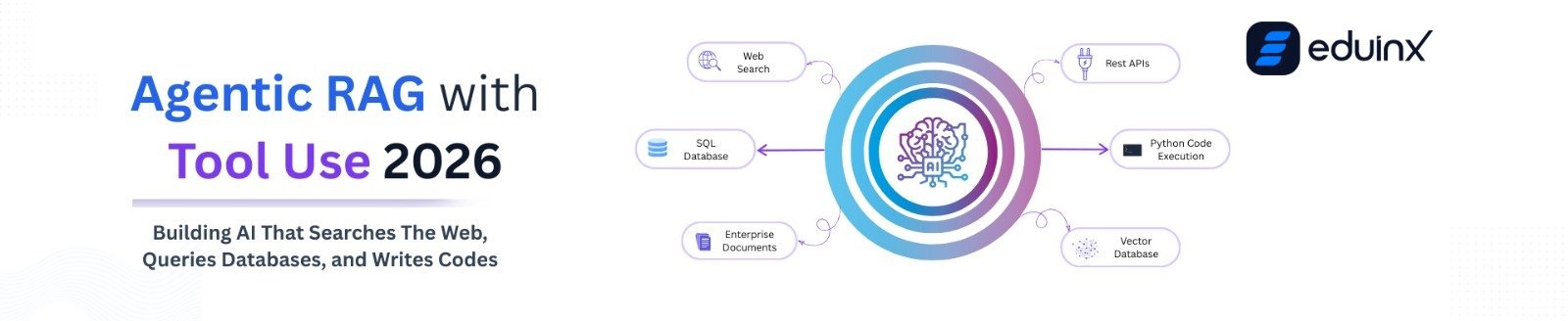
Ask a standard RAG pipeline a question outside its indexed documents and it simply fails. Ask an agentic RAG system the same question and it decides to open a browser tab, run a database query, or write a short script to check. That shift, from lookup to decision, is what separates agentic RAG from everything that came before it.
In 2026, agentic RAG has moved out of research demos and into production systems that plan, act, and check their own work. This guide breaks down what agentic RAG actually is, how the architecture works, and how tool-using AI agents are already automating research, analysis, and engineering tasks at companies hiring for exactly these skills right now.
What Is Agentic RAG? The Real Difference Between RAG and Agentic RAG
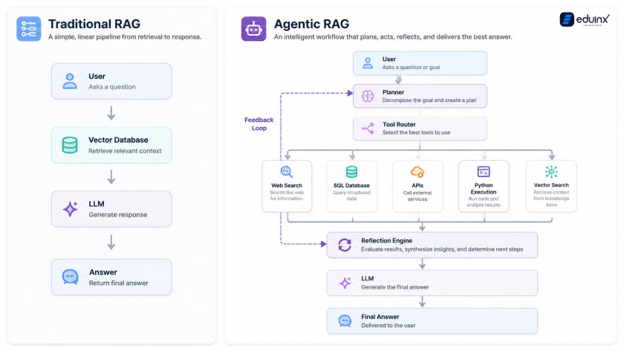
Classic RAG follows one path: embed the query, retrieve the closest chunks, stuff them into the prompt, generate an answer. It works well for straightforward document lookup, but it has no way to notice when the retrieved information is wrong, incomplete, or simply out of date.
Agentic RAG changes the sequence. Instead of retrieve then generate, the system plans, retrieves, reflects, and decides whether it needs to retrieve again. The model isn't just producing text anymore, it's acting as a router, a planner, and a reasoner that chooses which tool actually fits the question. If you want a clean walkthrough of the core mechanics of retrieval augmented generation before going deeper into the agentic layer, that's the right place to start.
The difference between RAG and agentic RAG really comes down to control. A traditional pipeline is reactive. Agentic RAG is proactive: it can rewrite a bad query, check a second source, or call a tool that the original prompt never mentioned.
Why Static Retrieval Falls Short
Static retrieval assumes the answer already lives somewhere in your vector index. That assumption breaks the moment someone asks about something happening right now, something scattered across multiple systems, or something that needs a calculation instead of a citation. Agentic RAG closes that gap by giving the model permission to go get what it needs instead of settling for whatever was already indexed.
Before adding an agent layer to your RAG system, log where the current pipeline actually breaks down. If failures trace back to ambiguity or missing real-time data, agentic RAG solves a genuine problem. If your queries are simple and single-hop, the added latency and cost may not be worth it yet.
The Agentic RAG Architecture: Planner, Router, and Reflection Loop
A production agentic RAG architecture is built in layers, not a straight line. An orchestration layer manages state and directs data between specialized agents. A planner breaks the user's question into smaller sub-tasks. A router decides which tool or data source fits each sub-task, whether that's vector search, a SQL database, or a live API.
Recent breakdowns of this pattern describe it as a loop rather than a pipeline: the system moves from query to plan to tool use to reflection and back to answering again, rather than following a single straight path. That loop, sometimes implemented as ReAct, is what lets the model catch its own mistakes mid-task instead of committing to a wrong answer early.
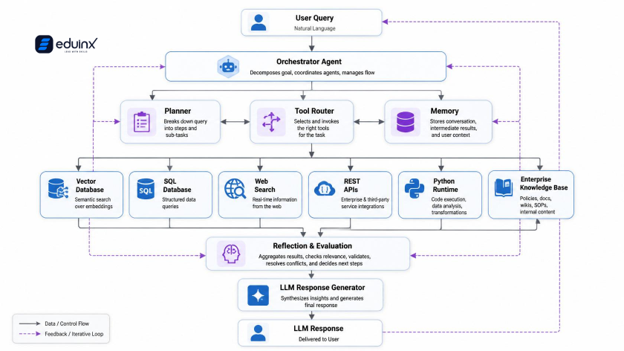
This layered design is also why Eduinx's breakdown of the shift from basic retrieval pipelines to agentic AI frameworks is worth reading before you start building. It maps out exactly where each generation of RAG design added a new capability on top of the last.
A fourth layer matters just as much as the first three: the critic, sometimes called a faithfulness judge. Its job is to look at the draft answer and check it against the retrieved evidence before anything reaches the user. If the answer drifts from what was actually retrieved, the critic sends the task back into the loop instead of letting a confident but wrong response go out. Add a memory layer on top of that, so the agent can recall what worked in past sessions, and you get a system that keeps improving instead of repeating the same retrieval mistakes every single run.
Function Calling: The Bridge Between Reasoning and Action
Function calling is what turns a reasoning model into an agent that can actually do something. Instead of only producing text, the model outputs a structured call, a function name plus arguments, that your code executes and feeds back into the conversation. This is the technical foundation behind API integration in agentic RAG: the model decides when to hit a weather API, when to query a customer database, and when a plain text answer is already enough.
Give every tool a clear name, a tight description, and strict argument types. Vague tool descriptions are the single biggest cause of agents calling the wrong function at the wrong time.
Tool-Using AI Agents in Practice: Web Search, Databases, and Code
Three tool categories show up in almost every production agentic RAG system today.
Web browsing agents handle anything time-sensitive: prices, news, current statistics, or facts your internal documents were never going to contain. A support agent checking whether a vendor's API had an outage this morning is a web browsing task, not a document retrieval task, and agentic RAG is what lets the same system recognize that distinction on its own.
Database and API tools let the agent pull structured, verified data instead of guessing from unstructured text. Ask a finance assistant for last quarter's actual revenue by region and you want a live SQL query against the data warehouse, not a paraphrase of a slide deck that might already be outdated.
Code execution tools let the agent do actual math, transform data, or validate its own output before answering, rather than hallucinating a calculation it never really ran. This is also where agentic RAG starts to blur into general AI automation: an agent that can write and run a short script to clean a dataset or verify a formula is doing real engineering work, not just retrieval.
This tool-use pattern already shows up in how people use AI day to day. Coding and technical work make up roughly a third of all Claude.ai conversations today, the single largest usage category tracked in Anthropic's Economic Index, which says a lot about where tool-using agents are already earning their keep.
"The best and safest form factors for AI agents right now are assistive."
- Jerry Liu, Co-founder and CEO, LlamaIndex: DataCamp podcast interview
Why Enterprises Are Adopting AI Agents for Automation
The numbers explain the urgency. Roughly 62% of organizations are now at least experimenting with AI agents, and about 23% are actively scaling agentic AI in at least one business function. That gap between experimenting and scaling is exactly where most of the hiring demand sits: companies got an agent working in a demo but need engineers who can make it reliable in production.
That said, this isn't a guaranteed win. Analysts project that more than 40% of agentic AI projects will be canceled by the end of 2027, citing rising costs, unclear business value, and weak risk controls. The lesson isn't to avoid agentic RAG, it's to build it with the same rigor as any production system: evaluation, monitoring, and clear boundaries on what the agent is allowed to do on its own. That's also where eliable guardrails for AI systems stop being optional and start being part of the architecture itself.
Treat every tool call an agent makes as an event worth tracing. When something goes wrong in production, a full trace of what was retrieved, what was called, and why is the only way to debug it fast.
Getting Started: Skills You Need to Build Agentic RAG Systems
If you want to work on agentic RAG systems, the skill stack looks different from classic RAG work. You still need retrieval fundamentals: embeddings, chunking, reranking, and enough vector database experience to know why a bad chunking strategy quietly ruins every downstream step. On top of that, you now need agent frameworks like LangGraph or LlamaIndex, comfort with function calling and API integration, and enough software engineering discipline to handle retries, latency budgets, and observability in a system that makes its own decisions.
Python is still the baseline language for almost all of this work, paired with async programming once you start running multiple tool calls in parallel. Familiarity with a vector store such as Pinecone or pgvector, plus a workflow orchestration tool like LangGraph, covers most of the practical stack employers are screening for right now.
This is also where AI reasoning and AI decision-making stop being abstract concepts and start being things you actually design and test, since the agent's judgment about when to retrieve, when to call a tool, and when to stop is the whole product.
Conclusion
Agentic RAG isn't a bigger version of RAG, it's a different kind of system. Where classic RAG retrieves once and answers, agentic RAG plans, acts, checks its own work, and decides when it actually has enough to respond. That shift, from a fixed pipeline to a system that reasons about its own next step, is what lets AI agents search the web, query live databases, and write code inside a single workflow.
For working professionals and students building AI and data science careers in 2026, this is the architecture worth understanding now, not later. The companies scaling agentic AI successfully are the ones hiring engineers who understand both halves of the problem: retrieval fundamentals and the agent design layer sitting on top of them.
Frequently Asked Questions (FAQs)
1. What is the difference between RAG and agentic RAG?
Classic RAG retrieves once and generates an answer in a single pass. Agentic RAG adds planning and reflection, so the system can decide to retrieve again, call a tool, or rewrite its own query before answering.
2. Is agentic RAG the same thing as an AI agent?
Not exactly. An AI agent is the broader concept of a model that can reason and take action. Agentic RAG is a specific pattern where that agent behavior is applied to retrieval and grounding tasks.
3. What is the orchestration layer of an agentic RAG?
The orchestration layer is the control system that manages state and data flow between an agentic RAG system's specialized agents. Instead of following one fixed path, it runs the planner, router, and reflection steps as a loop, allowing the system to revisit earlier steps until it reaches a reliable answer.
4. What does the planner do in an agentic RAG?
The planner breaks a user's question into smaller sub-tasks before any retrieval happens. This is what lets agentic RAG handle multi-part questions reliably — rather than relying on one tool or data source, it assigns each piece of the question to the tool best suited to solve it.
5. What is the router in an agentic RAG?
The router is used to work on sub-tasks designated by the planner, routing queries to tools such as vector search, a SQL database, or an API call. This decision-making enables the system to recognize, for instance, the need to do a live web lookup rather than a document search for a pricing question.
6. What is the reflection loop or ReAct pattern in agentic RAG?
The reflection loop (often the ReAct pattern) takes the system from the query phase to the plan phase, to the use of a tool, and then back to the phase of reflection before the answer phase, rather than a linear path. It acts as a loop for the model to correct its own errors halfway through a process rather than failing at the end.
7. What is a critic or faithfulness judge in an agentic RAG?
A critic checks a draft answer against the retrieved evidence before it reaches the user. If the answer doesn't match what was actually retrieved, the critic sends the task back into the loop instead of letting the system present a confident but incorrect response.
8. What is function calling in AI agents?
Function calling lets a model output a structured request, a function name with arguments, that your code executes. It's how an agent moves from suggesting an action to actually performing one.
9. How does memory improve agentic RAG systems?
Memory lets an agentic RAG system recall what worked in past sessions so it doesn't repeat the same retrieval mistakes. Combined with the critic layer, this creates a system that improves over time rather than treating every query as a one-off, isolated task.
10. Do I need agentic RAG for every use case?
No. If your queries are simple and single-hop, a standard RAG pipeline is faster, cheaper, and easier to debug. Agentic RAG earns its cost when queries are ambiguous or need multiple tools.
11. What do web browsing agents do in agentic RAG?
Anything time-sensitive, like prices, breaking news, or current statistics—which were never to be recorded in internal documents—are done by web browsing agents. They handle non-document retrieval tasks, allowing the system to find real-time answers without human intervention.
12. What are the roles of databases and API tools in an agentic RAG system?
A database or API tool can provide structured and verified data for an agent to retrieve rather than guessing based on unstructured textual data. This ensures users get actual, up-to-date metrics rather than paraphrased, potentially outdated data.
13. In agentic RAG, what are code execution tools used for?
Code execution tools allow an agent to perform actual calculations, data transformations, or validations of their own output prior to answering. This moves the system into general AI automation, as the agent can write and execute a script instead of hallucinating a computation.
14. What skills do I need to build agentic RAG systems?
Start with retrieval fundamentals like embeddings and reranking, then add agent frameworks like LangGraph or LlamaIndex, function calling, and basic observability so you can trace what the agent actually did.
15. Why are so many agentic AI projects not successful or cancelled?
Analysts project over 40% of agentic AI initiatives will be discontinued by 2027 due to high costs, uncertain business impact, and poor risk management. Building agentic RAG requires treating it as a conscientious production system—including rigorous evaluation, monitoring, and strict limits on autonomous actions.