If you expect an AI system to respond to inquiries from a large document, it is like piecing together a jigsaw puzzle without the reference image on the box. When the document is broken into small segments, you will lose the overall context. However, if the segments are too large, the AI may become overwhelmed and overlook important details. In order to achieve the right balance, you need to understand chunking.
When you ask an AI a question, it does not read the whole document like a human would. Instead, it looks for the specific 'chunk' that holds the answer to your question. If your chunking strategy is bad, the AI ends up holding the wrong piece of the puzzle, leading to wrong answers, hallucinations, or total confusion. In this post, you will understand the best ways to slice your data so your AI gets the right piece every single time.
A Quick Brief on RAG
Retrieval-Augmented Generation (RAG) is an approach that enhances the capabilities of large language models by combining them with external knowledge sources. Instead of relying solely on what the model has been trained on, RAG retrieves relevant information from a database or document collection and uses it to generate more accurate and contextually grounded responses.
The importance of RAG lies in its ability to reduce errors and “hallucinations” that can occur when models generate information without verification. By grounding outputs in actual data, organizations can trust AI systems to deliver reliable insights. This has significant implications for digital products, customer support, research, and enterprise applications. For example, companies adopting RAG pipelines report measurable improvements in productivity, with AI tools saving several hours per week on tasks such as drafting documents or analyzing competitive intelligence.
What is Chunking in RAG and How to Chunk Documents?
Chunking in Retrieval-Augmented Generation (RAG) involves techniques for dividing documents into smaller, manageable units that can be retrieved. The selected strategy significantly influences the accuracy, speed, and cost of systems powered by large language models (LLMs). As of 2026, adaptive and semantic chunking are the predominant methods.
The importance of chunking extends far beyond simple data organization; it fundamentally shapes how AI systems understand and retrieve information. Large language models and RAG pipelines require chunking due to their inherent limitations in context windows and computational constraints.
RAG pipelines depend on the retrieval of pertinent text chunks from extensive corpora before they are processed by an LLM. Ineffective chunking can result in irrelevant retrievals, loss of context, or increased computational expenses. Successful chunking strikes a balance between granularity, coherence, and efficiency.
Here are some metrics for assessing chunking:
- References Completeness (RC): Verifies that chunks include complete citations or references.
- Intrachunk Cohesion (ICC): Evaluates the semantic consistency within a chunk.
- Document Contextual Coherence (DCC): Maintains logical flow across different chunks.
- Block Integrity (BI): Prevents the division of essential units such as tables or code.
- Size Compliance (SC): Ensures chunks remain within the token limits set for LLMs.
How does Splitting Documents Improve Retrieval Accuracy?
When documents are split randomly or into fixed sizes, the AI might pull incomplete or irrelevant pieces of text. For instance if a paragraph about data privacy is cut in half, the system may retrieve only part of the explanation, which would give rise to incorrect answers. However, when all documents are chunked based on their structure or context, the retrieved piece contains all the information for a precise and coherent response.
- By splitting documents, AI can understand where one concept ends and the other begins
- This process reduces noise, prevents context loss, and makes search results relevant
- Splitting documents with well-designed chunking strategies transform RAG systems from simple text retrievers into context-aware engines that provide highly accurate and reliable insights
Document Chunking Strategies for RAG
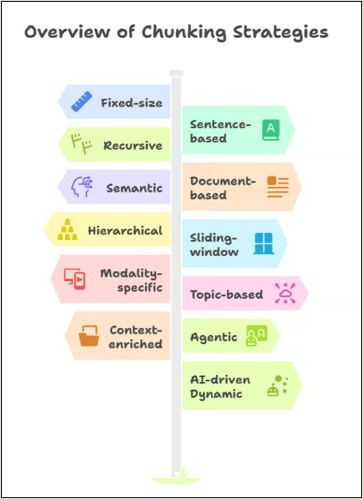
The landscape of chunking strategies presents a variety of methods designed for various content types, applications, and performance needs. The above image illustrates the progression from basic rule-based methods to advanced AI-driven techniques, each providing unique benefits for particular applications and performance criteria. Now, let us look into the common chunking strategies.
Langchain Chunking Strategies
Fixed Size Chunking
Fixed-size chunking is the most straightforward approach. It divides text into segments based on characters, words, or tokens, without considering meaning or structure. This method of chunking is fast and predictable, making it an ideal choice for industry thought leaders.
- Character-based: This method divides text after a predetermined number of characters. It is beneficial for lightweight processing but may result in cutting sentences or words in inconvenient locations.
- Word-based: This approach separates text after a specified number of words. It is more natural than the character-based method, yet it still carries the risk of breaking sentences apart.
- Token-based: This method employs the same tokenization scheme as the target model (for instance, OpenAI’s tokenizer). This guarantees compatibility with the model's context limits, although token boundaries may not always correspond with semantic boundaries.
Recursive Chunking
Recursive chunking represents a more sophisticated technique compared to earlier methods. It involves splitting rules in a sequential manner until each segment adheres to a specified size limit. The primary benefit of this method is its flexibility. By adopting a top-down approach, recursive chunking maintains the document's structure while ensuring it aligns with model context windows. Nevertheless, implementing recursive chunking can be more intricate, and the quality of the outcomes is contingent on the organization of the source document.
Semantic chunking
Semantic chunking emphasizes meaning by dividing text according to conceptual boundaries. This meaning-aware technique utilizes embeddings or semantic similarity to segment text at points where topic transitions occur. Rather than relying on arbitrary divisions, chunks are determined by their meaning.
Document-based Chunking
Document Structure-Based Chunking means breaking text apart by following its natural layout—like sections, headings, paragraphs, or tables—rather than cutting it into random blocks of fixed size. Think of it like reading a book: instead of tearing out every 500 words, you divide it by chapters and subheadings. This way, each chunk keeps its meaning intact and is easier to retrieve when the AI needs to answer a question.
Semantic Chunking vs Fixed Size Chunking
Fixed-size chunking is like slicing a book into uniform pieces without considering the content, whereas semantic chunking involves organizing it by chapters and sections. In many practical RAG applications, semantic chunking tends to produce better results, although fixed-size chunking is still valuable when speed and ease of use are the main concerns. Here’s a deep dive into the comparison of semantic chunking vs fixed size chunking.
| Semantic Chunking | Fixed-size Chunking |
|---|---|
| Splits text by meaning, structure, or sections | Splits text into equal-sized blocks |
| Content preservation is high | Low content preservation |
| Variable, depends on document structure | Consistent, predetermined length |
| Requires NLP preprocessing or semantic cues | Simple, fast, easy to implement |
| Is quite accurate- Improves retrieval relevance | Not accurate- Can reduce relevance due to broken context |
| More complex, higher compute overhead | Highly efficient, predictable performance |
| Used in legal, technical, or structured documents | Used in quick indexing and for large-scale datasets |
What is the Chunking in RAG?
Chunking in RAG, or Retrieval-Augmented Generation, is the process of breaking large documents into smaller, meaningful text segments called chunks. These chunks are stored in a vector database and retrieved when a user asks a question. Since large language models have limited context windows, chunking helps the AI system retrieve only the most relevant parts of a document instead of processing the entire file. A good chunking strategy improves retrieval accuracy, reduces hallucinations, increases response speed, and lowers overall LLM processing cost.
Why is chunking important in RAG pipelines?
Chunking is important in RAG because it directly affects how accurately an AI system retrieves information. If documents are split poorly, the retriever may miss important context or return incomplete information. Correct chunking helps preserve meaning, maintain document structure, and ensure that the LLM receives enough context to generate accurate answers. In real-world RAG applications, chunking can significantly improve answer quality, citation accuracy, and user trust.
What is fixed-size chunking in RAG?
Fixed-size chunking splits text into chunks of a fixed length, usually based on characters, words, or tokens. For example, a document may be divided into chunks of 500 tokens each. This method is easy to implement and computationally efficient. However, fixed-size chunking can break sentences, paragraphs, tables, or explanations in the middle, which may reduce retrieval accuracy. It is best suited for simple documents or use cases where speed is more important than deep contextual accuracy.
What is semantic chunking in RAG?
Semantic chunking is a chunking strategy that splits text based on meaning, topic, and context rather than a fixed size. It attempts to keep related ideas together in the same chunk. Semantic chunking improves retrieval relevance because each chunk contains complete and meaningful information. It is especially useful for technical documentation, legal content, research papers, product manuals, and enterprise knowledge bases. However, it usually requires more preprocessing and computational effort than fixed-size chunking.
What is the difference between semantic chunking and fixed-size chunking?
The main difference between semantic chunking and fixed-size chunking is how the text is split. Fixed-size chunking divides content by length, while semantic chunking divides content by meaning. Fixed-size chunking is faster and easier to scale, but it may break important context. Semantic chunking preserves meaning better and usually improves retrieval accuracy, but it can be more expensive to process. For most real-world RAG applications, semantic chunking gives better results when accuracy is more important than speed.
How do you measure a good chunking in RAG?
The important chunking evaluation metrics are References Completeness, Intrachunk Cohesion, Document Contextual Coherence, Block Integrity and Size Compliance. These metrics determine if chunks retain citations, are semantically consistent, have a logical flow and don't split tables or code. They work together to decide if a chunking approach is successful in a specific RAG pipeline.
What causes AI hallucinations due to the poor chunking?
Bad chunking can result in half or less of the paragraphs or explanations being retrieved by the AI. If context is missing, it can provide erroneous, inconsistent or fake responses (hallucinations). This can be averted to a large extent through structured chunking in terms of document context.
Which Chunking is suitable for technical or legal documents?
Technical or legal documents work best with semantic chunking or document chunking since it maintains the structural and conceptual integrity of the document. The methods do not split critical entities such as clauses, tables, or code segments. As a consequence, even complex and highly structured content is retrieved with accuracy.
What is token-based chunking? Why is it important for LLMs?
Token-based chunking chunks text based on the same tokenizer as the target language model, like OpenAI's tokenizer. This way, when the model's context limits are exceeded, no errors will occur. But token boundaries do not always correspond with natural semantic boundaries and this can also have a negative impact on the quality of retrieval.