Introduction
Most enterprise AI projects fail the same way: they work beautifully in a demo, then fall apart in production. The retrieval is slow, the outputs are unreliable, and no one in the security team is happy. Scaling generative AI for enterprises is not just a model problem. It is an architecture problem, a governance problem, and increasingly a competitive advantage problem.
This is what separates organizations that are genuinely extracting value from generative AI from those still running controlled pilots eighteen months after launch. The difference, more often than not, comes down to how well they have built and secured their RAG pipelines.
What Enterprise Generative AI Actually Demands
Consumer-facing AI products operate on a different set of constraints than enterprise systems. In an enterprise context, the model is only one component. What really matters is whether the system can retrieve the right information, at the right time, from the right source, and deliver it only to the right people.
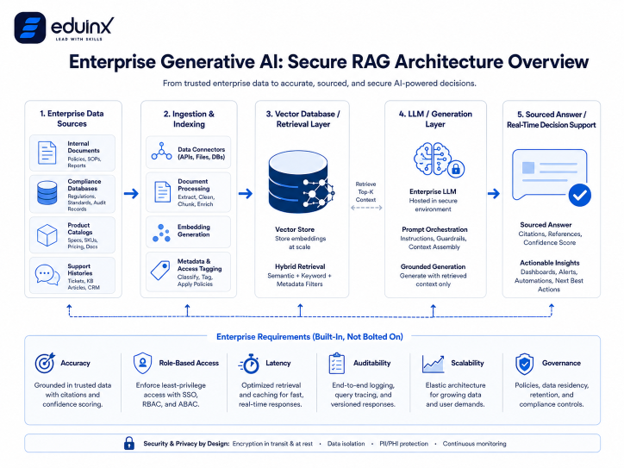
This is where scalable RAG architecture becomes foundational. A well-designed RAG pipeline connects large language models to live organizational knowledge: internal documents, compliance databases, product catalogs, and support histories, without baking that data into the model itself. The result is an AI that answers from your company's actual truth, not from generalizations it learned at training time.
The business case is sharp. Enterprises using retrieval-augmented generation report significantly shorter search-to-decision cycles. Instead of an analyst digging through SharePoint folders and outdated PDFs, they get a precise, sourced answer in seconds. At scale, that compresses entire workflows.
But the moment you start connecting LLMs to sensitive internal data, the security stakes go up fast.
The Security Problem No One Talks About Enough
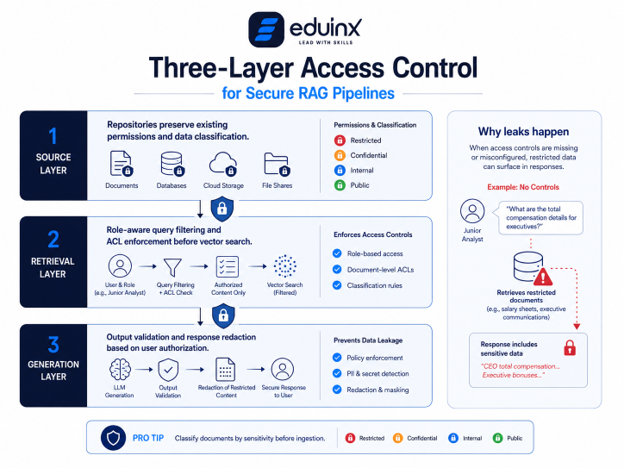
Here is a scenario that plays out quietly in many organizations. A RAG-based internal tool is deployed for HR and finance teams. The retrieval layer is not configured with role-aware access controls. A junior analyst queries the system about a topic and, because the retrieval mechanism is pulling from a shared document corpus, the response surfaces salary data or confidential executive communications the analyst was never meant to see.
This is not a hypothetical. Research published on arXiv on participant-aware access control in RAG systems demonstrates that when retrieval mechanisms fail to strictly enforce access control lists for all users in an interaction, restricted content routinely enters the model's context and leaks into the output. The paper makes a clear case: RAG pipelines must enforce access controls at every stage of processing, not just at the application layer.
What does that look like in practice? It means access controls operating at three levels: at the source (document repositories maintaining existing permission structures), at the retrieval layer (queries filtered by user role before embedding search), and at the generation stage (outputs validated against what the requesting user is authorized to see).
Building this right requires treating your RAG corpus as critical infrastructure, not just a bag of documents you throw into a vector database.
🔍 Pro Tip: Start With a Data Classification Audit. Before connecting any internal data source to a RAG pipeline, classify every document by sensitivity level. Define who can retrieve what before you write a single line of retrieval code. Access control is exponentially harder to retrofit than it is to build in from day one.
Building a Scalable RAG Architecture for Enterprise
There is a reason agentic RAG frameworks and multi-agent AI systems are moving from research labs into production infrastructure. A naive RAG setup (embed documents, store in a vector DB, retrieve on query, generate) breaks at enterprise scale for several reasons.
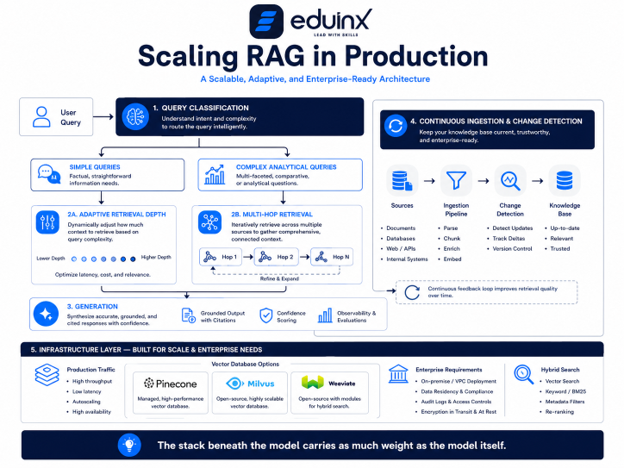
First, not all queries are equal. Asking "what is our Q3 refund policy?" and asking "summarize the last five years of litigation involving our supply chain contracts" are fundamentally different retrieval tasks. A flat vector search treats them the same. Adaptive RAG architectures, which dynamically select retrieval depth based on query classification, solve this. Simple queries get fast, shallow retrieval. Complex analytical queries trigger multi-hop retrieval chains across multiple data sources.
Second, the embedding layer needs to keep pace with organizational knowledge as it changes. Most teams underinvest here. Documents are ingested once, at deployment, and the index grows stale within weeks. Production-grade RAG systems need continuous ingestion pipelines with change detection, so the knowledge base reflects what is actually true in the organization today.
Third, at the infrastructure layer, the choice of vector database matters more than teams realize. Pinecone, Milvus, and Weaviate are optimized differently. Pinecone is developer-friendly and handles production traffic well. Milvus is better suited for large-scale on-premise deployments where data residency is a constraint. Weaviate offers native hybrid search combining dense vector retrieval with BM25 keyword search, which is often a meaningful accuracy improvement for enterprise document types.
The stack beneath the model carries as much weight as the model itself.
AI Governance Frameworks Are Now Non-Negotiable
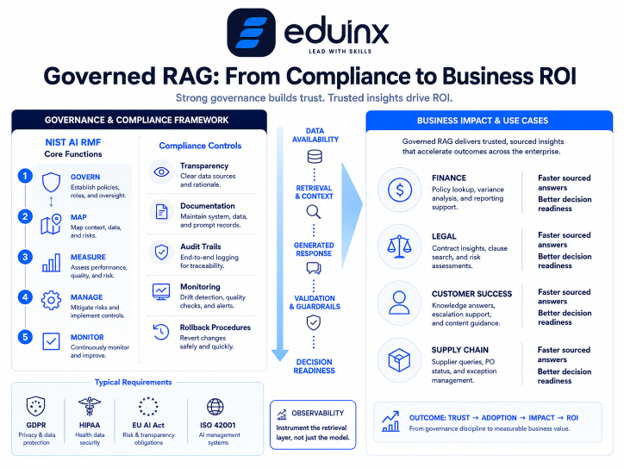
When the EU AI Act came into full effect in August 2025, many enterprise teams discovered that their RAG deployments had compliance gaps they had not planned for. The act requires transparency, documentation, and auditability of AI systems operating in high-risk categories. For an enterprise, almost any internal decision-support tool that touches HR, finance, or legal can fall into that category.
Compliance here is not just a legal obligation. It is an architectural constraint that shapes how you build. Every retrieval decision in a production RAG system ideally has an audit trail linking the generated output back to the specific source documents that informed it. Not because a regulator might ask for it (though they might), but because that is how you catch and correct hallucinations in high-stakes environments.
The NIST AI Risk Management Framework offers a practical structure: Govern, Map, Measure, Manage. For RAG systems, "Map" means documenting every data source in the retrieval corpus and its associated risk. "Measure" means continuous output monitoring, not just at launch. "Manage" means having rollback procedures when a model or a data source starts producing degraded outputs.
Enterprises that are serious about responsible AI governance and ethical frameworks are increasingly treating these controls not as compliance overhead but as the baseline for any AI that touches a production decision.
"In 2026, RAG is not just a trend. It is the strategic backbone of enterprise knowledge management. Those who build solid, scalable RAG architectures early will lead in the AI-driven decade ahead."
— Squirro AI Research Team,State of RAG and GenAI 2026
🎯 Pro Tip: Map Every Compliance Requirement to a Control. For each regulatory requirement your organization faces (GDPR, HIPAA, EU AI Act, or ISO 42001), define an explicit technical control in your RAG architecture. Automated evidence generation and audit trail tooling should be part of the deployment, not an afterthought.
Real-Time Decision Making: Where RAG Delivers Business ROI
The practical value of a well-built enterprise RAG system shows up most clearly in time-sensitive decision contexts. A financial analyst querying a RAG system connected to live regulatory filings, internal research, and market data gets a synthesized, sourced answer in under three seconds. Without it, that same analysis might take half a day and still carry more interpretive risk.
This applies across functions. Legal teams use RAG to surface relevant case law and contract precedents against a specific negotiation scenario. Customer success teams use it to pull account history, product documentation, and known issue logs before a client call. Supply chain managers use it to cross-reference supplier agreements against current logistics constraints.
The common thread is that RAG compresses the gap between data availability and decision readiness. That compression is where the real competitive advantage sits, not in which model you use.
What separates the deployments that deliver ROI from those that stall is architecture discipline. A retrieval pipeline that is fast but leaks data destroys trust and creates liability. One that is secure but too slow to be useful gets abandoned. One that is both but has no governance layer fails the moment it encounters an audit or an edge case it was not designed for.
The teams getting this right are the ones who treat RAG as infrastructure from day one, not as a prototype that will "be productionized later."
🧠 Pro Tip: Instrument Your Retrieval Layer, Not Just Your Model. Most observability tools focus on model outputs. Build logging and monitoring directly into the retrieval layer: track which documents are being retrieved most frequently, which queries are failing to retrieve useful context, and where latency is accumulating. That telemetry is your primary signal for continuous improvement.
What This Means for Your AI Career
If you are building toward a career in AI or data science, the organizations hiring right now are not just looking for people who can fine-tune a model. They want engineers and architects who understand the full stack: retrieval design, vector databases, access control, observability, and governance. RAG pipeline architecture is one of the most in-demand skill sets in enterprise AI in 2026.
Getting hands-on with LangChain, LlamaIndex, and a vector database like Weaviate or Milvus is a practical starting point. Understanding how to implement role-based access at the retrieval layer will distinguish you from candidates who have only worked on the model surface.
The gap between what enterprises need and what most practitioners know how to build is still wide. That gap is an opportunity.
Conclusion
Enterprise generative AI is not about deploying the most powerful model. It is about building systems that retrieve accurately, protect data rigorously, scale reliably, and satisfy governance requirements without slowing everything down. RAG pipelines are the connective tissue between organizational knowledge and AI-driven decisions.
Getting that architecture right is the actual work. The enterprises investing in it now are building compounding advantages that will be very difficult to close later. The question is not whether your organization needs a secure, scalable RAG pipeline. It is whether you are building one before your competitors do.
Frequently Asked Questions (FAQs)
1. Why do most enterprise RAG deployments fail?
They often fail because teams treat them as a model problem rather than an infrastructure problem. Issues arise when the underlying architecture cannot scale, data becomes stale, retrieval is too slow for production, or security protocols are not built into the retrieval layer, leading to data leaks.
2. What is scalable RAG architecture?
A scalable RAG (Retrieval-Augmented Generation) architecture is a robust system designed to connect large language models (LLMs) to live, continuously updated enterprise data (like databases, intranets, and support histories) dynamically. It ensures fast, accurate retrieval across massive datasets without needing to retrain the underlying model.
3. Why is access control so difficult in RAG systems?
In traditional search, access control happens at the application layer. In RAG, if access controls are not enforced before the vector search happens, the LLM might retrieve and synthesize restricted data (e.g., HR salaries) into an answer for an unauthorized user. Access control must be enforced at the source, retrieval, and generation layers.
4. What is the difference between a flat vector search and adaptive RAG?
A flat vector search treats every query the same, which is inefficient. Adaptive RAG classifies queries first. Simple queries get fast, shallow retrieval, while complex analytical queries trigger deep, multi-hop retrieval across multiple data sources, optimizing both cost and latency.
5. Which vector database is best for enterprise RAG?
It depends on enterprise needs. Pinecone is excellent for developer-friendly, high-traffic production. Milvus is often preferred for massive-scale, on-premise deployments requiring strict data residency. Weaviate is favored for native hybrid search (combining vector and keyword search), which often improves accuracy for enterprise documents.
6. How does the EU AI Act affect enterprise RAG systems?
The EU AI Act requires transparency, documentation, and auditability for AI systems, especially those in high-risk categories (which often include internal HR or financial tools). Enterprises must maintain an audit trail linking AI-generated outputs back to the specific source documents to remain compliant and to manage hallucinations.
7. How does RAG deliver business ROI?
RAG delivers ROI by drastically compressing the "search-to-decision" cycle. By providing employees (analysts, lawyers, customer success reps) with precise, sourced answers from internal data in seconds rather than hours, it speeds up workflows, reduces interpretive risk, and accelerates time-sensitive decision-making.
8. Why do I need to "instrument the retrieval layer"?
Most teams only monitor the final output of the LLM. Instrumenting the retrieval layer means tracking which documents are retrieved, where latency occurs, and which queries fail to find context. This telemetry is crucial for troubleshooting and continuously improving the accuracy of the RAG system.
9. What skills are needed to build enterprise RAG pipelines?
Modern AI teams need practitioners who understand the full stack beyond just prompting or fine-tuning models. Key skills include retrieval design, managing vector databases (like Milvus or Pinecone), implementing role-based access control (RBAC), observability, and understanding AI governance frameworks.
10. What is the most critical step before building an enterprise RAG system?
A data classification audit. Before connecting internal data to an AI pipeline, you must classify every document by sensitivity level and define who is authorized to retrieve what. Retrofitting access controls into an existing RAG pipeline is notoriously difficult and risky.