AI product teams face a different prioritisation challenge from traditional software teams. Building an AI feature is no longer the only concern. Teams must also determine whether the model can deliver reliable results, whether users will trust its outputs, and whether the feature is worth maintaining.
AI feature prioritisation is the process of ranking potential AI capabilities based on their expected user value, business impact, development effort, technical feasibility, and associated risks. Frameworks such as RICE and ICE help product managers compare opportunities, while model-risk scoring identifies potential problems with AI performance, safety, and compliance.
Understanding how these methods differ helps product teams invest in features that solve real problems without overlooking the risks of deployment.
Why AI Features Need a Different Prioritisation Approach
AI makes it easier to experiment with new capabilities, but faster development does not guarantee useful products. A feature may attract attention during a demonstration but fail to deliver consistent results in actual workflows.
Three factors make AI product prioritisation more complex:
- •Quality uncertainty: An AI feature must meet acceptable accuracy, reliability, and response-quality thresholds before it can deliver meaningful value.
- •Ongoing maintenance: Prompt optimisation, model updates, evaluation monitoring, and data management create recurring operational costs.
- •Model-related risks: Bias, privacy issues, security vulnerabilities, and incorrect outputs can affect users and business operations.
This distinction matters because a feature with high projected adoption may still be unsuitable for release if it cannot meet the required quality or safety standards.
Understanding the Three AI Feature Prioritisation Methods
1. RICE Scoring: Prioritising Features by Impact and Effort
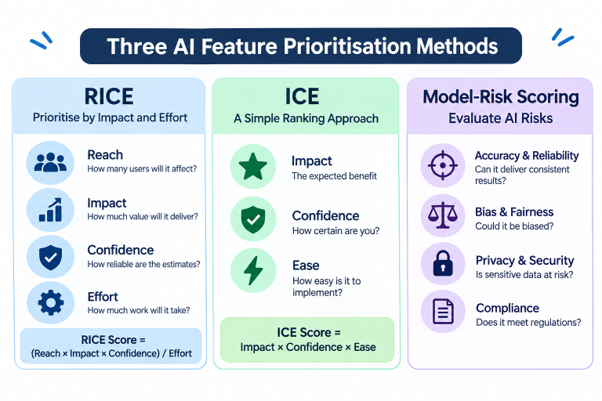
The RICE scoring model helps product managers rank feature ideas using four factors: Reach, Impact, Confidence, and Effort.
RICE Score = (Reach × Impact × Confidence) / Effort
- •Reach: How many users or transactions will the feature affect within a defined period?
- •Impact: How significantly will it improve the user experience or business outcome?
- •Confidence: How reliable are the estimates for reach, impact, and effort?
- •Effort: How much work will the product, design, and engineering teams need to complete it?
For example, an AI-powered support assistant expected to serve 5,000 customers may receive a high reach score. However, if its response accuracy is uncertain or development requires substantial effort, its overall RICE score will decrease.
Advantages: RICE provides a structured way to compare opportunities and makes assumptions more visible.
Limitations: It can underestimate AI development complexity if teams calculate effort using prototype estimates rather than production requirements. Ongoing maintenance and quality validation should also be considered.
2. ICE Scoring: A Simpler Way to Rank AI Features
The ICE scoring model evaluates feature ideas using three factors: Impact, Confidence, and Ease.
ICE Score = Impact × Confidence × Ease
Teams typically assign each factor a score from 1 to 10, based on predefined criteria.
- •Impact: The expected benefit to users or the business.
- •Confidence: How certain the team is about the expected outcome.
- •Ease: How quickly and easily the feature can be implemented.
For example, an AI autocomplete feature may score highly because it solves a frequent user problem, has a relatively straightforward implementation, and can be tested quickly.
Advantages: ICE is simple to apply and useful for quickly ranking early-stage ideas, experiments, and product improvements.
Limitations: Its scoring can be subjective. It also provides less detail about reach and development effort than RICE, making it less suitable for complex roadmap decisions without additional assessment.
3. Model-Risk Scoring: Evaluating AI Risks Before Development
Unlike RICE and ICE, model-risk scoring evaluates the potential risks associated with an AI feature or model. It helps teams determine whether a proposed capability can operate safely, reliably, and within acceptable business and regulatory boundaries.
Common assessment factors include:
- •Accuracy and reliability: Can the model consistently produce acceptable results?
- •Bias and fairness: Could its outputs disadvantage particular user groups?
- •Data privacy and security: Could sensitive information be exposed or misused?
- •Explainability: Can users and reviewers understand the basis and limitations of its outputs?
- •Operational risks: Could model failures, downtime, or performance drift disrupt workflows?
- •Compliance exposure: Does the feature introduce legal or regulatory concerns?
Teams can assign likelihood and severity scores to individual risks, then use a risk matrix to classify them as low, medium, or high.
AI features may also need to meet specific regulatory requirements depending on their application, industry, and target market. Product managers should account for these obligations during prioritisation rather than treating compliance as a final-stage consideration. For a closer look at these requirements, explore our guide to AI regulatory compliance for product managers.
There is no single universally accepted model-risk scoring formula. The scoring criteria should reflect the feature's intended use, potential impact, and operating environment.
The NIST AI Risk Management Framework guides identifying, measuring, and managing AI risks throughout the system lifecycle.
Three AI Feature Prioritisation Methods at a Glance
RICE vs ICE vs Model-Risk Scoring: Key Differences
| Evaluation factor | RICE | ICE | Model-risk scoring |
|---|---|---|---|
| Primary focus | Product impact | Quick prioritisation | AI-related risks |
| Key factors | Reach, Impact, Confidence, Effort | Impact, Confidence, Ease | Safety, reliability, privacy, compliance |
| Complexity | Moderate | Low | Depends on risk framework |
| Best suited for | Roadmap planning | Early-stage ranking | Risk assessment |
| Main limitation | Estimate-dependent | Subjective scoring | Does not independently measure product value |
The key difference is that RICE and ICE help determine which features deserve investment, while model-risk scoring identifies which risks need to be addressed before investment or deployment.
Prioritising AI features also involves considering their ethical implications. Product managers need to evaluate how AI systems affect users, address potential bias, and maintain transparency and accountability. Explore our guide to The Ethics of AI in Product Management to understand these considerations in greater detail.
How to Combine RICE, ICE and Model-Risk Scoring
Product teams do not need to choose just one AI feature prioritisation framework. Combining these approaches creates a more balanced decision-making process.
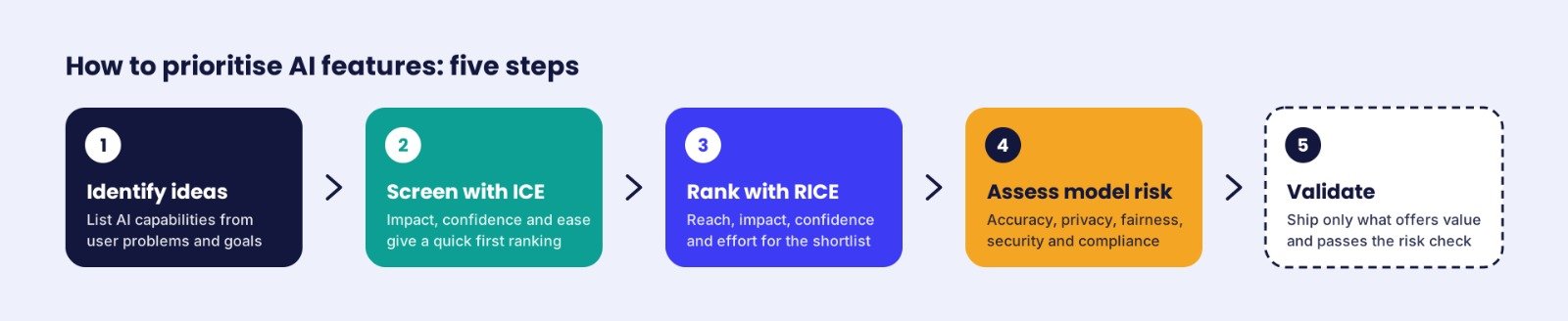
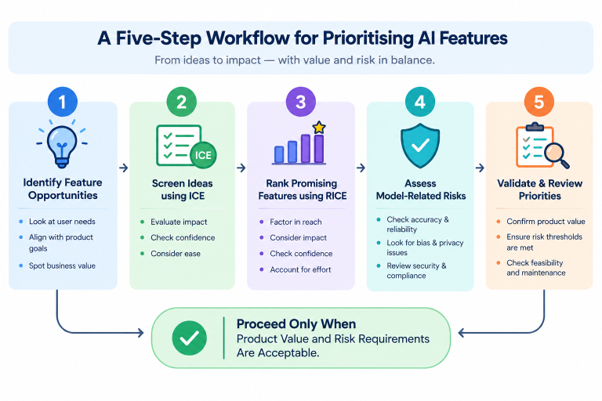
A practical workflow involves five steps:
- 1. Identify feature opportunities: List proposed AI capabilities based on user problems, product goals, and business needs.
- 2. Apply ICE scoring: Quickly screen ideas using impact, confidence, and ease.
- 3. Use RICE for detailed ranking: Compare promising features based on reach, impact, confidence, and total effort.
- 4. Conduct model-risk assessments: Evaluate accuracy, data availability, privacy, fairness, security, and potential harm.
- 5. Review and validate priorities: Move forward with features that offer meaningful value and meet acceptable risk thresholds.
For uncertain features, conduct a time-boxed feasibility test before committing to full development. Test domain-specific performance, edge cases, data availability, and estimated inference costs.
Also account for recurring maintenance, including evaluation monitoring, prompt updates, and model changes. A successful prototype alone is not proof of production readiness.
Prioritisation should not end once a feature enters the development backlog. Teams need to keep evaluating user feedback, product performance, and emerging opportunities. This ongoing process connects closely with continuous product discovery with AI.
Importantly, a high RICE or ICE score should never override an unacceptable safety or compliance risk.
A Quick Visual Guide to Prioritising AI Features
Which AI Feature Prioritisation Method Should You Choose?
The right method depends on your product's maturity, available data, and decision-making needs.
- •Choose RICE when you need structured, impact-based roadmap prioritisation.
- •Choose ICE when you need to rank early-stage ideas or experiments quickly.
- •Choose model-risk scoring when assessing AI reliability, safety, security, and compliance.
- •Combine all three when balancing product value, implementation effort, and AI-related risks.
For most AI product teams, combining the methods provides a more complete view than relying on a single prioritisation score.
Conclusion
Prioritising AI features requires more than comparing their potential business value. Product teams must also consider technical feasibility, model reliability, risk exposure, and the effort required to maintain each feature after launch.
RICE and ICE help compare opportunities, while model-risk scoring highlights potential issues that need attention before deployment. Using these approaches together helps product managers make informed decisions and balance innovation with responsible AI development.
Want to strengthen your AI product management skills? Explore Eduinx's Fast-Track AI Product Management Program to learn about AI-driven product strategy, feature prioritisation, roadmap development, and responsible AI practices.
Frequently Asked Questions
1. What is AI feature prioritisation?
AI feature prioritisation is the process of ranking proposed AI capabilities based on their expected value, business impact, development effort, and potential risks. It helps product teams focus on features that solve meaningful user problems and support product goals. Teams also consider technical feasibility and model reliability before committing resources.
2. What is the RICE scoring model?
RICE is a prioritisation framework that evaluates features using four factors: Reach, Impact, Confidence, and Effort. Each factor helps product managers estimate a feature's potential value and implementation requirements. The resulting score helps compare competing ideas and make roadmap decisions.
3. What does ICE stand for in product prioritisation?
ICE stands for Impact, Confidence, and Ease. It helps product managers quickly evaluate ideas based on their expected benefits, the certainty of those benefits, and implementation difficulty. It is particularly useful for ranking early-stage ideas, experiments, and smaller product improvements.
4. How does model-risk scoring work?
Model-risk scoring evaluates the potential risks associated with an AI feature before development or deployment. Teams assess factors such as accuracy, reliability, bias, privacy, security, and compliance. They assign likelihood and severity scores to identify risks that require mitigation.
5. What is the difference between RICE and ICE?
RICE evaluates Reach, Impact, Confidence, and Effort, providing a structured approach to roadmap planning. ICE uses Impact, Confidence, and Ease to simplify the evaluation process. RICE is generally more suitable for detailed prioritisation, while ICE works well for quick comparisons.
6. Is RICE or ICE better for prioritising AI features?
The choice depends on the complexity of the feature and the information available. RICE is useful when teams need to compare user reach, expected impact, and development effort. ICE is better suited to quickly evaluating early-stage ideas and experiments.
7. Why is risk assessment important when developing AI features?
AI features can produce inaccurate outputs, introduce bias, expose sensitive data, or create security vulnerabilities. Risk assessment helps product teams identify these issues before they affect users or business operations. It also helps determine whether a feature meets the necessary safety and compliance requirements.
8. What factors should an AI model-risk assessment include?
An AI model-risk assessment should cover accuracy, reliability, fairness, data privacy, security, and explainability. Teams should also consider operational risks, such as performance degradation and model failures. Applicable legal and regulatory requirements should be included based on the feature's intended use.
9. Can RICE and model-risk scoring be used together?
Yes. RICE helps product teams rank features based on expected value and development effort, while model-risk scoring identifies potential AI-related risks. Using both provides a broader basis for prioritisation. However, high RICE scores should never override unacceptable safety or compliance risks.
10. How often should AI feature priorities be reassessed?
AI feature priorities should be reviewed at major development milestones and during roadmap planning. Teams should also reassess them when user needs, model performance, development costs, or regulatory requirements change. Regular reviews help ensure that priorities remain relevant and feasible.