Product managers are involved in various tasks such as user research, feature prioritization, creating product documentation, planning product roadmaps, and communicating with stakeholders. While generative AI can automate a lot of these tasks, the quality of the outputs is largely dependent on what the instructions are for the AI.
This is where prompt engineering for product managers becomes useful. With proper context, clear instructions, and clear output requirements, product managers can produce more appropriate, actionable answers using those AI tools.
This article explores 12 reusable ChatGPT prompts for product managers covering different stages of the product management lifecycle, along with practical ways to improve AI-generated outputs.
What Is Prompt Engineering in Product Management?
Prompt engineering in product management involves crafting well-defined prompts to ensure that AI tools provide clear and accurate output for product-related tasks. It entails giving context, making a definition and giving the desired output.
A good prompt sets up business goals, user requirements, priorities, and resource limitations, as opposed to feeding AI the product roadmap. This enables them to get more meaningful output, which can be reviewed and improved by the product managers.
12 Reusable AI Prompts for Everyday Product Management Tasks
The following AI prompts for product managers can be adapted to different products, industries, and business requirements. Replace the bracketed placeholders with your actual product information before using them.
1. User Research and Customer Insights
Understanding customer feedback helps product managers identify recurring problems and unmet needs.
Act as a product research analyst. Read the following customer feedback and analyse it: [PASTE FEEDBACK]. Figure out common pain points, user needs, user grievances, and contradictions. Distinguish between evidence and inference. Do not invent customer opinions or statistics. Summarize results in a table with evidence, and include suggested research questions.
Understanding recurring feedback is also important for product improvement. Explore how AI automates Voice of Customer analysis by turning support tickets into actionable product insights.
2. Creating User Personas
User personas help product teams understand their target audiences and make user-focused product decisions.
Act as a UX researcher. Based on the following research findings [INSERT DATA], develop user personas for [PRODUCT]. Add user attributes, objectives, motivations, annoyances, actions, and product requirements. Use only supported information and label any assumptions clearly.
3. Competitor Analysis
Competitor analysis helps product managers understand market positioning and identify opportunities for differentiation.
Act as a product strategy analyst. Contrast [PRODUCT] with [COMPETITOR PRODUCTS]. Using the information you are given, analyze their attributes, audience, positioning, advantages, and disadvantages. Recognise market opportunities and differentiate. Indicate missing information, rather than inventing competitor capabilities.
Product managers can extend this analysis by exploring AI-powered competitive intelligence to identify market gaps and understand competing products.
4. Generating Product Ideas
AI can support product discovery by exploring possible solutions to identified customer problems.
Act as a product innovation strategist. Using the following problems [INSERT PROBLEMS] and business goals [INSERT OBJECTIVES], generate 10 potential product ideas. For each idea, explain the user problem addressed, proposed value, and potential challenges. Propose ways to check the accuracy of the suggestions before recommending implementation.
5. Feature Prioritisation
Feature prioritisation requires balancing customer needs, business objectives, and development constraints.
Act as a product prioritisation consultant. Consider the user impacts, business value, development effort, and strategy when evaluating these proposed features [LIST FEATURES]. Use the supplied evidence [INSERT DATA]. Point out trade-offs, missing information, and uncertainties. Avoid creating numerical RICE or ICE scores without supporting metrics.
6. Writing Product Requirements Documents (PRDs)
A Product Requirements Document (PRD) communicates what needs to be built, why it matters, and how success will be evaluated.
Act as an experienced product manager. Using the following information [INSERT DETAILS], develop a PRD for [PRODUCT/FEATURE]. Define and include the problem statement, target users, objectives, requirements, success metrics, constraints and dependencies, and out-of-scope items. Separate the problem definition and proposed solution. Identify missing requirements and assumptions to review.
For more practical guidance on structuring product documentation, see how to write better PRDs with AI.
7. Creating User Stories
User stories translate product requirements into development tasks from the user's perspective.
Act as an Agile product manager. Turn the following approved requirements [INSERT REQUIREMENTS] into user stories in the format of "As a [user], I want [action], so that [benefit]". Include Given, When, and Then statements to include acceptance criteria. Use appropriate boundary conditions and error states. Mark unknown business rules as 'open' questions.
8. Building Product Roadmaps
Product roadmaps communicate product direction, priorities, and planned initiatives.
Act as a product roadmap strategist. Create a roadmap for [PRODUCT] based on these business objectives [INSERT OBJECTIVES], customer needs [INSERT NEEDS], and available resources [INSERT CONSTRAINTS]. Organise initiatives into suitable phases, identify dependencies, and explain prioritisation. Distinguish confirmed commitments from proposed timelines.
9. Defining Product Metrics and KPIs
Product metrics help teams measure whether product initiatives achieve their intended outcomes.
Act as a product analytics specialist. Based on this product objective [INSERT OBJECTIVE], recommend relevant success metrics and KPIs. For each metric, explain what it measures, how it can be calculated, the data required, and its relevance to the objective. Do not invent baseline values or targets.
Product teams can also use generative AI for A/B testing to evaluate product changes and understand their impact on user experience.
10. Sprint Planning and Task Breakdown
Breaking product requirements into smaller tasks helps development teams plan and execute work more effectively.
Act as an Agile project planning specialist. Break down these approved requirements [INSERT REQUIREMENTS] into manageable development tasks. Group related tasks, identify dependencies, suggest sprint goals, and highlight potential blockers. Do not estimate effort without sufficient technical information.
11. Product Launch Planning
A launch plan coordinates activities across product, marketing, sales, support, and engineering teams.
Act as a product launch manager. Create a launch plan for [PRODUCT/FEATURE]. Include pre-launch activities, testing, stakeholder responsibilities, launch communications, deployment requirements, and post-launch monitoring. Use the supplied timeline [INSERT TIMELINE] and identify missing responsibilities or dependencies.
12. Stakeholder Communication and Updates
Clear stakeholder communication keeps teams informed about product progress, decisions, and potential risks.
Act as a product communications specialist. Prepare a stakeholder update using the following project information [INSERT DETAILS]. Summarise progress, completed milestones, upcoming activities, key decisions, risks, and blockers. Keep the language concise and distinguish confirmed updates from pending decisions.
How to Write Better AI Prompts for Product Management
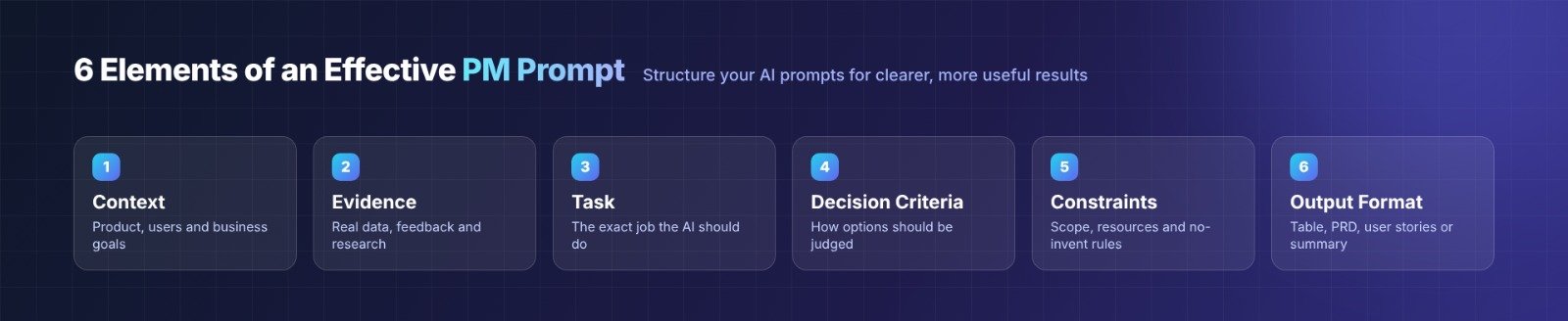
A useful AI prompt should give the model enough information to understand the task and produce relevant results. Product managers can structure their prompts around six essential elements:
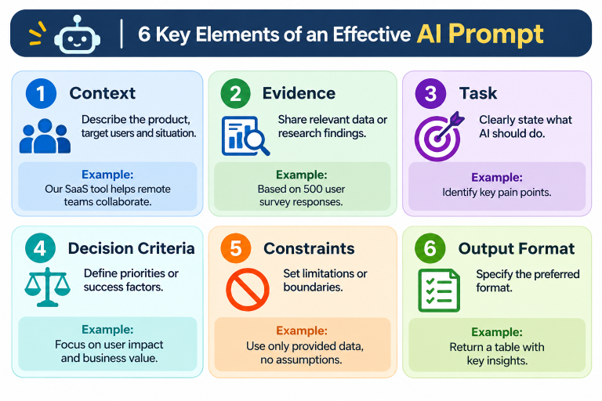
Following this structure helps product managers create more focused prompts, reduce ambiguity, and review AI-generated results more effectively.
For complex tasks, include examples of the expected output. OpenAI's prompt engineering guidance and Anthropic's prompting best practices provide further guidance on context, clear instructions, examples, and structured prompts.
How to Validate AI-Generated Product Management Outputs
AI-generated content can be useful for product research, documentation, and planning, but it still requires human review before implementation.
Product managers should:
- Verify facts and evidence: Check whether metrics, customer insights, and claims are supported by actual data.
- Identify assumptions: Separate verified information from AI-generated interpretations and assumptions.
- Check requirements and scope: Ensure AI has not introduced unapproved features, requirements, or technical decisions.
- Review success metrics: Confirm that proposed KPIs are relevant and can be measured using available product data.
This keeps product managers accountable for the accuracy and strategic relevance of AI-assisted work.
Can AI Replace Product Managers?
AI can assist with research, documentation, analysis, and repetitive tasks, but it cannot take full responsibility for product decisions. Product managers must evaluate business priorities, validate customer needs, assess trade-offs, and align stakeholders. AI should support product judgment, not replace it.
Conclusion: Make AI a Practical Part of Product Management
Prompt engineering for product managers makes generative AI more useful across everyday workflows. These 12 reusable prompts provide a starting point for improving research, planning, and documentation. Adapt them to your product requirements, verify the outputs, and retain human oversight over important decisions.
Product managers looking to build advanced skills in AI-driven product strategy, decision-making, and leadership can explore the Advanced AI Product Management & Product Leadership Program.
Frequently Asked Questions
1. What is prompt engineering for product managers?
It is the practice of creating structured AI instructions to support product research, planning, prioritisation, and decision-making. Providing relevant context and defining the expected output helps product managers get more useful and actionable results.
2. How can product managers use ChatGPT in their daily work?
Product managers can use ChatGPT for customer research, competitor analysis, PRDs, user stories, roadmaps, and stakeholder updates. It can help organise information and speed up routine tasks, while product managers retain control over final decisions.
3. What are the best AI tools for product managers?
ChatGPT, Claude, and Gemini are useful for research, analysis, documentation, and brainstorming. The right tool depends on the specific task, required capabilities, and the product team's workflow.
4. Can AI help product managers write PRDs?
Yes. AI can structure PRDs, draft requirements, identify ambiguities, and suggest questions for product and engineering teams. Product managers should review the generated document to ensure it reflects actual business requirements.
5. How can AI help with product prioritisation?
AI can compare proposed features based on user impact, business value, development effort, and strategic alignment. It can also highlight trade-offs and missing information, helping product managers make more informed prioritisation decisions.
6. Can ChatGPT analyse customer feedback?
Yes. ChatGPT can categorise customer feedback, identify recurring themes, and highlight common pain points from supplied data. Product managers can use these findings to identify areas for further investigation and product improvement.
7. How can product managers use AI for competitor analysis?
They can use AI to compare competitor features, positioning, target audiences, and potential market opportunities. This helps product managers identify differences between competing products and explore possible areas for differentiation.
8. Can AI create product roadmaps?
Yes. AI can organise product initiatives into phases based on business objectives, customer needs, priorities, and available resources. Product managers should review suggested timelines and dependencies before finalising the roadmap.
9. Do product managers need to learn prompt engineering?
Learning prompt engineering helps product managers provide clearer instructions and obtain more relevant results from generative AI tools. It is particularly useful for improving everyday tasks such as research, documentation, planning, and analysis.
10. What makes a good AI prompt for product management?
A good AI prompt includes relevant context, a clearly defined task, specific constraints, and an expected output format. It should also provide supporting data or examples when necessary to help the AI generate more accurate and useful responses.