Retrieval-Augmented Generation (RAG) is a technique in AI that allows it to provide answers to queries based on information found in company documents, databases, or any external sources. Using a large language model (LLM) with a knowledge base introduces security risks that ordinary model safeguards cannot address alone.
RAG security is dedicated to safeguarding the entire process, from document ingestion to access control and response generation. AI systems can be vulnerable to prompt injection, data poisoning, and unauthorized disclosure of information, potentially undermining their trustworthiness and security.
In 2026, organisations need layered security controls to protect their AI knowledge bases without sacrificing the usefulness of retrieved information.
What Is RAG Security and Why Does It Matter in 2026?
RAG security involves securing the data source, the retrieval mechanism, the vector database, the input and output data to the model, and the input and output data to the retrieval mechanism.
A RAG system is not a standalone LLM, but aims to retrieve external information before generating a response. This provides more opportunities for malicious information and unauthorized access.
The OWASP GenAI Security Project's 2026 Top 10 ranks prompt injection first, sensitive information disclosure second, and data and model poisoning fifth among its major LLM application risks. It also identifies vector and embedding weaknesses as a separate security concern.
These risks make AI knowledge base security essential for organisations using RAG to process internal policies, customer records, technical documentation, and confidential business information.
For organisations planning to implement an internal AI assistant, understanding the implementation process is equally important. Read our guide to building an RAG-powered internal knowledge bot.
The 3 Biggest Security Risks in RAG Systems
The main security risks in RAG systems stem from reliance on external data sources, document retrieval, and user input to generate responses. Prompt injection, data poisoning, and access to sensitive data are three significant dangers that the organisation must counter.
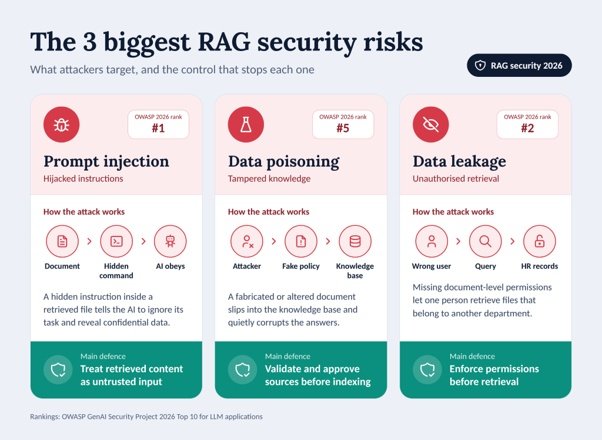
RAG security risks infographic showing prompt injection, data poisoning, and data leakage, each with an attack path and its main defence
1. Prompt Injection Attacks in RAG
RAG prompt injection occurs when malicious instructions manipulate an AI system's behaviour through user inputs or retrieved content.
Direct prompt injection comes from the user's prompt. Indirect prompt injection occurs when an attacker embeds instructions in a document, webpage, email, or other source that the AI retrieves.
For instance, if an AI assistant copies confidential data from a document, it could be misprogrammed to ignore a malicious directive in an uploaded document. The model can execute the injected instruction if the application does not differentiate trusted instructions from untrusted content.
2. Data Poisoning in RAG Knowledge Bases
RAG data poisoning is the technique of altering, manipulating, or injecting knowledge base information to affect both retrieval and generated answers by RAG.
An attacker could add fake policy documents, change technical advice, or file false information into a trusted source. This content may be misinterpreted or altered when retrieved by the system.
RAG poisoning can attack the external documents and indexing pipeline, unlike the model training-data poisoning attacks that involve modifying the model's weights.
3. Sensitive Data Leakage and Unauthorized Retrieval
A system can leak confidential data when the user requesting the data has no need to see it; this is known as RAG data leakage.
A misconfigured internal assistant could, for instance, access HR data or financial information from a different department. Inadequate output validation, insecure logs, and excessive tool permissions can create additional exposure.
A secure RAG application should impose permission rules before the model is presented with restricted information, instead of letting the model determine what it should show.
How to Protect Your RAG System and AI Knowledge Base
RAG security best practices involve a combination of preventive controls, attack detection, and continuous monitoring.
1. Validate and Sanitize Knowledge Sources
Verify the origin of the document, limit access to the document to those who are authorised, and scan it before indexing. Maintain approval workflows for sensitive content; delete suspicious, malicious, and unauthorized files.
Continuous focus on data quality, data validation, and feedback is key to ensuring that the knowledge base is reliable. Learn how data quality and feedback loops contribute to more reliable LLM applications.
2. Treat Retrieved Content as Untrusted Input
Clearly separate system instructions from retrieved documents. Apply explicit data boundaries and/or spotlight methods for identifying untrusted data. Encoding (such as Base64) may be useful to help identify boundaries in some implementations, but does not neutralise malicious instructions.
In addition to filtering trusted instructions from retrieved material, organisations should also set up the necessary safeguards to manage the information AI systems interpret and respond to. Explore how AI guardrails for RAG help maintain reliable and responsible AI outputs.
3. Enforce Access Controls Before Retrieval
Implement identity-based permissions and document-level filtering when retrieving. Evaluate whether users can obtain information without being in their roles, such as using paraphrased queries and indirect requests.
Enterprise applications tend to fetch data from many data sources like databases and APIs. Understanding a structured RAG architecture can help organisations understand how these different data sources work together within an AI retrieval pipeline.
4. Secure the Embedding and Vector Database Pipeline
Limit access to the database, secure vectors and metadata, encrypt sensitive data as needed, and check indexing operations. Monitor document history and modifications to detect suspicious changes and investigate them.
5. Test Against Prompt Injection and Data Poisoning
Test the resistance of the test documents to adversarial attacks and assess the possibility of very malicious content being able to override instructions, manipulate retrieval, or reveal sensitive information. Add token checking and sanitisation as extra precautions, but test them to see their accuracy and impact on normal work.
6. Monitor, Audit, and Update the System
Record significant retrieval incidents, permission denied incidents, changes in indexing, and suspicious output. Ensure that logs cannot be accessed by unauthorized users and procedures are in place for removing poisoned content and responding to incidents.
A Secure RAG Architecture: Where Should Security Controls Apply?
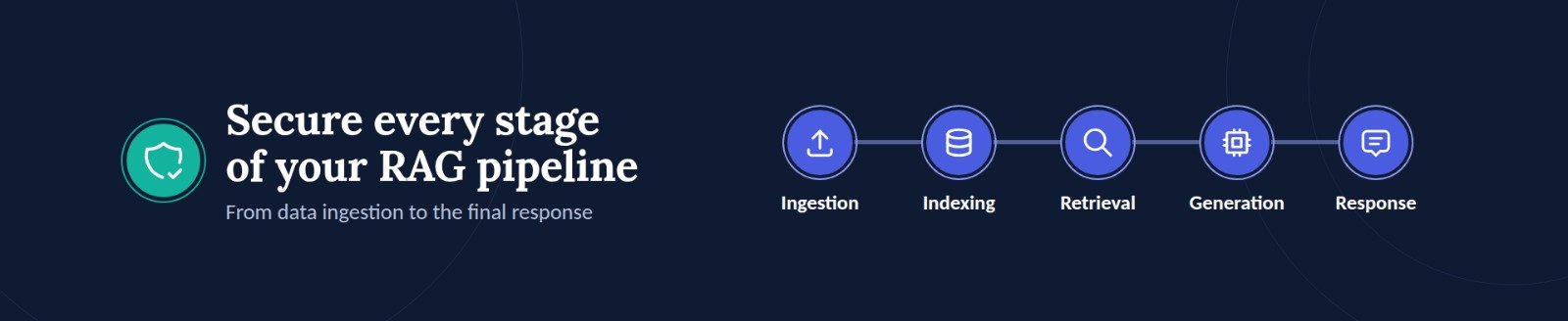
A secure RAG architecture places safeguards at every stage of the workflow:
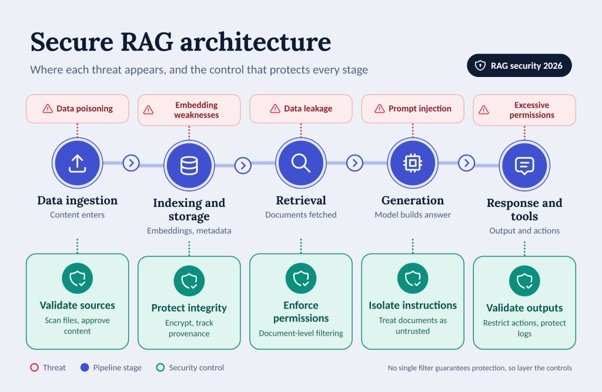
Secure RAG architecture diagram showing security controls at each pipeline stage: data ingestion, indexing, retrieval, generation, and response
- 1. Data ingestion: Validate sources, scan files, and approve content before indexing.
- 2. Indexing and storage: Protect embeddings, metadata, and document integrity.
- 3. Retrieval: Authenticate users and enforce document-level permissions.
- 4. Generation: Separate instructions from retrieved content and detect suspicious inputs.
- 5. Response and tool execution: Validate outputs, restrict actions, and prevent unauthorised data disclosure.
Research into indirect prompt injection also explores layered defences, including detection-and-quarantine pipelines and token-level identification of malicious instructions. These approaches can complement access controls and input isolation, but their effectiveness depends on the model, attack type, and evaluation conditions.
No single filter, encoding method, or detection model can guarantee complete protection. Security must extend across the full RAG pipeline.
RAG Security Checklist for 2026
Before deploying an AI knowledge base, verify that your team can:
- • Validate and approve data sources before ingestion.
- • Treat retrieved documents as untrusted content.
- • Enforce permissions before retrieving sensitive information.
- • Secure vector databases, embeddings, and metadata.
- • Test for direct and indirect prompt injection.
- • Detect and investigate suspicious document changes.
- • Protect sensitive information in outputs and logs.
- • Retest controls after significant changes to models, data, or workflows.
Conclusion
An AI Knowledge Base doesn't just need to be filtered in real-time or secured with database measures. A combination of trusted data ingestion, permission-aware retrieval, layered prompt injection defences, and ongoing testing is the key to having effective RAG security. Organisations can protect all aspects of the pipeline, minimising the risk of data poisoning, unauthorised data retrieval, and malicious instructions, and ensuring valuable, reliable AI applications.
Want to develop practical expertise in building AI applications with LLMs and RAG? Explore the Applied Generative AI: From LLMs to RAG Systems course to strengthen your understanding of generative AI technologies and their real-world applications.
FAQs: RAG Security in 2026
1. What is RAG security?
RAG security protects the data sources, retrieval pipeline, vector storage, and generated responses of Retrieval-Augmented Generation applications against manipulation and unauthorised access. It ensures that sensitive information remains protected throughout the retrieval and response generation process.
2. Can RAG systems be vulnerable to prompt injection?
Yes. Malicious instructions in user prompts or retrieved documents can influence model behaviour if the application lacks effective isolation and safeguards. These attacks can be direct (through user inputs) or indirect (through malicious instructions hidden in retrieved content).
3. What is data poisoning in RAG?
RAG data poisoning manipulates knowledge base documents or indexed content to influence retrieval results and cause inaccurate or misleading AI-generated answers. Regular document validation, source verification, and content approval can help prevent such attacks.
4. How does indirect prompt injection affect RAG applications?
It embeds malicious instructions in external content that the system retrieves, potentially causing unintended responses or misuse of connected tools. For example, a malicious instruction hidden in a webpage could influence an AI assistant when that page becomes part of its retrieved context.
5. How can I prevent data leakage in a RAG system?
Enforce user permissions during retrieval, restrict access to sensitive documents, validate outputs, and protect logs and connected systems. Key measures include:
- Role-based access controls.
- Document-level permission filtering.
- Restricted access to confidential information.
6. Are vector databases secure for storing sensitive information?
They can be secured using access controls, encryption, network restrictions, and monitoring, but configuration and application-level permissions remain essential. Organisations should also protect embeddings and metadata against unauthorised access.
7. Can a RAG system expose data from another user?
Yes. Missing document-level permissions or incorrect metadata filtering can allow unauthorised cross-user or cross-department retrieval. Enforcing access permissions before retrieval helps prevent users from accessing information outside their authorised roles.
8. How do you test a RAG system for security vulnerabilities?
Test malicious documents, retrieval manipulation, access-control bypasses, data leakage, and prompt injection using controlled adversarial scenarios. Regular testing helps identify weaknesses before attackers can exploit them.
9. What is the difference between RAG security and LLM security?
LLM security protects the model and its application, while RAG security additionally addresses retrieval, external knowledge sources, embeddings, and document permissions. Therefore, RAG security requires controls across both the AI model and its connected data pipeline.
10. What are the best practices for securing an enterprise AI knowledge base?
Validate sources, enforce access controls, isolate untrusted content, secure vector storage, test adversarial inputs, and continuously monitor system behaviour. Regular security reviews and updates also help maintain the reliability of enterprise AI applications.