Large Language Models (LLMs) such as GPT-4, Claude, and Gemini have emerged as essential components of contemporary AI applications, ranging from chatbots and content creation tools to enterprise knowledge assistants. However, as usage increases, API expenses can escalate rapidly. Each interaction with an LLM utilizes tokens, which directly convert into monetary costs.
The positive aspect? It is possible to significantly reduce expenses without compromising on performance. By implementing caching, enhancing retrieval methods, and optimizing prompts, teams can streamline their LLM systems, making them more efficient, quicker, and considerably more cost-effective. Let’s explore how each of these strategies functions in straightforward terms.
Caching: Don’t Pay Twice for the Same Answer
Imagine asking the same question to your AI assistant multiple times—each time paying for a full API call. That’s what happens when caching isn’t used.
Caching means storing previous responses so that if the same or similar query appears again, the system can reuse the old answer instead of calling the LLM again.
- When a user sends a query, the system checks if a similar one exists in the cache.
- If found, it returns the stored response instantly.
- If not, it calls the LLM, stores the result, and serves it to the user.
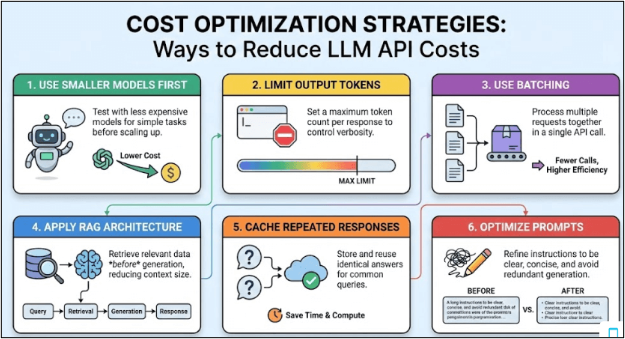
Caching can reduce API calls by 30–60%, depending on how repetitive your queries are. For example, customer support bots often receive similar questions (“How do I reset my password?”). With caching, those answers can be served instantly—saving both time and money. Use semantic caching: Instead of matching exact text, use embeddings to detect similar queries. Here’s how it works.
- Set expiration rules: Refresh cached answers periodically to keep them accurate.
- Cache at multiple levels: Store both raw LLM outputs and processed summaries.
Better Retrieval: Ask Smarter, Not Harder
While LLMs are highly capable, they are not all-knowing. Providing them with excessive irrelevant data leads to token wastage during processing. This is where retrieval optimization becomes essential. Retrieval is the process of identifying the most pertinent information from your knowledge base before it is sent to the LLM. In a Retrieval-Augmented Generation (RAG) framework, the model retrieves documents or snippets that relate to the user’s query and employs them to formulate an accurate response.
Ineffective retrieval results in unnecessary context being sent to the model—leading to increased token usage and costs. Effective retrieval, on the other hand, ensures that only the necessary information is transmitted. For example, if your knowledge base contains 10,000 documents, but only 3 are relevant to the query, you should retrieve and send only those 3. Here are a few ways to improve retrieval.
- Utilize embeddings effectively: Convert documents into vectors to enable the system to identify semantically similar content.
- Adjust chunk size: Break documents into smaller, meaningful segments (for instance, 200–500 words). If the chunks are too large, you risk wasting tokens; if they are too small, you may lose important context.
- Implement hybrid search: Merge keyword and semantic search techniques to enhance accuracy.
- Rank results: Employ relevance scoring to deliver only the most pertinent chunks to the LLM.
Organizations that have adopted optimized retrieval pipelines have experienced up to a 40% decrease in token usage per query. This is due to the model handling less text while still preserving the quality of the answers.
Prompt Optimization: Say More with Less
Every word in your prompt costs money. The longer the prompt, the more tokens consumed. But trimming prompts isn’t just about cutting words—it’s about making them smarter.
Why Prompts Matter
LLMs charge based on input and output tokens. A verbose prompt like:
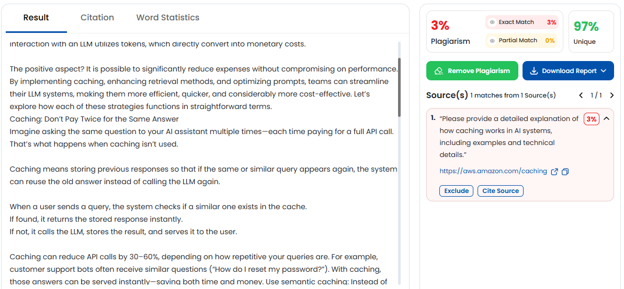
“Please provide a detailed explanation of how caching works in AI systems, including examples and technical details.”
The above prompt can be shortened to:
“Explain caching in AI with examples.”
Both yield similar results, but the second costs less.
Techniques for Prompt Optimization
a. Use Templates
Create reusable prompt templates for common tasks. Instead of writing new prompts each time, fill in variables dynamically.
Example:
“Summarize the following document in 3 bullet points: {document_text}.”
b. Remove Redundancy
Avoid repeating instructions. If your system already knows the format (e.g., “always respond in bullet points”), don’t restate it every time.
c. Compress Context
Summarize long histories or previous messages before sending them to the LLM. Instead of feeding 10 past exchanges, condense them into one short summary.
d. Use System Prompts Efficiently
System prompts define the model’s behavior. Keep them concise—every extra sentence adds cost.
e. Experiment with Model Parameters
Sometimes, smaller models (like GPT-3.5 instead of GPT-4) can handle simpler tasks at 70–80% lower cost. Use the right model for the right job.
The Future of Optimization
As LLM adoption grows, cost efficiency will become a competitive advantage. Companies that master caching, retrieval, and prompt optimization will deliver faster, cheaper, and more scalable AI experiences. Emerging tools are already automating these optimizations. For instance, vector databases like Pinecone and Weaviate handle semantic caching, while prompt engineering platforms like PromptLayer track and refine prompt performance.
Reducing LLM API costs isn’t about cutting corners—it’s about working smarter. By caching repeated queries, retrieving only what’s relevant, and crafting efficient prompts, you can make your AI system both powerful and affordable. Think of it like tuning a car engine: you’re not changing the car, just making it run smoother and use less fuel. In a world where every token counts, these optimizations turn AI from a costly experiment into a sustainable, scalable solution.
With companies working towards optimizing costs at each touchpoint of their business journey, you can be the most sought after resource if you are well versed in LLM API cost optimization and RAG. Learn how to achieve perfect cost optimization through better retrieval, cashing, and prompt optimization at Eduinx, a leading edtech institute in India. We offer both online and offline learning experience through a practical approach. Our mentors are here to help you understand complex concepts and assist you in landing your dream job. Whether you are a working professional or an aspiring entrepreneur, we offer a wide range of courses to achieve a breakthrough in your career. Get in touch with us here to learn more.
Plagiarism Report
AI Check
FAQs: Reducing LLM API Costs
1. Is there any free LLM API?
Yes, Google AI Studio gives a completely free tier of the Gemini API, no credit card needed, and then there's the free tier keys for multiple open models, such as Groq, Cerebras, and NVIDIA NIM. While OpenAI no longer provides API credits for free, Anthropic doesn't have a free API tier per se, but there's limited access via GitHub Models. Free tiers usually have rate limits and may not be suitable for commercial applications – be sure to review the terms of each provider before developing on a free tier.
2. What are the way I can decrease consumption of LLM Tokens?
The three largest levers are: caching repeated responses to avoid re-querying the same or similar information; optimizing retrieval to only provide the most relevant chunks of context to the model; and tightening prompts by reducing redundant instructions and by summarizing long conversation history. These techniques, in combination, are typically said to reduce the number of tokens used by 30-60%, without any significant change in output quality.
3. What is LLM caching techniques?
Examples of common caching strategies are exact-match caching (caching a response for a specific query only for identical queries), semantic caching (caching a response for a specific query only for similarly worded queries using embeddings) and prompt caching (caching and reusing the token cost of a long, repeating system prompt or context section, while only charging for the new portion of a query). Multiple cache layers (raw model outputs and processed summaries) usually yield more savings than do just a single caching layer.
4. What does semantic caching mean and how is it different from exact-match caching?
Semantic caching uses embeddings to detect queries that are similar in meaning rather than requiring an exact text match before reusing a stored response. This means, that a slightly reworded question, like "how do I reset my password" versus "the password reset steps," can still hit the cache, whereas exact-match caching would treat them as two separate, uncached requests.
5. How big should the chunks be for the documents to be retrieved?
It is the common practice to partition documents into smaller, more coherent sections (typically between 200 and 500 words). If the chunks are too large, they will have irrelevant surrounding text and waste tokens, and if they are too small they will miss important context required to accurately answer the query.
6. What is a prompt template and how does it help lower the API costs?
A prompt template is a pre-defined format for frequently used prompts, in which variables can be dynamically inserted, avoiding the need to write a new, possibly more lengthy, prompt each time. For instance, a template such as "Summarize the following document in 3 bullet points: {document_text}" ensures the consistency of the token usage and prevents having to repeat the instructions over and over such as "Summarize the following document in 3 bullet points".
7. What is the meaning of context compression in prompt optimization?
Context compression involves sending the history of conversations or previous exchanges to the LLM, but only a summary of the longer history. The system does not repeat 10 exchanges word for word, but rather summarizes them in a short sentence with minimal tokens used in the process.
8. Why is it important to set the rules for the expiration of cache?
It is important that the answers are not stored forever so that they do not become “stale” and begin to provide inaccurate information as facts, policies, or product information change over time. If there were no expiration rules, a system could continue to confidently return a cached answer long after it had become stale.
9. What are practical limits on reducing the number of calls to the API by caching?
Depending on the repetitiveness of the queries that a given application typically makes, API calls can be cut in half, which equals 30 to 60%. A good example is customer support bots, as they commonly get a large number of the same questions, such as password reset, which can be met automatically from a cache rather than by creating a new model call that charges a customer.
10. What is the role of relevance ranking and reranking when it comes to costs of LLMs?
Relevance ranking chunks pulls in and filters out weakly relevant content before it gets to the LLM, saving tokens in the prompt for the most relevant chunks. For instance, if a Knowledge base contains a hundred thousand documents and just 3 are relevant to a particular query, ranking will only send these 3 rather than a larger, noisier set of documents.
11. How does eliminating duplicate items in a prompt reduce costs without affecting output quality?
Inconsistencies in the instructions can lead to confusion, as if a system has a consistent rule, like "always answer in bullet points," repeating that same rule in each prompt is redundant and won't provide any new information the model can use. Eliminating this type of redundancy will make prompts more efficient and produce the same output structure and quality the team were already producing.