Learning Data Science is not just about Python programming or training a machine learning model. Some of the challenges that beginners face include dealing with datasets, choosing the appropriate features, avoiding data leakage, and assessing model performance accurately.
Data science problems can become easier to handle with the use of Generative AI, which can clarify concepts, provide code suggestions, and guide students to explore errors. AI-generated answers, however, must be verified independently. With knowledge of these seven typical data science pitfalls for beginners, you can create more reliable models and enhance problem-solving abilities.
7 Common Data Science Mistakes Beginners Make
Understanding these common mistakes can help beginners build a stronger foundation in data science. Here are seven pitfalls to watch out for and how Generative AI can help you overcome them.
- Building Models Before Understanding the Problem
- Skipping Exploratory Data Analysis (EDA)
- Applying Incorrect Data Preprocessing and Feature Engineering
- Copying AI-Generated Code Without Understanding It
- Ignoring Data Leakage and Improper Validation
- Choosing the Wrong Model or Ignoring Underfitting and Overfitting
- Treating AI as a Replacement for Independent Learning
Let us explore these in detail.
Building Models Before Understanding the Problem
A mistake often made by beginners in machine learning is doing it without first determining the business problem, knowing the domain, or even deciding if machine learning is needed.
How Generative AI can assist: Use the AI to explain the problem, to determine potential target variables, and to compare machine learning and simpler baseline methods. Don't immediately start to develop a complex model; ask it to explain the assumptions behind each option.
A business looking into customer churn might first need a definition of churn and an understanding of which decisions the predictions will support.
Skipping Exploratory Data Analysis (EDA)
Failing to investigate the data during training can hide missing values, unusual observations, skewed distributions, and relationships between variables. This can impact the ability to make pre-processing decisions and model performance.
How Generative AI can help: AI can suggest Python code to calculate summary statistics, look for missing values, and visualize feature distributions using pandas. They also might be able to help clarify patterns and ask additional questions.
Even the beginning student should look at the results and apply domain knowledge to see if the odd values are due to fault or significant observation.
Applying Incorrect Data Preprocessing and Feature Engineering
Cleaning up missing data or coding categorical data does not ensure a useful dataset. A model can be weakened by incorrect encoding, by scaling a model improperly, and by failing to consider important feature relationships.
How Generative AI can help: AI can suggest imputation methods, explain when to employ one-hot encoding and ordinal encoding, and propose useful features depending on the problem.
For instance, a retail dataset might benefit from features such as average purchase value or purchase frequency. These transformations must be backed with some meaningful reasons, not just because AI "thinks of them."
Find out how AI can streamline data preparation tasks in our guide to AI-augmented data wrangling and automated data cleaning.
Copying AI-Generated Code Without Understanding It
AI coding assistants can produce Python code in a short time, but the output code might include logical mistakes, wrong assumptions, or inappropriate techniques. Code that runs successfully is not necessarily correct.
Research published in ACM Transactions on Software Engineering and Methodology analyzed 829 coding problems from different sources like CodeContests, APPS and HumanEval. Depending on the benchmark, between 47.56% and 75.76% of tasks were found to have no identical test outputs generated when repeated on ChatGPT. This result applies to code generation consistency, and not the overall accuracy of AI tools.
How Generative AI helps: Ask AI to explain unfamiliar code, identify potential edge cases, or provide hints for debugging. Run the code against test cases, inspect its outputs, and understand the logic before using it in a project.
Ignoring Data Leakage and Improper Validation
Data leakage occurs when data that cannot be used at prediction time is used to influence the development of the model. This can make evaluation scores appear better than the model's actual performance on unseen data.
One reason is to include preprocessing steps on the full data set prior to separating training and test data.
How Generative AI helps: AI can check for a workflow for leakage and recommend appropriate validation strategies. But its recommendations need to be verified with the actual pipeline.
The scikit-learn documentation on common pitfalls recommends splitting datasets before preprocessing and using pipelines to help prevent leakage. Fit transformations on training data, then apply them to validation and test data.
Choosing the Wrong Model or Ignoring Underfitting and Overfitting
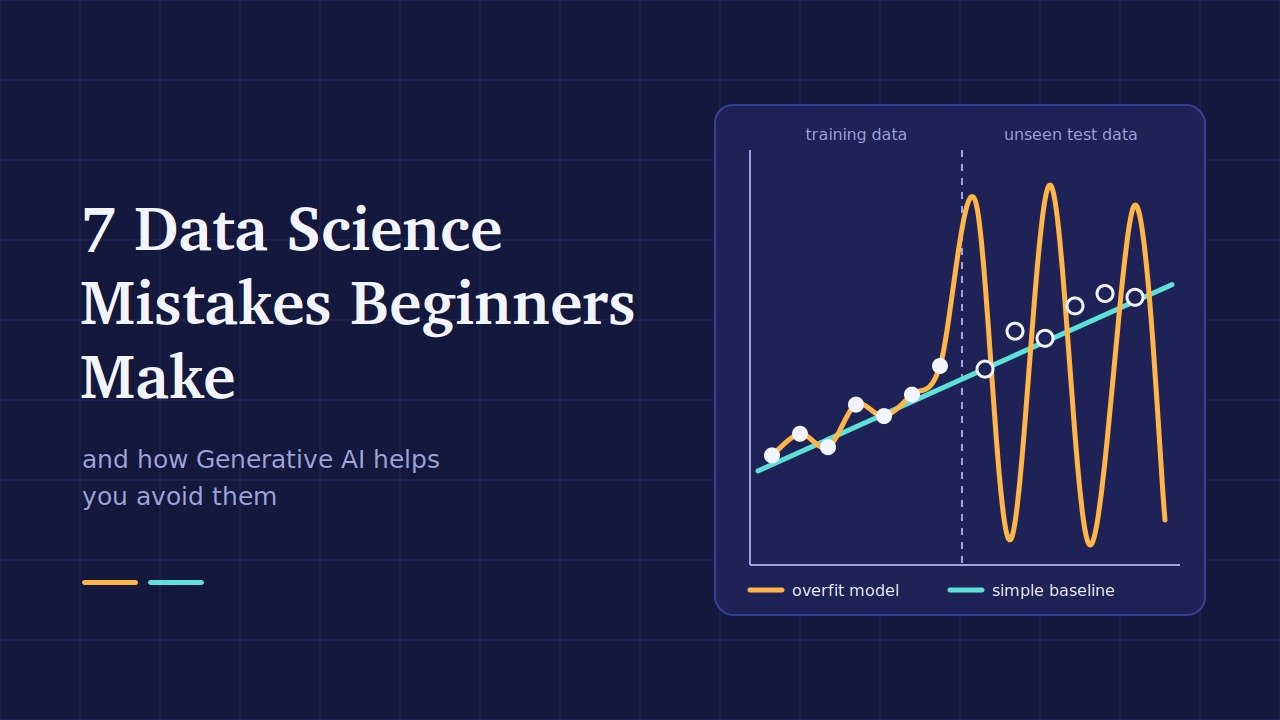
People who are new to AI programs may think that complicated algorithms always work better. In fact, a model that is too simple may fail to capture all patterns in the data. While overly complex models can simply memorize the training data and fail to accurately model new data.
How Generative AI can help: AI can provide explanations of algorithm trade-offs, suggest some baseline models, and help interpret differences between training and validation performance.
Use cross-validation where appropriate, compare suitable evaluation metrics, and consider regularization or simpler models when overfitting occurs. Increase model complexity only when evaluation results justify it.
Treating AI as a Replacement for Independent Learning
Relying on complete AI-generated solutions can prevent beginners from developing debugging skills, computational thinking, and the ability to evaluate technical decisions independently.
How Generative AI helps: Use AI as an interactive tutor. Request hints, step-by-step explanations, worked examples, and practice exercises before asking for complete solutions.
For example, if there is a failure in a panda operation, for instance, ask AI for an explanation of the failure and then request a solution. Try to correct it on your own, execute it, and find out if it is correct. This is a method that will make AI tools for data science more than just a solution to dependence but a means to skills development.
After mastering these basics, use what you've learned to create your own data science portfolio with six projects using Generative AI.
| Common Mistake | Typical Pitfall | How Generative AI Assists |
|---|---|---|
| 1. Rushing into Model Building | Skipping problem definition and business objectives. | Frames problem scope, identifies target variables, and sets simple baselines. |
| 2. Skipping EDA | Missing hidden outliers, nulls, and skewed distributions. | Generates pandas summary scripts, visualizes distributions, and prompts questions. |
| 3. Flawed Preprocessing | Using improper imputation or inappropriate feature encoding. | Explains encoding tradeoffs and suggests domain-specific feature ideas. |
| 4. Blindly Copying AI Code | Unchecked bugs, logic errors, and invalid assumptions. | Walks through logic, creates edge-case tests, and suggests debugging steps. |
| 5. Overlooking Data Leakage | Fitting transforms on entire dataset before train/test split. | Audits pipeline logic and suggests scikit-learn pipeline patterns. |
| 6. Poor Model Selection | Defaulting to complex architectures without baseline checks. | Compares model trade-offs and helps analyze bias-variance behavior. |
| 7. Over-Relying on AI | Failing to develop core debugging and reasoning abilities. | Acts as a personal tutor with hints, step-by-step guides, and exercises. |
How to Use Generative AI Effectively in a Data Science Workflow
To minimise common errors follow a structured workflow:
- Define the problem: Establish the objective, target variable, and success criteria.
- Explore the data: Examine distributions, missing values, outliers, and relationships.
- Prepare the features: Select appropriate preprocessing and feature engineering methods.
- Split and validate: Separate training and test data before fitting preprocessing steps.
- Build a baseline: Start with a simple model and evaluate its performance.
- Verify AI assistance: Test generated code, examine assumptions, and document limitations.
If you'd like to see these steps in action, explore how to build an end-to-end data science pipeline using Generative AI tools.
This approach joins the power of Generative AI with the core attributes necessary for effective machine learning. Do not input sensitive or private information to AI unless the AI's data handling guidelines and the organization's procedures allow for it.
Conclusion
Avoiding common data science mistakes requires sound problem formulation, careful data preparation, appropriate validation, and critical thinking. Generative AI can make learning data science more accessible, but reliable results still depend on human judgment. Use AI to understand, experiment, and verify; not simply to generate code or conclusions.
To develop a stronger foundation in data science and Generative AI, explore Eduinx’s Post Graduate Program in Data Science with Generative AI.
Frequently Asked Questions
What are the most common data science mistakes for beginners?
Common mistakes include skipping exploratory data analysis, applying incorrect preprocessing, neglecting feature engineering, overlooking data leakage, choosing unsuitable models, and trusting AI-generated code without testing it.
How does Generative AI help beginners learn data science?
Generative AI can explain statistical concepts, suggest Python code, assist with debugging, recommend analytical approaches, and provide practice exercises that support independent learning.
Can Generative AI replace Python skills in data science?
No. AI can assist with coding, but beginners must understand programming logic, test generated code, troubleshoot errors, and interpret analytical results.
Is Generative AI useful for data cleaning?
Yes. It can suggest ways to handle missing values, duplicates, inconsistent formats, and outliers. The appropriate solution depends on the dataset and its context.
What is feature engineering in data science?
Feature engineering involves creating, transforming, or selecting variables to help a model capture useful patterns, such as calculating purchase frequency from transaction records.
What is data leakage in machine learning?
Data leakage occurs when information unavailable at prediction time influences model development, resulting in misleading evaluation scores and potentially poor performance on new data.