Product Managers (PMs) are often described as the “CEOs of the product.” They balance customer needs, business goals, and technical feasibility. One of their most important tasks is writing Product Requirement Documents (PRDs)—the guiding blueprint for engineering, design, and marketing teams. A clear PRD ensures alignment, reduces confusion, and speeds up execution.
PRDs take hours or even days to draft. PMs must gather inputs, analyze feedback, and structure requirements carefully. But with the rise of Generative AI, this process is being transformed. Large Language Models (LLMs) can now help PMs draft PRDs in minutes, freeing up time for strategy and customer engagement. Did you know that writing PRDs with AI reduces drafting time by up to 80%.
Generative AI for Product Managers
Generative AI is not just about writing text it’s about creating structured, meaningful content. For PMs, this means turning raw ideas, customer feedback, or meeting notes into polished PRDs. Instead of starting from scratch, PMs can feed the AI a few inputs like the problem statement, target audience, and desired outcome and receive a draft PRD that is clear, structured, and actionable. This shift allows PMs to focus less on formatting and more on decision-making. AI becomes a trusted companion, helping PMs move faster without sacrificing quality and making AI for Product Managers essential.
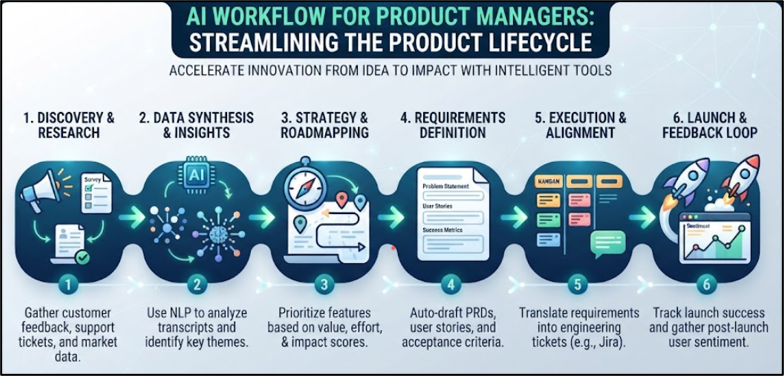
AI Workflow for Product Managers
The workflow for using AI in PRD creation is simple yet powerful. A PM begins by gathering inputs: customer pain points, stakeholder requests, and business goals. These are fed into the AI, which generates a draft PRD. The PM then reviews, refines, and aligns the draft with engineering feasibility and stakeholder priorities. This workflow reduces the time spent on documentation while ensuring consistency. It also allows PMs to generate multiple versions quickly—for example, a detailed PRD for engineers and a simplified summary for executives.
Product Roadmap AI
Beyond PRDs, AI is also helping PMs with product roadmaps. Roadmaps are strategic documents that outline what features will be built and when. AI can analyze customer feedback, market trends, and usage data to suggest roadmap priorities. If customer support tickets show recurring issues with navigation, AI can highlight this as a priority feature. Combined with PRDs, this ensures that roadmaps are not just aspirational as they are grounded in real data.
AI for Product Documentation
Documentation is often seen as tedious, but it is essential for alignment. AI can generate not just PRDs but also supporting documents like feature specs, FAQs, and release notes. This ensures that teams have consistent, clear documentation across the product lifecycle. By automating documentation, PMs can spend more time on customer interviews, strategy sessions, and cross-functional collaboration.
AI Requirements for Documentation
Using AI for documentation requires a few key considerations.
- PMs must provide clear inputs. The quality of the draft depends on the clarity of the problem statement and goals.
- AI drafts should be treated as starting points, not final documents. Human judgment is essential to ensure accuracy and relevance.
- Organizations should establish standards for AI-generated documentation. This ensures consistency across teams and prevents confusion.
How to Write a PRD with AI
Writing a PRD with AI is straightforward. A PM begins by defining the problem, the goal, and the audience. These inputs are fed into the AI, which generates a draft PRD. Here’s a quick brief on the same.
- Problem: Users struggle to find saved reports.
- Goal: Improve discoverability of saved reports.
- Audience: Business analysts using the platform.
The AI then produces a draft PRD:
- Problem Statement: Saved reports are difficult to locate, leading to frustration and reduced productivity.
- Proposed Solution: Add a dedicated “Saved Reports” section in the dashboard with search and filter options.
- Scope: Include search by name, filter by date, and quick access shortcuts.
- Success Metrics: Increase report retrieval speed by 30%, reduce support tickets related to report discovery by 25%.
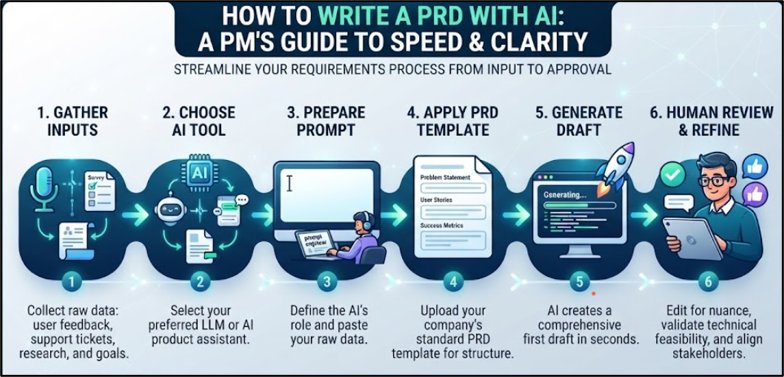
The PM reviews this draft, adds stakeholder inputs, and aligns it with engineering feasibility. The result is a polished PRD created in minutes instead of hours.
Benefits of AI-Powered PRDs
The biggest benefit is speed. What used to take hours can now be done in minutes. However, speed is not the only advantage. AI ensures consistency, making PRDs easier to read and compare. It improves clarity, rephrasing complex ideas into simple language. And it enhances collaboration, allowing teams to iterate faster and align sooner.
Companies adopting AI for PRDs are seeing tangible results. If AI reduces PRD drafting time by 60%, PMs spend more time on customer interviews. Another enterprise noted that AI-generated drafts improved stakeholder alignment because documents were clearer and more structured.
Best Practices for PMs Using AI
While AI is powerful, PMs should follow a few best practices. Always provide clear inputs the quality of the draft depends on the clarity of the problem statement and goals. Treat AI drafts as starting points, not final documents. Use AI to brainstorm alternatives, asking the model to suggest multiple solutions. Keep stakeholder alignment central: AI can draft quickly, but PMs must ensure the document reflects real business priorities.
The Future of PRDs with AI
Looking ahead, AI will not just draft PRDs, it will integrate with enterprise tools. Imagine an AI that pulls customer feedback from support tickets, usage data from analytics, and market trends from reports, then generates a PRD automatically.
This future is not far off. As AI systems become more connected, PRDs will evolve into living documents—continuously updated with real-time data and insights. For PMs, this means less time writing and more time leading. AI will handle the drafting, while PMs focus on strategy, vision, and execution. Writing PRDs has always been a critical but time-consuming task for Product Managers. With AI, especially LLMs, this process is being transformed. PMs can now draft clear, structured, and actionable PRDs in minutes, freeing up time for higher-value work.
The role of the PM is not diminished, it is elevated. By leveraging AI, PMs can spend less time on documentation and more time on what truly matters: understanding customers, shaping product vision, and driving outcomes. AI doesn’t replace the art of product management—it amplifies it. This is a game changer for PMs striving to move fast while staying aligned. Now, nearly 97% of content marketers plan to use AI to support content marketing efforts in 2026.
Now that you have understood the nuances of writing better PRDs with AI, you need to know how to implement it in real time. Here’s where Eduinx comes into the picture. As a leading edtech institute in India, we have a team of non academic mentors and thought leaders with decades of industry-relevant experience to guide you. We also offer placement support in landing the right job for a handsome pay. Get in touch with us to learn more about our courses. Whether you are a budding entrepreneur or an aspiring AI engineer, Eduinx is here to help.
Frequently Asked Questions (FAQs)
1. What is PRD and why is it important for Product Managers?
A PRD (Product Requirements Document) is the blueprint that brings engineering, design, and marketing teams together around the product they are creating and its purpose. Although a PRD can be lengthy and complicated, often taking hours or even days to complete, it is one of the most essential documents a product manager creates to avoid confusion and speed up execution.
2. What is the AI-assisted PRD workflow?
This workflow is quick and straightforward, saving time on documentation and ensuring consistency between drafts. The PM gathers data from customers, stakeholders, and business goals. The AI uses this information to create a draft PRD. The PM then reviews, expands, and finalizes the draft, considering engineering feasibility and stakeholder priorities. Many versions can be produced quickly, including a detailed PRD for engineers and a shorter version for executives.
3. What are the inputs required for an AI to create a good PRD?
Before the AI can create a useful first draft, the PM typically needs to establish three key inputs:
- Users' problem statement
- The purpose of the feature
- The target user for the feature or document
These inputs are crucial for the AI's clarity.
4. What are the elements that should be included in a typical PRD created by an AI?
An AI-generated draft typically includes a problem statement that describes the issue and its effects, a proposed solution that outlines what needs to be built, a defined scope detailing the specific features, and measurable success metrics. For example, a PRD for report discoverability might feature a section called “Saved Reports” that includes a search and filter feature aimed at reducing the time it takes to find reports by 30%.
5. How can AI help develop a product roadmap?
AI can analyze customer feedback, market trends, and usage patterns to suggest priorities for the roadmap, rather than relying solely on intuition. For instance, if AI identifies frequent navigation issues in support tickets, this information can be combined with AI-generated PRDs to keep the roadmap data-driven.
6. What other product documents can the AI help create besides PRDs?
AI can also generate documents like FAQs, product release notes, and feature specs, in addition to PRDs. This ensures teams have clear and accurate documentation throughout the product lifecycle. As a result, PMs can save time on customer communication, strategy sessions, and other interactions.
7. Why should AI PRD drafts be considered drafts, and not final documents?
AI drafts are based on the information provided to it and may not capture all the details a PM knows about stakeholder priorities, technical limitations, or business nuances. Finalizing any document relies on human judgment to ensure it is accurate, reflects business goals, and is feasible from an engineering standpoint.
8. What is the actual time to be saved on drafting a PRD using AI?
AI can speed up the drafting process by as much as 80%, with some companies reporting that it saves PMs up to 60% of their drafting time. This efficiency allows PMs to focus more on customer interviews and strategic work. In addition to speed, teams have found that AI-generated drafts lead to better alignment with stakeholders due to their clarity and structure.
9. How to write a PRD with AI?
First, clearly define the problem, objective, and audience before entering anything into the AI. For example:
- Easily find saved reports.
- Solution: Find saved reports easily.
- Summary: The goal is to make it easier to locate stored reports.
- Why: To improve report discoverability.
- Target User: All Business Analysts using the platform.
Then, the AI creates a draft framework with sections for the problem statement, proposed solution, scope, and success metrics, which are reviewed and revised by the PM based on stakeholder input.
10. What can product managers do to encourage AI to produce better drafts of PRD?
A few practices yield better drafts:
- Provide clear and specific inputs, as the quality of the draft reflects the quality of the defined problems and goals.
- Use AI-generated drafts as a starting point, not the final product.
- Brainstorm various alternative solutions instead of settling on the first one.
- Keep stakeholder alignment as a priority; AI can draft quickly but cannot verify facts.
11. What is the current uptake of companies on using AI to create content and documentation such as PRDs?
Adoption has surged in content-related work, with nearly 97% of content marketers planning to use AI for content marketing by 2026. A similar trend is occurring in product management, where AI-driven documentation is becoming an integral part of the PM process rather than just a trial-and-error approach.