
Introduction
Product management is going through its biggest structural shake-up since agile replaced waterfall. This time it is not a new ceremony or template driving the change. It is AI sitting inside the actual workflow, doing synthesis, drafting, and first-pass analysis that used to eat up a PM's week.
The result is a new organizational shape: the AI-native product team. These are not old teams with a chatbot bolted on. They are smaller, faster, and built around a completely different division of labor between humans and models. If you are a product manager, founder, or aspiring PM trying to figure out where you fit in 2026, this restructuring is worth understanding in detail.
What Makes a Team Actually AI-Native (Not Just AI-Enabled)
Plenty of teams use AI tools without being AI-native. The difference comes down to where intelligence sits in the workflow. An AI-enabled team still runs a traditional staged process: discovery, then PRD, then handoff to engineering, then QA. AI tools just speed up individual steps along that chain.
An AI-native team runs on a continuously operating decision system instead, where signals from analytics, support tickets, sales calls, and user behavior feed prioritization in real time rather than at the start of a quarterly cycle. Feature lists give way to structured opportunity spaces that get reassessed constantly. This operating model is often described as the AI-native product loop, and it marks a real departure from the staged product lifecycle most teams still run today.
This shift changes what a PM spends time on. Less time chasing status updates across tools, more time deciding which validated opportunity deserves engineering hours next.
Organizations already running mature agentic retrieval systems tend to make this transition faster, since the underlying data infrastructure for real-time synthesis is already in place.
The New Anatomy of the Product Pod
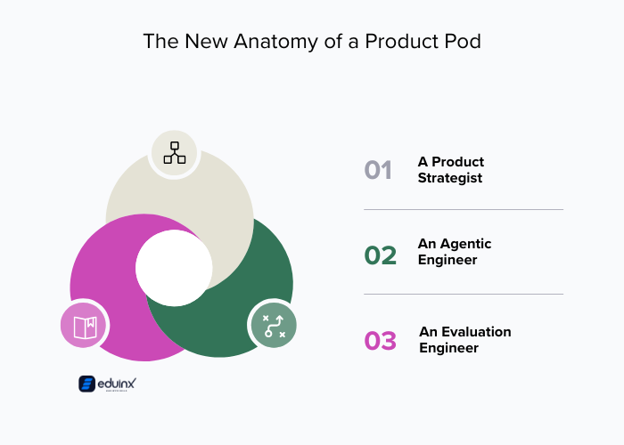
The org chart itself is shrinking and reshaping. Industry practice in 2026 has converged on small, cross-functional pods of three to five people that replace the traditional eight to twelve person team with multiple layers of handoff, according to a 2026 engineering management study by Optimum Partners.
A typical pod looks like this:
- A Product Strategist who blends classic product judgment with AI literacy, defining problems and owning the evaluation framework
- An Agentic Engineer who combines software engineering with applied AI, building and wiring up the systems
- An Evaluation Engineer focused purely on quality, checking whether AI-generated outputs actually meet the bar before they ship
Larger products sometimes add an AI Solutions Architect or an Agentic Designer, but the core unit stays small by design. Linear is a frequently cited real-world example of this shift in practice, having run with a two-person PM team in 2026 even at a meaningful scale.
💡 Pro Tip: Audit your pod before you restructure. Before splitting a large team into pods, map who currently owns evaluation and quality checks for AI outputs. If nobody owns this today, hire or designate an Evaluation Engineer first. Skipping this step is the most common reason pod restructures fail within two quarters.
The PM Role Itself Is Splitting in Two
Here is the part that surprises people: PM headcount is not disappearing. It is polarizing. A BCG 2026 report on AI and workforce transformation, which analyzed over ten thousand job postings across forty industries, found that PM headcount at AI-native companies grew eighteen percent year over year in 2025, while PM headcount at companies simply adding AI to existing products grew only six percent.
The mix inside those teams is what actually changed. Job postings asking for AI fluency grew roughly sevenfold between 2024 and 2026, and the role is now splitting into distinct tracks. The AI Product Manager path carries the deepest technical demands, covering model selection, evals, and API cost trade-offs, while the Strategic PM path leans hardest on systems thinking and stakeholder influence. A third track, AI-Native Product Ops, is emerging around context libraries and feedback pipelines that keep the whole system fed with good data.
Organizations that treat this restructuring seriously are already seeing it reshape leadership decisions.
"The transformational leaders in this next stage of AI will be those willing to redesign how products are built and how organizations operate. Good product leaders will move features faster. Great ones will rethink the product OS."
— Renée Niemi, Resident Chief Product Officer, Products That Count, from the 2026 CPO Insights Report
This is not a call to panic. The PMs feeling the most market pressure in 2026 are the ones who waited until the restructuring became obvious before adapting, not the ones who moved early.
From Backlogs to Decision Architecture
The weekly rhythm of product work has changed alongside the org chart. AI-first teams are moving away from fixed roadmaps and staged release cycles, leaning instead into short exploration sprints and parallel experiments. Support tickets, sales calls, and product analytics now feed real-time synthesis that points PMs toward opportunity spaces rather than static backlogs.
This is the practical, day-to-day version of agile transformation that most teams are actually living through right now, not the ceremony-heavy version from a decade ago. Standups get shorter because status is visible in the system already. Roadmap reviews get replaced by opportunity reviews.
The center of gravity shifts from backlog management to decision architecture, and the long-term result is not replacement of PMs but compression of coordination overhead. Teams that manage this well cross-link their internal frameworks and playbooks so nobody has to reconstruct context from scratch, an approach that mirrors how strong multi-agent orchestration systems are designed to avoid redundant work between agents.
💡 Pro Tip: Track decision velocity, not ticket velocity. If your team still reports sprint velocity as the main health metric, you are measuring the old model. Start tracking how long it takes an opportunity to go from signal to validated decision. That number will tell you more about whether your team is actually AI-native.
The Skills and Tools That Actually Matter Now
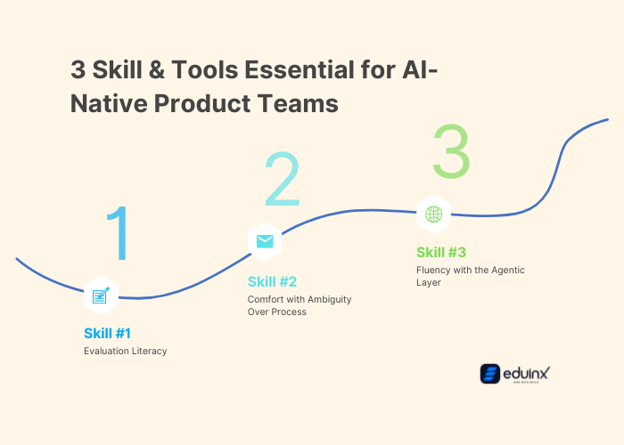
None of this works without the right tooling underneath it. NotebookLM, Perplexity, and Claude-native workflows now handle most research synthesis tasks that previously occupied twenty to thirty percent of a PM's weekly time, including summarizing customer interviews, synthesizing competitor research, and distilling industry reports, according to the same BCG-based analysis. The PM's job has shifted from producing that synthesis to evaluating whether it is any good.
This puts a premium on three specific skills:
- First, evaluation literacy. If AI drafts your PRD, you need to know how to judge whether the output actually reflects the right trade-offs, not just whether it reads well.
- Second, comfort with ambiguity over process. PMs whose main job is passing context between teams are the most exposed to this shift, while the ones who keep their edge are the ones who make trade-offs, deal with ambiguity, and own hard ethical calls.
- Third, fluency with the agentic layer itself. This isn't just prompting a chatbot for a summary. Teams that have already built strong cross-functional AI product teams report that this fluency compounds quickly once the basic pod structure is in place.
💡 Pro Tip: Start with a 90-day repositioning plan, not a full role change. Rather than trying to become a full AI Product Manager overnight, pick one track (strategic depth, technical AI fluency, or product ops) and build the underlying skill over one quarter. Small, consistent moves beat one large pivot attempted under pressure.
What This Means If You Are Building or Leading a Team
If you are restructuring a team this year, start with the smallest viable pod rather than reorganizing everyone at once. Give one pod ownership of a real opportunity space, let AI handle the first-pass synthesis, and measure how fast that pod moves from signal to shipped decision. Scale only once that loop actually works.
If you are a PM figuring out where you fit, resist the urge to specialize in everything. Strategic judgment, technical AI fluency, and product ops each have a real path forward. Pick one and go deep rather than staying shallow across all three.
The organizations winning this transition in 2026 are not the ones with the most AI tools. They are the ones who rebuilt their decision architecture around those tools, then trusted their smaller, sharper teams to run it.
Frequently Asked Questions (FAQs)
1. What is an AI-native product team, exactly?
It is a team structured around continuous, AI-assisted decision making rather than staged handoffs between departments. Signals feed prioritization in real time, and small cross-functional pods replace large siloed teams.
2. What is an AI-native product compared to an AI-enabled one?
An AI-native product is designed from the beginning to be AI-driven, rather than an AI feature added to an existing workflow. It is built to support continuous AI reasoning, retrieval, and decision making from the start. Without the AI, the product would no longer function. AI-enabled products simply add a "smart" feature or chatbot later in the cycle.
3. Will AI replace product managers entirely?
No. Data shows PM headcount growing faster at AI-native companies than at traditional ones. The role is splitting into specialized tracks (strategic, technical AI, and product ops) rather than disappearing.
4. What is the AI-native product loop?
The AI-native product loop is an operating model in which a structured opportunity space supersedes a fixed feature list and is continually re-evaluated. It is a new way of thinking compared to the traditional roadmap approach, which is more of a one-off event where priorities are decided at once and then carried out.
5. How big should an AI-native product pod be?
Most organizations have converged on three to five people per pod, replacing the older eight to twelve person team model. Larger products sometimes add one or two specialist roles like an AI Solutions Architect or Agentic Designer on top.
6. What is the role of a Product Strategist in an AI-native pod?
A Product Strategist combines traditional product sense with AI skills. They are responsible for problem framing and defining the process and framework for opportunity and output evaluation. They provide critical direction without compromising on solving the right problem when speeding up workflows with AI tools.
7. What skills should a PM build first to stay relevant?
Evaluation literacy tops the list. Being able to judge whether an AI-generated PRD or analysis is actually sound matters more now than being able to write one from scratch. Comfort with ambiguity and fluency with the agentic layer are also essential.
8. What is AI-Native Product Ops?
AI-Native Product Ops is a new specialization that concentrates on constructing and maintaining context libraries and feedback pipelines to supply current, accurate information. It ensures the AI-native team's decision-making system stays fueled with reliable data.
9. Why do pod restructures sometimes fail in the first two quarters?
The number one cause is not conducting an audit of the present owners of evaluation and quality checks for AI outputs prior to forming pods. When no one is assigned the role of owner, quality problems are ignored, and the new structure is likely to collapse.
10. What is the biggest risk for PMs in this restructuring?
Waiting too long. PMs whose main value was passing context between teams are the most exposed, while those who move early into strategic or technical specialization report the least market pressure.