Product-led growth (PLG) has changed how SaaS companies acquire, activate, retain, and monetize users. Instead of relying primarily on sales teams to demonstrate value, PLG puts the product itself at the centre of the customer journey.
AI is now making that product-led journey more adaptive. From intelligent onboarding and behavioral recommendations to predictive analytics and AI assistants, products can increasingly respond to what individual users need rather than giving everyone the same experience.
This shift matters as AI adoption moves beyond experimentation. McKinsey's 2026 State of AI survey found that nearly nine in ten respondents regularly use AI in at least one business function, while 44% reported that AI was scaling across their enterprise.
For PLG businesses, the opportunity is to use AI not simply as a feature, but as a growth layer that helps users reach value faster.
What Is Product-Led Growth?
Product-led growth is a business strategy where the product becomes a primary driver of customer acquisition, activation, retention, and monetization.
A typical PLG journey looks like:
Acquisition → Sign-up → Onboarding → Activation → Engagement → Retention → Monetization
Instead of asking users to understand the product through lengthy sales processes, PLG encourages them to experience its value directly.
Amplitude describes PLG as a growth model that uses the product to drive acquisition, retention, and monetization.
The challenge is that users do not all reach value in the same way. This is where AI can make PLG more responsive.
How Is AI Changing Product-Led Growth?
AI-powered PLG uses behavioral, contextual, and product data to personalize the user journey and identify the next action most likely to help a user reach value.
Traditional PLG often depends on predefined onboarding flows, rules, segments, and product recommendations. AI can make these experiences more dynamic by interpreting user behavior and adapting the experience accordingly.
| Traditional PLG | AI-Powered PLG |
|---|---|
| Standard onboarding | Adaptive onboarding |
| Fixed user journeys | Behavior-based journeys |
| Rule-based segmentation | AI-assisted intent detection |
| Generic recommendations | Contextual recommendations |
| Static product guidance | Dynamic in-product guidance |
| Manual analysis | AI-assisted product analytics |
| Periodic optimization | Continuous experimentation |
The goal is not to replace the fundamentals of PLG. It is to reduce friction between what a user wants to accomplish and the moment they actually achieve it.
AI-Powered Onboarding: From One Journey to Personalized Journeys
AI-powered onboarding adapts the initial product experience based on a user's role, behavior, goals, and interaction with the product.
A traditional onboarding flow may show every new user the same checklist. An AI-powered experience can consider signals such as:
- User role or use case
- Features explored
- Actions completed
- Product usage patterns
- Stated goals
- Previous interactions
- Where the user stops or drops off
For example, a project manager and a developer may sign up for the same collaboration platform but need different features to reach their first meaningful outcome.
Instead of giving both users the same onboarding sequence, AI can prioritize relevant actions, surface appropriate templates, or provide contextual guidance.
How Does AI Improve Product Activation?
AI improves product activation by helping users reach the specific action that represents meaningful value for them.
Activation is not simply completing an onboarding checklist. It should represent the moment when a user experiences the core value of a product.
Understanding these moments starts with mapping how users move through the product and where they encounter friction. AI-powered customer journey mapping can help product teams identify these patterns more systematically. For one product, activation could mean creating a first project. For another, it could mean inviting a teammate, connecting a data source, generating a report, or completing a workflow.
AI can support activation by:
- Identifying behavioral patterns linked to successful activation.
- Detecting where users are getting stuck.
- Recommending the next relevant action.
- Triggering contextual guidance.
- Personalizing onboarding based on user intent.
Amplitude's product benchmarks also treat activation as a key indicator of whether users are finding early value, although activation benchmarks vary considerably by product and industry.
Why Faster Time-to-Value Matters in PLG
Time-to-value (TTV) measures how long it takes a user to experience meaningful value from a product.
In PLG, a shorter TTV can reduce friction between sign-up and activation. The faster users understand why a product matters, the sooner they can begin using its core functionality.
AI can help reduce TTV through:
- Automated setup
- Personalized templates
- AI-assisted workflows
- Contextual product recommendations
- Conversational assistance
- Automated data analysis
- Intelligent feature discovery
This creates a simple growth loop:
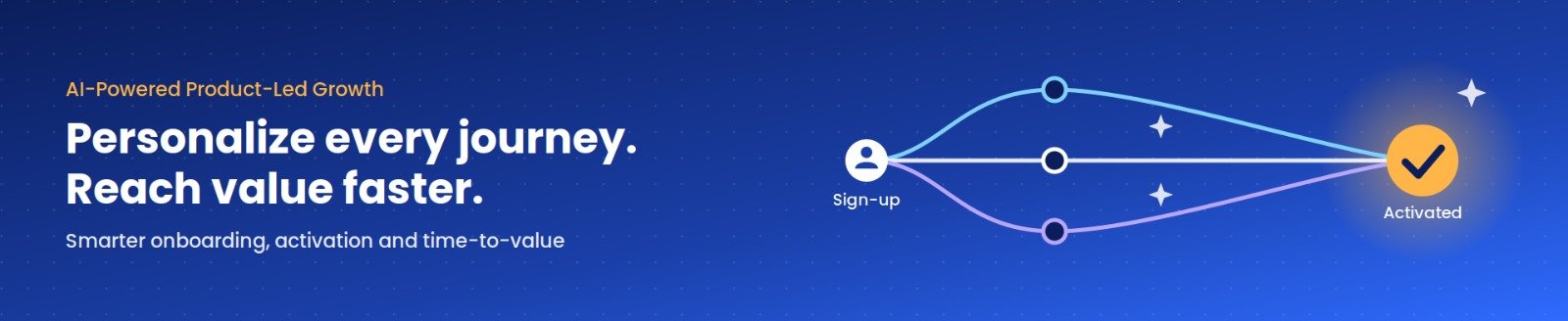
Sign-up → Understand intent → Personalize experience → Reach value → Activate → Continue using product
The objective is not simply to make onboarding shorter. It is to make every onboarding step more relevant.
AI Personalization Across the PLG Funnel
AI can influence multiple stages of the product-led growth funnel.
| PLG Stage | User Challenge | AI Opportunity |
|---|---|---|
| Acquisition | Finding the right use case | Intent and audience analysis |
| Onboarding | Knowing where to start | Personalized setup |
| Activation | Reaching the aha moment | Next-best-action recommendations |
| Engagement | Discovering useful features | Contextual suggestions |
| Retention | Losing momentum | Predictive signals and nudges |
| Expansion | Identifying additional value | Usage-based recommendations |
This means AI-powered PLG is broader than an AI chatbot inside a product. It can become an intelligence layer across the entire user journey, enabling hyper-personalized product experiences based on user behavior, intent, and context.
5 Key AI Use Cases in Product-Led Growth
Here are the 5 AI use cases in product-led growth.
- AI Onboarding Assistants: Conversational assistants can answer questions, guide setup, explain features, and help users complete tasks without leaving the product.
- Personalized Product Recommendations: AI can recommend features, templates, workflows, or actions based on how a user interacts with the product.
- Predictive Activation: Behavioral data can help identify patterns associated with successful activation and highlight users who may need additional guidance.
- AI Product Analytics: AI can help product teams analyze large volumes of behavioral data, identify friction points, and surface patterns that may otherwise take longer to discover.
- Contextual In-Product Guidance: Instead of showing the same tooltip or message to everyone, AI can help determine when guidance is relevant based on the user's current behavior.
Which PLG Metrics Should You Track?
AI does not replace PLG metrics. It makes them more actionable.
| Metric | What It Measures |
|---|---|
| Activation rate | Percentage of new users reaching the defined activation event |
| Time-to-value | Time taken to experience meaningful product value |
| Time-to-activation | Time taken to reach the activation event |
| Feature adoption | Usage of important product features |
| Free-to-paid conversion | Percentage of free users becoming paying customers |
| Retention | Percentage of users who continue using the product |
| PQL rate | Percentage of users showing product-qualified buying signals |
For example:
Activation Rate = Activated Users ÷ Total New Users × 100
The important point is to define activation around actual product value rather than an arbitrary number of clicks.
How to Build an AI-Powered PLG Strategy
A practical AI-powered PLG framework can be built around seven steps:
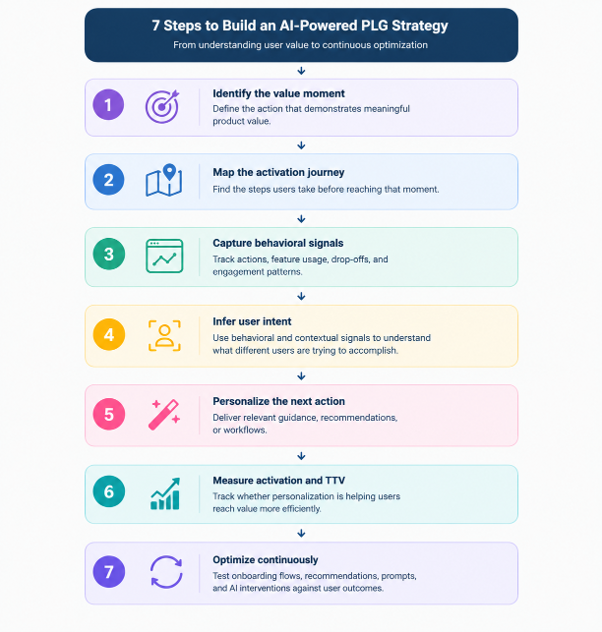
This creates a continuous loop:
User behavior → AI interpretation → Personalized action → User response → New data → Optimization
Building this kind of strategy also requires product teams to understand how AI can be applied across product discovery, experimentation, user experience, and decision-making. This is an important part of developing advanced AI product management and product leadership skills.
Common Challenges of Implementing AI in PLG
AI-powered personalization depends on user data, which makes transparency and responsible data use essential.
Salesforce's State of the AI Connected Customer research found that 71% of customers feel increasingly protective of their personal information, while 72% say it is important to know when they are communicating with an AI agent.
PLG teams therefore need to consider:
- What data is being collected?
- Why is it being collected?
- How is it being used?
- Which AI decisions require user control?
- When should users know they are interacting with AI?
Other challenges include poor data quality, incorrect recommendations, over-personalization, implementation costs, and difficulty connecting AI activity to measurable business outcomes.
What Is the Future of PLG in 2026?
The next stage of product-led growth is likely to be more adaptive rather than simply more automated.
Instead of asking users to navigate a fixed product journey, AI can help products respond to changing intent and behavior.
The emerging model is:
Intelligent onboarding → Faster activation → Shorter time-to-value → Deeper engagement → Better retention opportunities
For product teams, the opportunity is not to add AI everywhere. It is to identify the points where users experience friction and determine whether AI can meaningfully reduce it.
Conclusion
Product-led growth has always focused on one fundamental idea: let the product demonstrate its value.
AI adds another layer to that model by helping the product understand what users need, personalize their journey, and guide them toward meaningful outcomes.
The strongest AI-powered PLG strategies will therefore not be defined by how much AI they add. They will be defined by how effectively they use AI to remove friction, improve activation, shorten time-to-value, and create a more relevant product experience. For professionals looking to build these capabilities, developing practical AI product management skills can help connect AI capabilities with real product and user-growth challenges.
FAQs About AI-Powered Product-Led Growth
What is AI-powered product-led growth?
AI-powered product-led growth combines PLG principles with AI-driven personalization, behavioral analysis, recommendations, automation, and contextual guidance to help users reach product value faster.
How does AI improve product-led growth?
AI can analyze user behavior, identify friction, personalize onboarding, recommend relevant actions, and help product teams optimize activation and retention.
What is AI-powered onboarding?
AI-powered onboarding uses user context and behavior to provide a more personalized introduction to a product instead of giving every user the same onboarding journey.
What is product activation in PLG?
Product activation is the point at which a user completes an action that demonstrates meaningful value from the product. The activation event differs by product.
What is time-to-value in product-led growth?
Time-to-value is the time between a user's initial interaction with a product and the moment they experience meaningful value from it.
How can AI reduce time-to-value?
AI can reduce TTV by automating setup, recommending relevant features, providing contextual assistance, personalizing workflows, and helping users complete valuable tasks faster.
Which metrics should PLG teams track?
Common PLG metrics include activation rate, time-to-value, time-to-activation, feature adoption, conversion, retention, and product-qualified leads.
What is the difference between traditional PLG and AI-powered PLG?
Traditional PLG often relies on predefined journeys and rules, while AI-powered PLG can adapt experiences using behavioral and contextual signals.
Does every PLG company need AI?
Not necessarily. AI is most useful when it solves a clear user or product problem, such as reducing onboarding friction, improving recommendations, or identifying behavioral patterns.
What is the future of AI and PLG?
AI is likely to make product-led experiences increasingly adaptive, with greater personalization across onboarding, activation, engagement, retention, and expansion.