You've done everything right. Your blog ranks on page one. Your backlinks are solid. Your Core Web Vitals are green. And yet, when someone asks ChatGPT or Perplexity a question your content answers perfectly, your brand is nowhere in the response.
That gap is exactly what Generative Engine Optimization (GEO) exists to close.
GEO is the practice of structuring content so AI-powered search engines cite it in their generated answers. Not ranking in a list of blue links, but actually being quoted, referenced, or synthesized inside the AI's response itself. As platforms like Google AI Overviews, ChatGPT Search, and Perplexity reshape how people find information, the rules of digital visibility are being rewritten in real time.
Why GEO Is Not Just "SEO with a New Name"
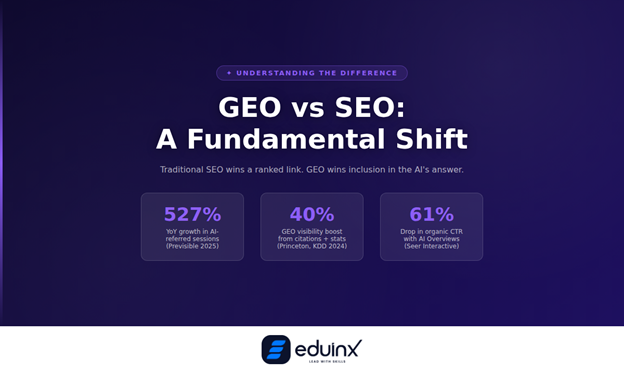
Traditional SEO and GEO share the same foundation: authoritative, well-structured content. But they optimize for fundamentally different outcomes. SEO gets you into the list. GEO gets you into the answer.
When a user searches traditionally, they see ten links and choose one. When a user queries an AI engine, they get a single synthesized response that draws from multiple sources. Your brand either makes it into that synthesis, or it doesn't appear at all.
A 2024 Princeton and Georgia Tech research paper (the foundational academic study on GEO, presented at ACM SIGKDD 2024) found that specific content optimization techniques could boost visibility in AI-generated responses by up to 40%. The top-performing methods were: adding citations to credible external sources, including expert quotes, and weaving in verifiable statistics. These three tactics alone drove the majority of the visibility gain.
Here's the other thing GEO changes: what "authority" means. In traditional SEO, authority came largely from backlinks and domain metrics. In GEO, E-E-A-T (Experience, Expertise, Authoritativeness, Trustworthiness) is evaluated differently. AI systems assess trust not just through on-page signals like author bios, but through off-site validation: which credible publications cite your content, what the broader web says about your brand, and whether your claims are traceable to real sources.
🎯 Pro Tip: Check Your AI Visibility Before You Optimize
Before revamping your content strategy, test where you currently stand. Ask ChatGPT, Perplexity, and Google AI Overviews the top 5 questions your ideal customer might ask in your niche. Note which brands appear in responses and which don't. This gives you a real baseline: not just keyword rankings, but citation presence across AI surfaces.
The Core GEO Strategies That Drive AI Citations
1. Write for Extraction, Not Just Ranking
AI engines don't read your page the way Google's crawlers do. They extract. They're looking for a clean, quotable answer to the user's prompt, and they'll pull from whichever source packages that answer most clearly.
The practical shift: Open every major section with a direct, concise definition or statement. Answer the question in the first two sentences, then build depth below it. Research from multiple 2025 studies found that Q&A and structured heading formats perform significantly better in AI citation patterns than dense prose paragraphs.
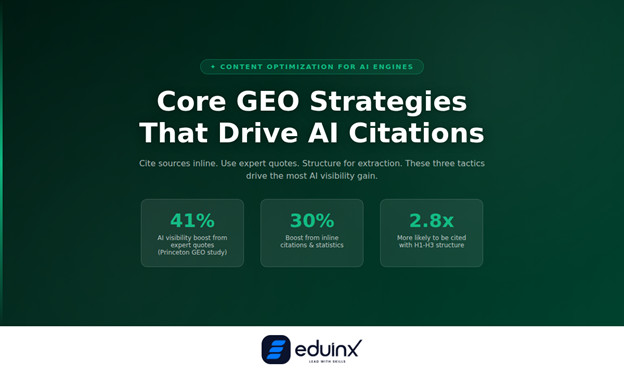
Pages with a clear H1-H2-H3 hierarchy are 2.8x more likely to be cited by AI models, according to an analysis of over 1,000 AI Overview citations. Content freshness also matters more than most SEOs expect: 79% of AI bots prioritize content published in the last two years, and 65% specifically target 2025 publications.
2. Statistics, Citations, and Expert Quotes: In Every Piece
The Princeton/Georgia Tech research was specific about which content elements drive AI visibility: inline citations to credible sources, verifiable statistics, and direct quotes from domain experts each delivered 30-41% improvements in AI response inclusion.
This isn't just academic theory. It matches what practitioners see. Content that cites McKinsey, Gartner, MIT, or similarly credible sources gives AI engines a reason to trust and relay what you've written. When an AI response synthesizes information for a user, it gravitates toward content that has already done the citation work, because that content is lower-risk to quote.
Embed your data inline. Don't list sources at the bottom of the page. Write "According to Gartner's 2025 CMO Spend Survey, 59% of CMOs report insufficient budget..." rather than footnoting it. The citation should be attached to the claim where the claim lives.
If you are learning to build AI-powered products that actually reach users, understanding how AI search models evaluate content authority is a core competency, and it's a topic covered in depth in Eduinx's guide to responsible AI governance frameworks.
🧠 Pro Tip: Use the "40-Word Answer Block" Technique
For every major H2 in your blog, write a 40-60 word summary answer directly below the heading, before the detailed explanation. This mirrors the format AI engines use when generating responses. It signals to retrieval systems exactly what your section answers, increasing extraction probability for that specific question type.
3. Semantic Structure and Entity Optimization
GEO is, at its core, about making content machine-readable in a new way. Traditional SEO taught you to optimize for keywords. GEO asks you to optimize for entities and relationships.
An entity, in this context, is a clearly defined concept: "Generative Engine Optimization," "E-E-A-T," "Retrieval-Augmented Generation," each tied to types, synonyms, and relationships. AI models build their understanding of a topic by mapping how concepts relate to each other, not just which keywords appear together.
Concretely define your primary term early and precisely. Use consistent naming throughout the piece (don't call it "GEO" in one paragraph and "generative search optimization" in the next without a clear link between them). Add schema markup where applicable. FAQ schema and HowTo schema are directly parseable by Google's AI Overview system.
HTML semantics matter too. Proper use of <article>, <section>, <header>, and ordered lists for step-based content makes your page architecture readable to AI crawlers in a single pass. This is the same principle behind API design: give the AI a predictable interface, and it will use your content reliably.
"Specifically, our top-performing methods (Cite Sources, Quotation Addition, and Statistics Addition) achieved a relative improvement of 30-40%. These methods require minimal changes but significantly improve visibility in generative engine responses, enhancing both credibility and richness of content."
— Aggarwal et al., Princeton University / Georgia Tech / Allen Institute for AI / IIT Delhi, GEO: Generative Engine Optimization (KDD 2024)
Optimizing for Google SGE (AI Overviews) Specifically
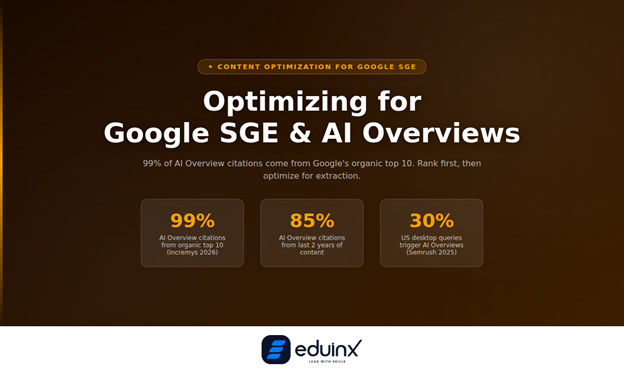
Google's AI Overviews, the search-generative experience that now appears for roughly 30% of U.S. desktop queries, has its own citation behavior worth understanding separately.
AI Overviews draw almost entirely from the organic top 10. Research tracking AI Overview citations found that 99% come from pages that already rank in Google's top results for that query. This means GEO doesn't replace SEO for Google's surface. It requires it. You have to rank first. Then, within that ranked content, the structural and citation quality of your page determines whether Google's AI includes you in the summary or just lists your link below it.
The format difference matters here. AI Overviews tend to cite specific factual claims, direct answers, and step-based explanations. Long narrative paragraphs without clear entry points are harder to extract from. Breaking your most citable content into short, headed subsections with concrete claims at the top of each section gives AI Overviews clean extraction targets.
Professionals building careers in AI-driven fields, whether in data science, product management, or ML engineering, need to understand how AI search works not just as users, but as creators of content. The skills behind AI content optimization overlap directly with the broader understanding of how large language models retrieve and weight information, which connects to what Eduinx covers in its guide on how agentic AI shifts decision-making in product tools.
🚀 Pro Tip: Refresh High-Ranking Posts Before Creating New Ones
If you have posts ranking in Google's top 10 for relevant queries, those are your highest-value GEO assets, because AI Overviews pull from that pool first. Updating those posts with 2025-2026 statistics, adding a 40-60 word answer block at the start of each major section, and embedding inline source links can meaningfully increase their AI citation rate without any new content investment.
AI Content vs. Human Content: What Actually Ranks
One question practitioners keep asking: does it matter whether content is AI-generated or human-written for GEO performance?
The short answer: AI authorship isn't a direct penalty. The actual penalties come from the signals AI authorship tends to produce: thin coverage, generic claims, no original data, no attributed quotes, and no external citations. Google's VP of Search, Liz Reid, stated in October 2025 that Google is explicitly pushing content that demonstrates expertise and a unique perspective, and actively down-ranking content that merely repeats what's already out there.
The winning approach isn't AI versus human. It's using AI tools to research, structure, and draft, then applying human expertise to add original analysis, real statistics, and genuine attribution. That combination produces content with the depth AI citation rewards and the freshness that keeps it inside the active citation window.
For professionals reskilling into AI roles, understanding the intersection of content quality, machine readability, and LLM behavior is increasingly part of the job description, whether you're in product, data science, or technical marketing. The Edge AI Trends 2026 breakdown on Eduinx is a strong companion read for understanding where AI-generated intelligence is moving at the model level.
Measuring GEO Performance
Traditional analytics tools like Google Search Console, GA4, and Ahrefs weren't built to track AI citation performance. This is the honest challenge with GEO right now: measurement barely exists in mainstream tooling.
What you can do: manually audit your brand's presence in AI responses for target queries. Query ChatGPT, Perplexity, and Google AI Overviews with your primary keywords monthly. Track whether your brand, specific statistics from your content, or your domain appears in responses. Note the sources AI engines prefer for your topic cluster. These are your citation competitors, not your traditional SERP competitors.
Conclusion
GEO isn't a replacement for SEO. It's the layer that determines whether your content actually shows up in the answers people are reading instead of the links they're skipping. The technical foundations remain the same: rank well, build authority, stay fresh. But the content layer now needs to be structured for extraction, packed with verifiable claims, and built around entities that AI models can map and trust.