Retrieval-Augmented Generation (RAG) helps large language models (LLMs) answer questions using information retrieved from external knowledge sources. But when a question requires connecting multiple pieces of information, a single retrieve-then-generate step may not be enough. ACL 2023 IRCoT study found that interleaving retrieval with reasoning steps improved retrieval performance by up to 21 percentage points and downstream question-answering performance by up to 15 points across four multi-step QA datasets.
This highlights why multi-hop reasoning in RAG is important for questions that require evidence to be retrieved, connected, and evaluated across multiple steps.
What Is Multi-Hop Reasoning in RAG?
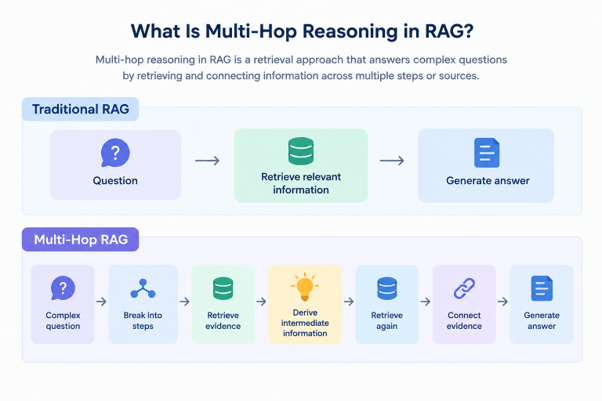
Multi-hop reasoning in RAG is a retrieval approach that answers complex questions by retrieving and connecting information across multiple steps or sources.
For example, consider the question:
"Which company acquired the startup founded by the researcher who developed a particular technology?"
The system may need to identify the researcher first, find the startup they founded, and then determine which company acquired it. No single passage may contain the complete answer.
Research on multi-step question answering supports this distinction. The ACL 2023 IRCoT study found that one-step retrieval can be insufficient for multi-step questions because the information needed for the next retrieval can depend on what was discovered previously.
Why Does Standard RAG Struggle With Complex Questions?
Standard RAG is effective when the answer exists within a small amount of relevant context. The problem becomes harder when information is distributed across several documents.
A complex question may involve:
- Multiple entities
- Several related facts
- Information spread across documents
- Ambiguous terminology
- Dependencies between sub-questions
- Evidence that must be verified before producing an answer
For example, asking “What was the product launched by Company A before its acquisition by Company B, and who developed it?” requires more than finding documents containing the words “Company A” and “Company B.”
The system needs to establish the relationships between those facts.
How Does Multi-Hop RAG Work?
A multi-hop RAG pipeline typically follows these steps:
- Analyze the Question: The system identifies the entities, relationships, and information needed to answer the question.
- Decompose the Question: A complex question is divided into smaller sub-questions.
- Main question: Which company acquired the startup founded by Researcher X?
- Sub-question 1: Who is Researcher X?
- Sub-question 2: Which startup did Researcher X found?
- Sub-question 3: Which company acquired that startup?
- Perform the First Retrieval: The retriever searches the knowledge base for evidence relevant to the first sub-question.
- Extract an Intermediate Fact: The retrieved information provides an entity or relationship that helps formulate the next query.
- Retrieve Again: The system uses the newly discovered information to perform another retrieval step.
- Connect the Evidence: Information from the different retrieval hops is combined to establish the complete evidence chain.
- Generate the Answer: The LLM produces the final response using the retrieved and connected evidence.
This approach makes retrieval dynamic rather than treating the original user question as the only search query. When retrieval requires planning, evaluation, and repeated tool calls, the workflow can move beyond a fixed retrieval chain toward Agentic RAG with tool use, where an AI system can decide what to retrieve and whether additional steps are necessary.
What Is a Retrieval Chain in RAG?
A retrieval chain in RAG is a sequence in which the result of one retrieval step helps determine what information should be retrieved next.
A simplified chain looks like this:
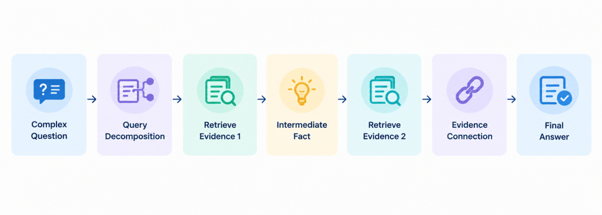
This is particularly useful for multi-step question answering, where the answer cannot be obtained from a single document or retrieval operation.
Multi-Hop RAG vs. Traditional RAG
The key difference between traditional RAG and multi-hop RAG lies in how they retrieve and connect information to answer a question. The table below highlights how their retrieval process, evidence handling, reasoning, and complexity differ.
| Feature | Traditional RAG | Multi-Hop RAG |
|---|---|---|
| Retrieval | Usually one main retrieval step | Multiple retrieval steps |
| Questions | Direct questions | Complex, interconnected questions |
| Evidence | Often from a limited context | Can span multiple sources |
| Reasoning | Limited retrieval dependency | Intermediate results guide retrieval |
| Complexity | Lower | Higher |
Multi-hop RAG is therefore not intended to replace every traditional RAG pipeline. Simple questions may not require multiple retrieval steps.
Example of Multi-Hop Reasoning in RAG
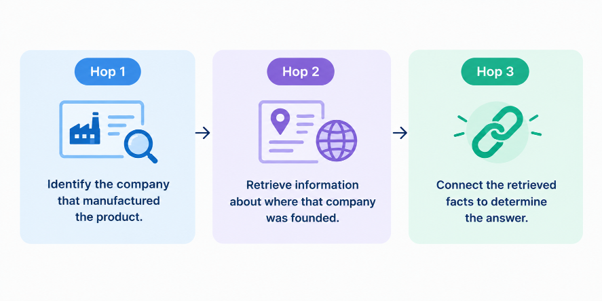
Consider the question:
"Where was a particular product manufactured if the company that manufactured it was founded in Germany?"
A multi-hop system could work as follows:
Key Techniques Used in Multi-Hop RAG
Several techniques can improve retrieval for complex questions.
- Query Decomposition: Breaks a complex question into smaller, manageable sub-questions. It is particularly useful when different parts of the answer require different sources.
- Iterative Retrieval: Retrieves information repeatedly, using intermediate results to guide subsequent searches.
- Query Rewriting: Reformulates the original question to make it more suitable for retrieval. Techniques such as Hypothetical Documents to Improve Semantic Search can create a more retrieval-friendly representation of the user's query.
- Knowledge Graphs: Represent entities as nodes and relationships as connections. GraphRAG can use these relationships to retrieve connected information and support questions involving broader themes across a document collection. Knowledge graphs can be particularly useful when questions depend on relationships between entities. In more advanced systems, these capabilities can be combined with vector search and AI agents through a hybrid RAG architecture.
- Evidence Verification: The system checks whether retrieved passages actually support the answer rather than relying solely on semantic similarity.
What Are the Challenges of Multi-Hop RAG?
Multi-hop reasoning can improve the handling of complex questions, but it also introduces additional challenges.
- Error propagation: An incorrect intermediate fact can affect every subsequent retrieval step.
- Latency: Multiple retrieval and generation operations can take longer than a single retrieval.
- Cost: Additional model calls and retrieval operations can increase computational costs.
- Conflicting evidence: Different documents may contain inconsistent information.
- Retrieval quality: Every hop needs sufficiently relevant evidence for the final answer to remain grounded.
This means adding more retrieval steps does not automatically produce better results. The retrieval chain must be evaluated for both relevance and factual support.
How Can You Improve Multi-Hop RAG Accuracy?
A strong multi-hop RAG pipeline should also be evaluated at each stage. Metrics such as RAGAS and context recall metrics can help teams assess whether the retrieved context actually supports the answer.
A practical multi-hop RAG pipeline should:
- Decompose complex questions carefully.
- Use high-quality and up-to-date knowledge sources.
- Track evidence across every retrieval hop.
- Rerank retrieved passages when necessary.
- Verify intermediate facts before continuing.
- Set a limit on retrieval iterations.
- Evaluate retrieval and final-answer accuracy separately.
For production systems, simple questions can continue using standard RAG, while complex questions can be routed to more advanced retrieval chains.
When Should You Use Multi-Hop RAG?
Multi-hop RAG is useful when answering questions that require multiple connected facts, such as:
- Research and literature analysis
- Enterprise knowledge search
- Legal document analysis
- Financial research
- Competitive intelligence
- Scientific question answering
- Complex customer-support investigations
For straightforward questions where the answer exists in one relevant passage, a traditional RAG pipeline may be sufficient.
Conclusion
Multi-hop reasoning in RAG extends retrieval-augmented generation beyond the basic retrieve-then-generate model. By decomposing complex questions, retrieving information iteratively, and connecting evidence across multiple steps, retrieval chains can support more demanding question-answering tasks.
The key is not to make every RAG system more complex. Instead, organizations can begin with standard RAG and introduce query decomposition, iterative retrieval, knowledge graphs, or other advanced techniques when evaluation shows that simple retrieval is insufficient.
Understanding multi-hop retrieval is one part of building reliable RAG applications. For readers who want to develop broader practical skills across LLMs, retrieval-augmented generation, and real-world AI applications, explore Applied Generative AI and RAG systems.
Frequently Asked Questions (FAQs)
What is multi-hop reasoning in RAG?
Multi-hop reasoning in RAG is a method of answering complex questions through multiple retrieval and reasoning steps. Information discovered during one step can guide the next retrieval until enough evidence is collected to generate the final answer.
What is multi-hop RAG?
Multi-hop RAG is a Retrieval-Augmented Generation architecture designed for questions requiring information from multiple passages, documents, or reasoning steps rather than a single retrieval operation.
How does multi-hop RAG work?
It analyzes a complex question, decomposes it into smaller tasks, retrieves relevant evidence, uses intermediate findings to guide additional retrieval, connects the evidence, and generates a grounded answer.
What is a retrieval chain in RAG?
A retrieval chain is a sequence of retrieval operations where information obtained in one step helps determine what information should be retrieved in the next step.
How is multi-hop RAG different from traditional RAG?
Traditional RAG generally performs retrieval before generation. Multi-hop RAG performs multiple connected retrieval steps, allowing intermediate findings to influence subsequent searches.
Why does RAG need multi-hop reasoning?
Some questions contain multiple dependent facts that cannot be answered from one passage. Multi-hop reasoning allows the system to retrieve and connect those facts before generating an answer.
What is query decomposition in RAG?
Query decomposition breaks a complex user question into smaller sub-questions. Each sub-question can then be retrieved separately before the system combines the resulting evidence.
What is iterative retrieval in RAG?
Iterative retrieval means performing retrieval more than once. Each retrieval step can use information discovered during earlier steps to improve the relevance of the next search.
What are the challenges of multi-hop RAG?
Common challenges include error propagation, increased latency, higher computational costs, conflicting evidence, and irrelevant retrievals. Strong evaluation and evidence tracking are important for reliable results.
What are the applications of multi-hop RAG?
Multi-hop RAG can support research assistants, enterprise search, scientific literature analysis, legal research, financial analysis, competitive intelligence, and other applications involving complex multi-step questions.