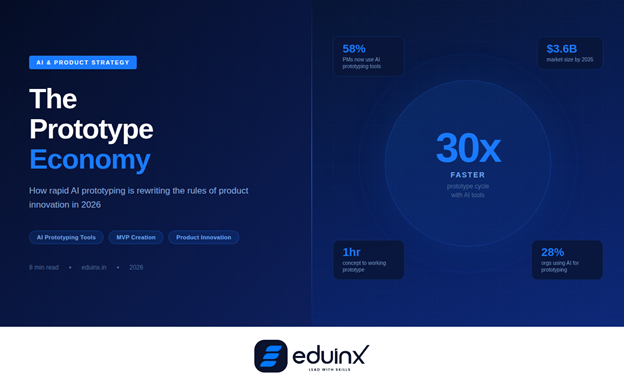
If you work in product, design, or tech, you have probably noticed that the rules changed somewhere in the last 12 months. The MVP cycle that once took 6 to 8 weeks has been squeezed into a few days. Entire product directions are being validated, killed, or pivoted before a single developer writes a line of production code. Welcome to the prototype economy - a fundamental shift in how companies build, test, and ship products. AI prototyping tools 2026 is not just a search trend; it is the operational reality that product teams, founders, and early-career professionals now have to navigate.
This blog breaks down what the prototype economy actually means, which tools are driving it, where the real career opportunities sit, and what you need to watch out for when speed becomes the default.
From Weeks to Hours: How AI Collapses the Prototyping Timeline
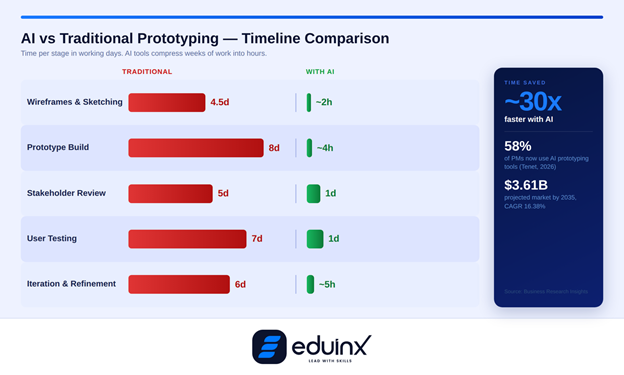
Traditional prototyping had a brutal setup cost. A designer would spend three to five days on wireframes. A developer would spend another week converting designs into something clickable. By the time stakeholders saw a working screen, the market might have moved.
AI for rapid product design has changed that calculus at every step. Tools like v0 by Vercel, Lovable, Framer AI, and Banani can generate high-fidelity, interactive UI prototypes from a plain-language prompt in minutes. What this means in practice: a product team can go from a one-paragraph product idea to a working browser-based prototype in under an hour.
The numbers back this shift. According to a 2026 Tenet report, over 58% of product managers now use no-code or AI prototyping generators in their workflow. That is not a niche practice anymore - it is mainstream. The global prototyping software market reflects this: valued at approximately $0.92 billion in 2026 and projected to reach $3.61 billion by 2035 at a compound annual growth rate of 16.38%.
🧠 Pro Tip: Stop thinking of AI prototyping as a design shortcut. Think of it as a validation engine. The point is not to produce a prettier mockup faster - it is to answer the question "does this idea actually work for users?" as early as possible, before any real engineering investment begins. Build two or three variants of the same product idea and test them in parallel.
The AI Prototyping Stack in 2026: What Tools Are Product Teams Actually Using?
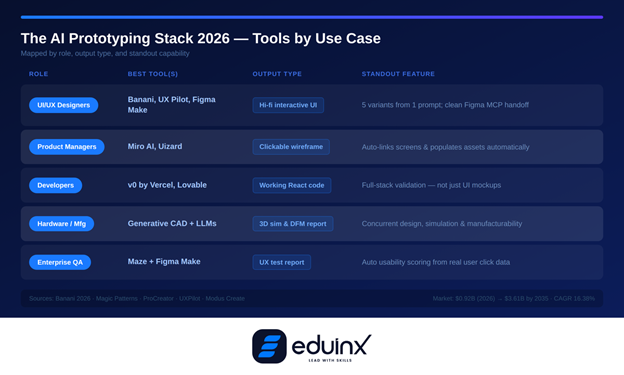
The prototyping landscape is more segmented than most people realize. Different tools serve very different purposes, and picking the wrong one for your context will slow you down. Here is a practical breakdown of how the AI prototyping tools 2026 stack actually maps to use cases.
For UI/UX designers: Banani stands out for generating multiple high-fidelity UI variants from a single prompt, with clean developer handoff via Figma export and MCP integration. UX Pilot goes further by letting you import your existing design system, which matters when brand consistency is non-negotiable. Figma Make, now part of Figma's core offering, handles natural-language interactions and state generation natively inside the tool most design teams already use.
For product managers and founders: Miro AI is the pick for rapid ideation and collaborative prototyping. Uizard's Autodesigner engine is particularly good for populating assets and linking screens automatically, making it useful for PMs who do not come from a design background.
For developers building full-stack validation: Lovable and v0 by Vercel produce actual working code, not just visual mockups. This distinction matters when you need to validate not just the UI but the end-to-end user flow, including backend interactions.
For hardware and physical products: The AI prototyping in product development story extends beyond software. Generative AI is now embedded in CAD workflows, enabling simultaneous design, simulation, and manufacturability assessment. According to Protolabs' 2026 Manufacturing Innovation report, digital twins now extend into multi-physics simulation, letting teams test thousands of operating conditions virtually before a single physical part is produced.
One thing worth noting from the research: there is a major gap between adoption self-reporting and actual usage. A 2026 product development study found that while 84% of product leaders claim AI is integrated across the product lifecycle, only 28% actually use AI for prototyping. The tools exist. The gap is in organizational workflow integration, not tool capability. The teams closing that gap fastest are the ones pairing rapid prototyping with agentic AI in product management, where autonomous agents can trigger, evaluate, and iterate on prototypes without waiting for a human-driven sprint cycle to complete.
🚀 Pro Tip: If you are a data science or ML professional looking to build your first product-facing project, start with v0 or Lovable. You can describe your model's inputs and outputs in plain English, generate a front-end interface around it, and have something you can demo to stakeholders in an afternoon. This closes the gap between a notebook-based model and a product that people can actually interact with.
The Business Models Emerging from the Prototype Economy
The prototype economy is not just changing how products are built - it is changing the commercial logic around product development itself.
The most significant business model shift is the collapse of investment bias. Traditional product development involved weeks or months of work before validation, which naturally created pressure to stick with whatever was built. AI prototyping for MVP creation reduces the cost of starting over to nearly zero. Teams can throw away a direction and start fresh without the sunk-cost pressure that plagued traditional development cycles.
According to CapTech's 2026 Tech Trends analysis, this is creating a class of "hyper-sprint" teams - small, high-velocity groups that can produce and test a working prototype within half a day. Product development that once required multi-week engineering cycles is now achievable before a Friday standup. The business model implication: organizations that have historically used long development timelines as a competitive moat are losing that advantage.
The AI innovation management tools 2026 category is responding to this. Platforms now combine prototype generation with integrated user testing, analytics, and iteration loops in a single workflow. Maze, for example, connects directly to Figma or InVision and runs automated UX testing against prototypes, collecting click data and user paths to generate actionable usability reports - without requiring a research team or a testing budget.
"The prototype economy frees organizations from investment bias as the effort to create something new is dramatically reduced. Teams can more easily throw away what's not working and start fresh." - CapTech 2026 Tech Trends Report
For professionals transitioning from data science into product roles, this shift is significant. AI and ML models no longer need to wait months for a product team to build an interface around them. You can prototype the product layer yourself, validate the concept with real users, and present a working demo - all before writing a single line of production ML infrastructure. The products that come out of this cycle are increasingly built around AI-driven hyper-personalization, where real-time user data shapes what the product shows each individual - and knowing how that layer works makes you a sharper prototyper, not just a faster one.
🎯 Pro Tip: For career-focused readers - the emerging role of "AI product prototyper" is a legitimate specialization. Teams increasingly need people who can move fluidly between prompt engineering, product thinking, and rapid build-and-test cycles. If you can prototype a product using AI tools and run basic usability validation in the same week, that is a skill set that crosses the PM-developer-designer boundary in a way most hiring managers have not seen before.
The Velocity Trap: When Speed Becomes a Liability
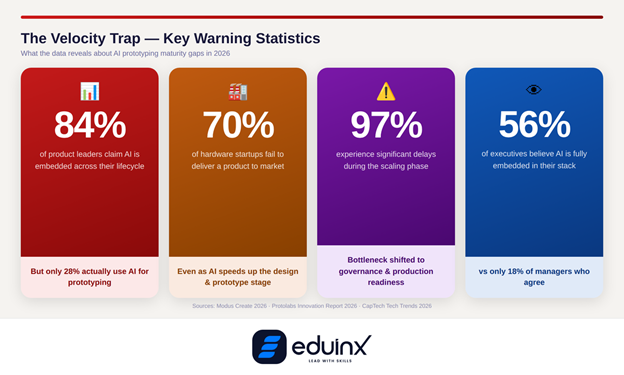
Here is the part that most enthusiasm around AI prototyping skips over: rapid AI prototyping trends also carry a well-documented failure mode.
Research from Modus Create's 2026 product development study puts it directly: only 28% of teams actually use AI for prototyping, and the organizations overstating their AI maturity are making specific, predictable mistakes. They scale too early. They underinvest in governance. And they expect ROI before the organizational foundations can support it.
The prototype economy rewards experimentation. But when teams prioritize development speed above everything else, they tend to sacrifice three things: thoughtful design, thorough testing, and strategic alignment with actual business needs. Modus Create calls this the "velocity trap" - producing prototypes faster than they can be meaningfully evaluated or integrated into a coherent product strategy.
The 3D printing AI integration story is a concrete example of where this shows up in physical products. Protolabs' 2026 Innovation report notes that approximately 70% of hardware startups still fail to deliver a product to market, and 97% experience significant delays during the scaling phase - even as AI makes the design and prototype stage dramatically faster. The bottleneck is not prototyping anymore. It is scaling, governance, and production readiness.
For software products, the equivalent risk is building fast and validating poorly. AI prototyping tools make it easy to generate interfaces that look usable without being tested against real users. Farsight, developed at Georgia Tech, offers a counterweight: it alerts prototypers when prompts could lead to harmful or poorly considered outcomes, and a user study of 42 prototypers found that Farsight users were meaningfully better at identifying potential product harms early.
The lesson: Treat the prototype economy as a tool for better decisions, not faster shipping. The goal is to validate more rigorously and earlier - not to compress the path from idea to launch while skipping the discipline that makes launches succeed. The AI models sitting underneath these tools are also evolving - moving from static generation toward agentic RAG frameworks that can retrieve live data and reason across multiple steps, which will soon make prototypes feel a lot closer to actual products.
What the Prototype Economy Means for Your Career
The clearest career signal from all of this: the separation between "technical" and "product" is narrowing fast. Andrew Ng has predicted a shift from roughly one PM per four engineers to two PMs per one engineer. Whether or not that exact ratio plays out, the direction is clear - product thinking is becoming as important as engineering execution, and anyone who can do both is increasingly valuable.
For data science professionals, the prototype economy opens a specific door. You already understand model behavior, data pipelines, and what AI systems can and cannot do. If you add the ability to rapidly prototype the product interface around those systems - and test it with real users - you become someone who can own an AI feature from concept to validated demo. That is a profile most companies are actively trying to hire.
For those earlier in their careers, the tools have never been more accessible. The prototyping software market growing at a 16.38% CAGR means the category is expanding and hiring. AI innovation management tools, UX validation platforms, and AI-native design tools all need people who understand both the technology and the product context.
The skills that matter here: prompt engineering for product tools, basic UX principles, ability to run lightweight user tests, and a clear understanding of what you are validating and why. None of these require a design degree. They require curiosity, iteration discipline, and a willingness to build things and throw them away quickly.
Conclusion
The prototype economy is not a phase - it is a structural shift in how products are built and validated. AI prototyping tools in 2026 have collapsed timelines that used to take weeks into a matter of hours. The market is growing rapidly, the tools are more capable than they have ever been, and the organizations that integrate this capability strategically will outpace those still treating AI as a peripheral experiment.
But speed is only valuable if the decisions made at speed are good ones. The teams winning in the prototype economy are not the fastest builders - they are the most disciplined validators. They use AI to test more ideas, not to skip the testing.
If you are building a career in AI, data science, or tech product development, the prototype economy is your competitive edge. Learn the tools. Build something. Break it. Start over. That cycle, compressed to hours instead of months, is the new competitive advantage.