Introduction
Most RAG systems have a quiet but serious problem. They retrieve documents, pass them to the LLM, and trust the output. When retrieval goes wrong, the model confidently generates wrong answers anyway.
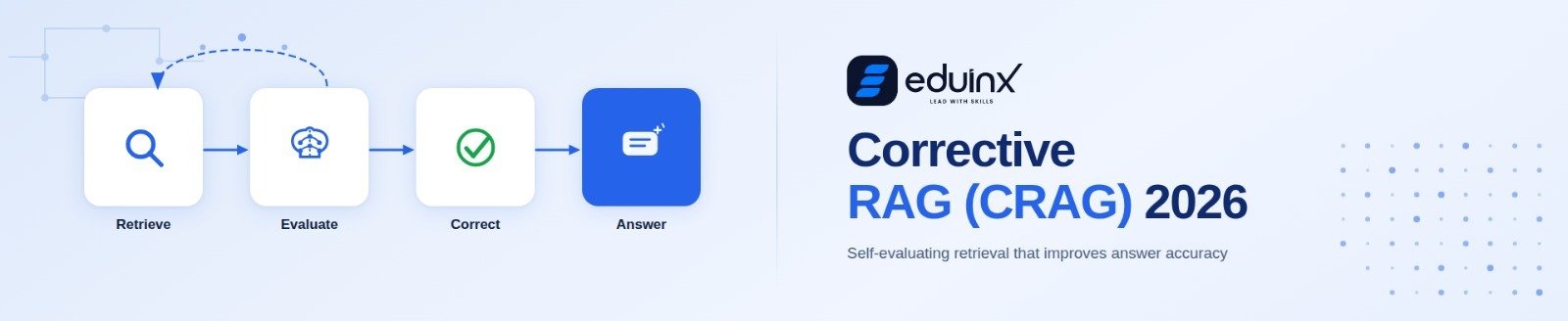
Corrective RAG changes that. CRAG adds an evaluator that scores what was retrieved, catches bad context before it reaches the generator, and triggers corrections automatically. It is one of the highest-leverage upgrades you can make to a production RAG pipeline right now.
This post breaks down how corrective RAG works, how CRAG implementation looks in LangChain, and how it compares to Self-RAG so you know which architecture fits your use case.
Why Standard RAG Fails Under Pressure

Standard RAG pipelines follow a simple sequence: receive a query, retrieve top-k documents, concatenate them, and prompt the LLM to respond. Clean and fast when retrieval works well.
The problem is that retrieval does not always work well. A 2024 RAG benchmark found that even state-of-the-art RAG systems answer only 63% of factual questions correctly, while basic RAG without advanced techniques scores just 44%. Vector similarity is a proxy for relevance, not a guarantee. A document can be semantically close to a query yet missing the exact fact the user needs.
When that happens, the LLM still receives context. Just the wrong context. Because LLMs are designed to synthesize and respond, they generate an answer from whatever you give them. The result looks authoritative. It is not.
That is the failure mode Corrective Retrieval-Augmented Generation is designed to eliminate.
How Corrective RAG Works: The Three-Path Architecture

CRAG was introduced by Yan et al. in 2024 and accepted at ICLR 2025. The core idea is simple: evaluate the quality of retrieved documents before they reach the generator, and take different actions depending on what you find.
The framework uses a lightweight retrieval evaluator, originally fine-tuned on a T5-large model, that scores each set of retrieved documents for a given query. Based on that score, the system routes to one of three paths.
Path 1: Correct. When retrieved documents are highly relevant, CRAG keeps them but refines them further. It applies a decompose-then-recompose technique: the documents are broken into fine-grained knowledge strips, irrelevant strips are filtered out, and the remaining information is recomposed into a clean context. The LLM gets a tighter, more focused input.
Path 2: Incorrect. When the evaluator judges that retrieval has completely failed, the system discards the vector store results entirely. It reformulates the query and issues a web search to pull fresh, relevant documents. This fallback mechanism is what makes CRAG genuinely robust. Your knowledge base is static. CRAG knows when to go beyond it.
Path 3: Ambiguous. When confidence is somewhere in between, CRAG uses both. It combines the partially useful vector store results with additional web search results, then filters and merges them before passing to the generator.
The plug-and-play design is a significant advantage. You do not need to retrain your LLM. CRAG slots into an existing RAG pipeline as middleware. It evaluates what comes out of your retriever and routes it accordingly.
To understand how this connects to broader retrieval-augmented architectures, read our overview of RAG Evolution: From Basic to Agentic AI Frameworks, which covers how retrieval systems have progressed from naive search to today's self-correcting pipelines.
Corrective RAG LangChain: Building CRAG with LangGraph
LangGraph, built by the LangChain team, is the standard way to implement CRAG in Python. It models the pipeline as a state machine where nodes are processing steps and edges are routing conditions, which maps cleanly to CRAG's three-path logic.
Here is the core structure of a corrective RAG LangChain setup:
from langgraph.graph import StateGraph, END
from typing import TypedDict, List

class GraphState(TypedDict):
    question: str
    documents: List[str]
    generation: str
    web_search_needed: str

# Node: Retrieve from vector store
def retrieve(state):
    question = state["question"]
    documents = retriever.invoke(question)
    return {"documents": documents, "question": question}

# Node: Grade documents for relevance
def grade_documents(state):
    question = state["question"]
    documents = state["documents"]
    filtered_docs = []
    web_search_needed = "No"
    for doc in documents:
        score = retrieval_grader.invoke(
            {"question": question, "document": doc.page_content}
        )
        if score.binary_score == "yes":
            filtered_docs.append(doc)
        else:
            web_search_needed = "Yes"
    return {
        "documents": filtered_docs,
        "question": question,
        "web_search_needed": web_search_needed
    }

# Node: Web search fallback
def web_search(state):
    question = state["question"]
    docs = web_search_tool.invoke({"query": question})
    web_results = "\n".join([d["content"] for d in docs])
    return {"documents": [web_results], "question": question}

# Conditional routing
def decide_to_generate(state):
    if state["web_search_needed"] == "Yes":
        return "transform_query"
    return "generate"
If the grader marks documents as irrelevant, the graph routes to a query transformation node, rewrites the question, and triggers a web search. If documents pass, it goes straight to generation. The retrieval grader is typically a small LLM call that returns "yes" or "no" per document. Tavily is the most common fallback search tool.
The pipeline self-audits every retrieval step without looping unnecessarily. Correction only fires when needed.
The original CRAG paper uses a fine-tuned T5-large as the retrieval evaluator. In practice, using a small LLM like GPT-4o-mini or Claude Haiku as your grader is faster to set up and surprisingly effective. Only move to a fine-tuned classifier if you have domain-specific data and need sub-100ms latency.
CRAG vs Self-RAG: Same Problem, Different Layers

A common question when implementing self-healing RAG architectures is whether to use CRAG or Self-RAG. They address the same core problem, but operate at different points in the pipeline.
CRAG is pre-generation middleware. It evaluates retrieved documents before the LLM ever sees them. If retrieval is bad, CRAG fixes it upstream. The model receives clean context or a web-searched replacement, untouched.
Self-RAG works during generation. It fine-tunes the LLM to emit special reflection tokens that ask: do I need to retrieve right now? Is this passage relevant? Is my output supported? The model reasons about evidence as it writes.
The key distinction: CRAG improves the quality of the evidence going in. Self-RAG improves how the model reasons over whatever evidence it receives.
They are complementary. The CRAG paper tested Self-CRAG, which combines both approaches, and it outperformed standard Self-RAG by 20% accuracy on PopQA and 36.9% on biography tasks. For most production teams, the practical starting point is CRAG: no model fine-tuning, no retraining budget. Add Self-RAG only when you need the model to decide dynamically when retrieval is necessary mid-generation.
For teams building more sophisticated pipelines that combine CRAG logic with agent decision-making, our post on AI Agents with RAG: Building Self-Learning Enterprise Workflows in 2026 covers how these components fit into production agentic systems.
Rather than routing on a hard yes/no from your grader, score each document from 0 to 1 and set threshold bands. Documents above 0.7 pass. Documents between 0.3 and 0.7 trigger a hybrid approach combining them with a web search. Documents below 0.3 are discarded entirely. This produces smoother pipeline behavior and avoids throwing away partially useful context.
CRAG Implementation: What the Benchmarks Actually Say
The original CRAG paper tested across four datasets covering different generation types: PopQA for short-form entity questions, Biography for long-form generation, PubHealth for fact verification, and Arc-Challenge for closed-set reasoning.
CRAG outperformed standard RAG by 7% on PopQA, 14.9% on Biography FactScore, 36.6% on PubHealth, and 15.4% on Arc-Challenge when tested on the same SelfRAG-LLaMA2-7b backbone.
The PubHealth number stands out: a 36.6 percentage point gain on fact verification. When retrieval pulls in tangentially related documents, standard RAG generates plausible-sounding but factually wrong answers. CRAG's filtering step eliminates exactly that failure mode.
In practice, gains are largest when your knowledge base has coverage gaps. CRAG also improves context precision, the ratio of relevant content in the window versus total content. One developer test found a baseline context precision of 0.444, meaning roughly half of what the LLM received was noise. CRAG's scoring and filtering reduced that substantially.
For a deeper look at how CRAG connects with other retrieval patterns including knowledge graph approaches, see our guide on Hybrid RAG Architecture: Vector Search, Knowledge Graphs and AI Agents.
Instrument every grader decision in production. Track which queries trigger the web search fallback, which documents get filtered, and what the relevance score distribution looks like. These logs reveal systematic gaps in your knowledge base, which is far more actionable than seeing hallucinations in final outputs and trying to trace them back.
When to Use Corrective RAG in Production
CRAG is not the right fit for every deployment. It adds latency and cost because every retrieval step now involves an evaluation step. For high-throughput, low-stakes applications where speed matters most, standard RAG with strong chunking may be sufficient.
Where CRAG earns its place is in high-stakes, user-facing tools where a wrong answer has real consequences: legal assistants, clinical decision support, financial research tools, enterprise knowledge bases. If users regularly ask questions at the edge of what your corpus covers, you want a controlled fallback to web search rather than confident hallucinations.
A corrective RAG LangChain setup using LangGraph takes a few hundred lines of Python and a Tavily API key. The architectural concept is straightforward, and the operational benefit in production environments with inconsistent retrieval quality can be substantial.
Conclusion
The single biggest reliability gap in most RAG systems today is that retrieval is treated as infallible. Corrective RAG fixes that by adding a self-evaluation loop that catches bad context before it ever reaches the generator.
CRAG's three-path routing: refine good context, fall back to web search for bad context, and combine both for ambiguous context, maps cleanly onto real-world retrieval failure modes. The LangChain and LangGraph ecosystem makes CRAG implementation accessible without a research team or fine-tuning budget.
If you are building or maintaining a RAG pipeline that users rely on for accurate answers, corrective RAG is one of the highest-leverage upgrades available in 2026. The benchmarks support it. The tooling is mature. The implementation path is clear.
Start with a grader, add the routing logic, and watch your context precision improve.
Frequently Asked Questions (FAQs)
1. What is Corrective RAG (CRAG)?
Retrieval Augmented Generation (RAG) is a framework that assesses retrieved documents prior to presenting them to the LLM, known as Corrective RAG (CRAG). It measures the relevance and routes to correction, refinement, or to the web search fallback. This self-evaluation loop corrects incorrect answers before they are used by users.
2. How does Corrective RAG work?
Corrective RAG works by adding a retrieval evaluation layer between the retriever and the LLM. After documents are retrieved from a vector database or knowledge base, a retrieval grader scores their relevance to the user’s query.
Based on the score, CRAG follows one of three paths:
A. Correct — relevant documents are refined and used for generation.
B. Incorrect — irrelevant documents are discarded and replaced with web search results.
C. Ambiguous — both retrieved documents and external search results are combined.
3. What problem does CRAG solve in RAG pipelines?
CRAG solves one of the biggest problems in traditional RAG pipelines: poor retrieval quality. In standard RAG, the LLM often generates answers using whatever documents are retrieved, even if those documents are irrelevant, outdated, or incomplete.
Corrective RAG prevents this by checking the quality of retrieved context before generation. If the context is weak, CRAG corrects the retrieval flow instead of allowing the model to produce a confident but inaccurate answer.
4. What are the three paths of CRAG?
There are three paths: Correct (refine relevant documents), Incorrect (discard and initiate web search), and Ambiguous (combine vector store and web results). This routing logic easily aligns with the modes of failure of retrievals in real-world production RAG applications.
5. How does CRAG and Self-RAG differ from each other?
The CRAG is pre-generation middleware that filters out evidence prior to the LLM seeing it. Self-RAG adds relevance as a memory to the model's generation process by introducing special tokens. Quality of input is enhanced by CRAG, quality of reasoning on an input is enhanced by Self-RAG. In simple terms, CRAG improves the quality of input context, while Self-RAG improves the model’s reasoning during answer generation.
6. What is the fallback method in CRAG to use the web search?
Tavily stems out as the most widely used web search tool in corrective RAG LangChain deployments. It is called when the retrieval grader determines that the documents in the vector store are not relevant, in order to fetch fresh documents for the corrected pipeline.
7. At what stage of production should you be using Corrective RAG?
When the stakes are high and the application is consumer-facing, such as legal assistants, clinical decision support, financial research tools, etc., and wrong answers have real consequences, CRAG fits the bill. It is not as well suited for a high throughput, non-critical app where latency becomes more significant.
8. In CRAG, what are confidence bands?
Confidence bands grade documents from 0 to 1: Anything above 0.7 passes, anything between 0.3 and 0.7 is a hybrid combination of web search, and anything below 0.3 is discarded. This results in smoother routing as compared to binary classification.
9. Is there a GitHub implementation for Corrective RAG?
Yes, the LangChain's LangGraph library is commonly used to implement corrective RAGs; the reference code uses the retrieve, grade_documents, web_search, and decide_to_generate nodes. When doing the search query, "Corrective RAG GitHub", one will discover LangGraph tutorial repos, and the community implementations that use Tavily for the web search fallback and small LLMs such as GPT-4o-mini or Claude Haiku for document scoring.
10. Why is Corrective RAG important in 2026?
Corrective RAG is important in 2026 because AI applications are moving from demos to real production systems. In production, users expect accurate, explainable, and reliable answers. Basic RAG often fails when retrieval quality is poor, but CRAG adds a self-evaluation step that catches weak context before the final answer is generated.
11. What is the main benefit of Corrective RAG?
The main benefit of Corrective RAG is improved factual accuracy. By evaluating retrieved documents before generation, CRAG reduces hallucinations caused by irrelevant or incomplete context.
It also improves user trust because the AI system does not simply answer from poor retrieval results. Instead, it corrects the retrieval path, searches for better evidence, and generates a more grounded response.