Generative AI and modern data science increasingly depend on large datasets, but much of this information can contain personal, financial, healthcare, or proprietary data. As organizations use AI to analyze and generate information, simply collecting sensitive data into centralized systems can create significant privacy risks.
This is driving interest in Privacy-Preserving AI—a set of approaches designed to extract value from data while reducing unnecessary exposure of sensitive information. Two important technologies in this area are Federated Learning (FL) and Differential Privacy (DP). Together, they can help organizations develop privacy-conscious AI systems while maintaining useful data and model performance.
What Is Privacy-Preserving AI?
Privacy-Preserving AI refers to AI techniques that allow models to learn from, analyze, or generate information while reducing the exposure of sensitive data.
Traditional AI systems often rely on centralized data collection. While centralized architectures can simplify model development, they also create a larger concentration of sensitive information.
Privacy-Preserving AI takes a different approach. Data can remain within its original environment, privacy mechanisms can be applied to model training or outputs, and organizations can reduce the amount of information that needs to be directly shared.
This is particularly relevant to healthcare, financial services, enterprise AI, research, and other environments where data privacy and sovereignty are important.
Importantly, privacy-preserving AI does not mean that a system is automatically completely private or secure. It requires appropriate technical controls, privacy parameters, governance, and security measures.
Why Privacy Matters in Generative Data Science
Generative data science combines data analysis with AI systems that can generate insights, predictions, synthetic datasets, text, and other outputs. This creates opportunities for organizations but also increases the importance of protecting training and analytical data.
AI models can potentially reveal information about their training data. NIST has highlighted that trained models can leak information about training datasets, including sensitive text and images, and that privacy attacks can occur even in Federated Learning environments.
The challenge is therefore no longer simply collecting more data. Organizations need to determine:
"How can we use valuable data while minimizing unnecessary exposure?"
Privacy-enhancing technologies (PETs), including Federated Learning and Differential Privacy, are designed to help address this challenge.
What Is Federated Learning?
Federated Learning is a machine learning approach in which models are trained across decentralized datasets without requiring the raw training data to be transferred to a central location.
Instead of moving all the data to the model, Federated Learning moves the model to the data.
A simplified workflow is:
- Local Data → Local Model Training → Model Updates → Aggregation → Global Model
In a Federated Learning system, a model is distributed to participating devices or organizations. Each participant trains the model using its own local dataset. Rather than sending raw records to a central server, participants send model updates that can be aggregated to improve the shared model.
What Are the Privacy Risks of Federated Learning?
Keeping raw data local does not automatically make Federated Learning completely private.
NIST's research on privacy attacks in Federated Learning notes that attackers can potentially extract information from model updates and trained models. In some cases, trained models can reveal characteristics of the data used during training.
This creates two important privacy concerns:
- Input privacy: protecting information contained in updates during training.
- Output privacy: limiting what can be learned from the resulting trained model.
As generative AI models become more capable and are trained on increasingly sensitive datasets, protecting information contained in model updates and outputs becomes more important.
This is where Differential Privacy can add another layer of protection.
What Is Differential Privacy?
Differential Privacy is a mathematical framework for quantifying and limiting privacy loss when information about individuals appears in a dataset or contributes to an analytical result.
A common implementation introduces carefully controlled statistical noise into data, model training, or outputs.
A simplified process is:
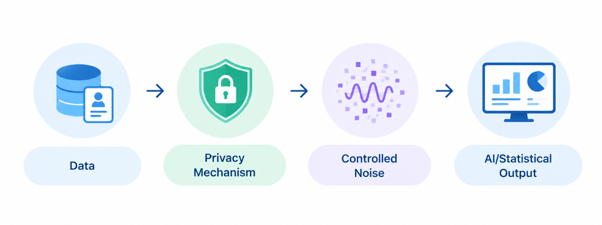
The objective is to make it difficult to determine whether a particular individual's information significantly influenced the result while preserving useful statistical or machine-learning information.
Differential Privacy is commonly described using parameters such as ε (epsilon) and δ (delta), which help quantify the privacy guarantee. NIST's SP 800-226 provides guidance for evaluating Differential Privacy claims and highlights the need to consider both mathematical guarantees and practical implementation risks.
Federated Learning vs. Differential Privacy
Federated Learning and Differential Privacy address different parts of the privacy problem.
| Feature | Federated Learning | Differential Privacy |
|---|---|---|
| Primary goal | Keep raw data decentralized | Limit information leakage |
| Main approach | Distributed model training | Mathematical privacy mechanism |
| Raw data sharing | Reduced | Depends on implementation |
| Protection focus | Data movement and training | Data inference and information leakage |
| Key challenge | Model-update attacks and coordination | Privacy-utility trade-off |
So, Federated Learning and Differential Privacy are complementary rather than competing technologies.
Federated Learning reduces the need to move raw data, while Differential Privacy can limit what can be inferred from model updates, data releases, or trained models.
How Federated Learning and Differential Privacy Work Together
Combining Federated Learning and Differential Privacy creates a layered approach to privacy-preserving machine learning.
A simplified architecture is:
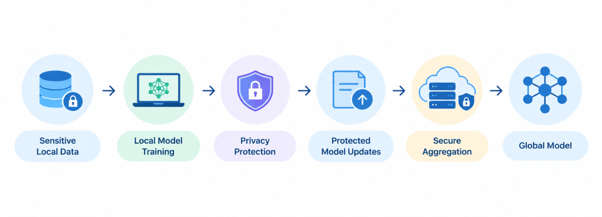
In a Federated Learning system, each participant can train locally and contribute an update. Differential Privacy can introduce controlled noise into appropriate stages of training or model updates to limit the information that can be inferred about individual data records.
NIST describes Differential Privacy as an important form of output privacy for Federated Learning and has documented approaches in which noise is added to model updates before aggregation.
This layered approach is particularly useful when organizations need to collaborate on AI while maintaining stronger privacy protections and data sovereignty.
Privacy-Preserving Generative AI and Data Science
The combination of Federated Learning and Differential Privacy has growing relevance to privacy-preserving generative AI.
Potential applications include:
- Healthcare AI and medical research
- Financial risk and fraud analysis
- Enterprise AI systems
- Personalized AI applications
- Privacy-aware customer analytics
- Synthetic data generation
Synthetic Data and Privacy
Synthetic data can provide another way to support privacy-conscious AI development. Instead of using real individual records directly for every stage of model development, organizations can generate artificial datasets that reproduce useful patterns from the original data.
Federated approaches can potentially allow multiple institutions to contribute to synthetic data generation while keeping their original datasets local.
However, synthetic data should not automatically be treated as private. A poorly designed generator may reproduce information from its training data. Additional privacy mechanisms may therefore be necessary depending on the use case and threat model.
The Privacy-Utility Trade-Off
One of the biggest challenges in Differential Privacy in AI is balancing privacy with usefulness.
Adding more noise can provide stronger privacy protection, but it can also reduce model accuracy or make statistical results less precise.
NIST's guidelines on evaluating Differential Privacy guarantees highlight the privacy-utility trade-off in Differential Privacy, noting that adding more noise can strengthen privacy but reduce the utility or accuracy of the resulting data or model.
For organizations implementing privacy-preserving AI, important questions include:
- What data needs protection?
- Where should privacy mechanisms be applied?
- How much noise is appropriate?
- What level of accuracy is acceptable?
- What privacy guarantee is required?
The objective is not simply maximum privacy. It is an appropriate balance between privacy, utility, accuracy, and risk.
Benefits and Challenges of Privacy-Preserving AI
Privacy-Preserving AI can provide several advantages:
- Reduces unnecessary exposure of sensitive information
- Enables collaboration across organizations
- Reduces reliance on centralized datasets
- Supports privacy-conscious generative AI
- Can help address data sovereignty requirements
- Encourages privacy-by-design AI development
Generative AI is also expanding into specialized data-driven domains such as mapping, retail, logistics, and disaster analytics, as explored in generative AI applications across GeoAI.
However, there are also challenges. Federated systems can create communication and coordination overhead, while differences between local datasets can affect model performance. Differential Privacy can reduce accuracy when stronger privacy protection requires more noise.
NIST also emphasizes that evaluating Differential Privacy requires looking beyond a single privacy parameter and considering practical implementation risks.
Privacy-preserving AI should therefore work alongside encryption, access controls, secure aggregation, monitoring, and broader AI governance.
These considerations are especially important when organizations deploy secure enterprise generative AI systems that use proprietary data for real-time decision-making.
The Future of Privacy-Preserving AI in 2026 and Beyond
As generative AI becomes more deeply integrated into data-intensive applications, privacy is increasingly becoming an engineering and architecture consideration, not simply a legal or policy requirement.
This shift is also changing how organizations structure teams and workflows, with AI-native product teams increasingly incorporating intelligence into product strategy and decision-making.
Federated Learning, Differential Privacy, synthetic data, secure aggregation, and other Privacy-Enhancing Technologies can help organizations use sensitive data while reducing unnecessary exposure.
The future of Generative Data Science will therefore depend not only on larger datasets and more capable models, but also on how responsibly those datasets can be used. Professionals looking to build these skills can explore a Postgraduate Program in Data Science with Generative AI to develop practical knowledge across data science, AI, and generative AI.
Conclusion
Privacy-Preserving AI is becoming an important foundation for responsible generative data science in 2026. Federated Learning reduces the need to centralize raw data, while Differential Privacy provides formal mechanisms for limiting privacy loss. When combined with techniques such as secure aggregation and synthetic data, these approaches can help organizations balance data utility with privacy.
For organizations building generative AI systems with sensitive data, privacy should increasingly be considered part of the technical architecture from the beginning, alongside security, transparency, copyright, and responsible AI governance.
Frequently Asked Questions (FAQs)
What is Privacy-Preserving AI?
Privacy-Preserving AI uses technical methods to allow AI systems to learn from or analyze data while reducing the exposure of sensitive or personally identifiable information.
What is Federated Learning?
Federated Learning trains AI models across decentralized datasets while sharing model updates rather than directly transferring the underlying raw data.
What is Differential Privacy?
Differential Privacy is a mathematical framework that limits the amount of information that can be inferred about individuals from datasets, analyses, or AI outputs.
What is the difference between Federated Learning and Differential Privacy?
Federated Learning focuses on keeping training data decentralized, while Differential Privacy focuses on limiting information leakage. They can be used together.
Can Federated Learning and Differential Privacy work together?
Yes. Federated Learning can reduce raw data movement, while Differential Privacy can add protection against information leakage from model updates or outputs.
How does Privacy-Preserving AI benefit generative data science?
It can help organizations develop AI models, analyze distributed datasets, and create synthetic data while reducing unnecessary exposure of sensitive information.
What are the benefits of Privacy-Preserving AI?
Privacy-Preserving AI can reduce unnecessary exposure of sensitive data, support collaboration across organizations, enable privacy-conscious AI development, and help organizations meet data governance and sovereignty requirements.
What are the challenges of Privacy-Preserving AI?
Key challenges include reduced model accuracy from Differential Privacy, communication and coordination costs in Federated Learning, differences between local datasets, and the need for strong security and governance controls.
Does Federated Learning guarantee data privacy?
No. Federated Learning reduces the need to transfer raw data, but model updates and trained models can still potentially reveal information. Additional techniques such as Differential Privacy and secure aggregation may be needed.
What is the privacy-utility trade-off in AI?
The privacy-utility trade-off refers to balancing privacy protection with model accuracy and data usefulness. Stronger privacy mechanisms, such as adding more noise through Differential Privacy, can sometimes reduce the accuracy or utility of AI outputs.